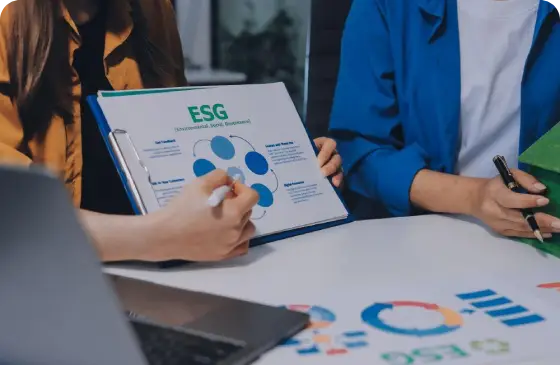
Sustainability and Climate Change Advisory
Aranca helps organizations accelerate their sustainability journey with data-driven intelligence, carbon-impact assessments, and tailored ESG strategies. We enable businesses to meet evolving regulations, reduce risks, and build long-term climate resilience.
Spotlight
How Aranca Delivers Evidence-Based Sustainability Advisory
We are a specialist sustainability and climate advisory practice working with corporations, financial institutions, public sector bodies and governments. We translate sustainability ambition into commercial strategy, operational execution and disclosure that meets the highest standards of analytical rigour.
Our work spans the full agenda: net zero roadmaps, climate technology investment, ESG due diligence, green finance structuring and mandatory reporting under CSRD, IFRS S1 and S2, TCFD and GRI. Every engagement is grounded in primary research, sector-specific intelligence and the commercial depth to make recommendations that hold up under the scrutiny of investors, regulators and boards.
The organizations we work with share one thing in common: they treat sustainability as a strategy question before it becomes a compliance question. We give them the evidence, the analytical foundation and the end-to-end capability to act with confidence rather than react under pressure.
- Assessing commercial viability and investment opportunity across new energy technologies such as green hydrogen, CCUS, renewables and energy storage
- Structuring green and transition finance instruments and conducting ESG due diligence across the transaction lifecycle
- Building science-based net zero roadmaps that satisfy investors, regulators and other stakeholders
- Producing audit-ready ESG disclosures aligned with mandatory and voluntary frameworks like CSRD, IFRS S1 and S2, TCFD, GRI, SFDR, etc
0+
Market Covered
0+
Project Executed
0+
Client Served
0+
Product and Services Covered
Sustainability and Climate Solutions for Business Transformation
The sustainability challenge facing organizations today does not fit into a single workstream. A corporation navigating CSRD disclosure is also managing Scope 3 pressure from its supply chain and green market opportunity in its product pipeline. Our six practice areas reflect that complexity - each a dedicated capability, all connected by a commitment to evidence-based advisory.
Sustainable Growth Advisory
The green economy is not a future scenario. It is reshaping buyer requirements, redirecting investment and creating new competitive dynamics right now. The organizations capturing value from it moved before the opportunity became obvious - with evidence on where demand is real, which markets are accessible and what winning actually requires. We help you get there first, with the market sizing, customer intelligence and go-to-market strategy to back every decision.
- Market Opportunity & Demand Analysis
- Customer & Stakeholder Intelligence
- Product & Service Innovation
- Market Entry Strategy for Climate Tech Sectors
Low-Carbon Climate Technologies
Hydrogen, CCUS, advanced nuclear, next-generation renewables, battery storage and alternative fuels are being deployed at scale and attracting record capital. For investors, project developers and corporate strategists, the challenge is knowing which technologies are commercially ready for your specific situation and which strategies hold up as cost curves shift. We help you separate the commercially viable from the speculative, identify the partners worth pursuing and build a technology strategy grounded in evidence.
- Green Hydrogen & Derivatives
- Carbon Capture, Utilization, and Storage (CCUS)
- Energy Transition & Renewable Energy
- Battery
- Alternative Fuels
- Nuclear
Net Zero and Decarbonization Transformation
The distance between a net zero commitment and a credible, costed, board-approved plan is where most organizations are right now. Investors are stress-testing transition plans. Supply chains are demanding verified emissions data. Regulators are moving from voluntary reporting to mandatory disclosure with assurance requirements. We help you close that gap with an emissions baseline you can defend, a reduction strategy sequenced around commercial reality and a roadmap built to hold up under scrutiny from every direction.
- Scope 1 & 2 - Emissions Monitoring & Accounting
- Product & Process Decarbonization
- Scope 3 & Value Chain Decarbonization
- Circular Economy
- Net Zero Roadmap
Sustainable Finance and Responsible Investment
Climate and ESG risk is already priced into the deals and portfolios of the organizations paying attention to it. For everyone else it is accumulating quietly - in transition-exposed assets, in governance gaps that surface during due diligence, in financed emissions regulators are increasingly requiring to be disclosed. We help you see it clearly: assessing risk at the transaction and portfolio level, structuring green finance that opens access to ESG-mandated capital and building investment frameworks that satisfy your LPs, lenders and regulators.
- Responsible Investment Advisory
- Sector level and Portfolio Risk Analysis
- M&A Feasibility Study and Due Diligence
- Green Finance
- Sustainability in Private Equity
- Financed Emissions
ESG Strategy, Reporting and Compliance
The gap between a sustainability commitment and the strategy, governance, data infrastructure and disclosure quality needed to satisfy today's stakeholders is where most organizations find themselves. CSRD is in force. IFRS S1 and S2 are becoming the global baseline. Auditors are reviewing climate disclosures with the same rigour they apply to financial statements. We help you build a strategy that is material and actionable, quantify climate risk with the depth regulators now expect and report with confidence knowing your data, methodology and narrative will hold up.
- Double Materiality Assessment and ESG Strategy Development
- ESG Reporting including IFRS S1 and S2, GRI, CSRD, SFDR, etc
- Climate Risk Assessment, Scenario Analysis and TCFD Alignment
- ESG Ratings Improvement and Assurance Readiness Support
Sustainability Data, Analytics and Digital Solutions
Sustainability decisions are only as good as the data behind them. We deliver digital-led sustainability solutions that transform fragmented ESG and emissions data into reliable, actionable and audit-ready intelligence. Combining sustainability data strategy, systems integration, carbon accounting automation, Scope 3 analytics and AI-powered energy transition intelligence platforms, we help organizations build scalable sustainability management capabilities that support real-time decision-making, ESG reporting, climate strategy and decarbonization planning through advanced dashboards, analytics and visualization tools.
Explore our Digital Platforms & tools supporting your Sustainability journey:
- Energy Transition Intelligence Platform
- ESG Digital Ecosystem
Technology Solutions to Support your Sustainability Journey
Deep Sector Knowledge Across Every Industry We Serve
Sustainability does not play out the same way across sectors. The decarbonization challenge in oil and gas requires different technology choices, capital allocation logic and regulatory navigation than the one in financial services, pharmaceuticals or consumer goods.
We work across industries with the sector-specific research depth and commercial understanding that allows us to give advice calibrated to your reality - not adapted from a generic framework built for someone else's context.
- Automotive and Mobility
- Consumer Products and Retail
- Energy and Renewables
- Chemicals
- Real Estate and Construction
- Manufacturing
- Metals and Mining
- Technology and Telecommunications

Green Market Entry Strategy for a Global Chemicals Manufacturer
Our Approach
- Sized low-carbon chemicals demand in Europe and North America.
- Tested willingness-to-pay via supply chain analysis and 40 customer interviews.
- Built a phased market entry and pricing plan.
Impact
The client entered two green segments within 18 months and secured internal capital approval. Research sharpened positioning and pricing, helping premium capture exceed initial projections.
Sustainable Product Innovation Roadmap for a Consumer Goods Company
Our Approach
- Analysed sustainability demand across eight categories using research, retail data and peer benchmarking.
- Prioritised product lines for greener positioning.
- Built an innovation roadmap covering packaging, materials and revenue impact.
Impact
The client launched one sustainable line within a year and moved two more reformulations into development within six months. The framework also became an ongoing competitor-monitoring tool.
Market Opportunity Assessment for a Private Equity Firm Evaluating the Carbon Services Sector
Our Approach
- Sized carbon services demand across major markets.
- Reviewed 60 players, mechanisms and value-chain interviews.
- Built an investment thesis, target screen and risk view.
Impact
The client shortlisted six targets and defined its carbon services strategy. Regulatory analysis shaped deal structure for the first transaction, which closed within nine months.
Sustainability-Driven Customer Segmentation for a B2B Energy Services Company
Our Approach
- Analysed customers and surveyed 200 buyers on sustainability criteria.
- Mapped buyer segments by industry, size and geography.
- Built targeted value propositions and account priorities.
Impact
The client relaunched its sustainability proposition within six months with segment-specific messaging. Early results showed better renewal rates in the highest-sensitivity segment.
Green Hydrogen Market Assessment for an Energy Infrastructure Investor
Our Approach
- Modelled green hydrogen economics across six markets.
- Evaluated value chain needs, providers and end uses.
- Ranked opportunities using policy, subsidy and return analysis.
Impact
The client made its first green hydrogen investment decision. The work shortened diligence and improved subsidy capture through better deal structuring.
CCUS Strategy Development for a Hard-to-Abate Industrial Manufacturer
Our Approach
- Tested CCUS feasibility and economics across key plants.
- Assessed technology, transport, storage and monetisation options.
- Created a phased implementation roadmap and decision gates.
Impact
The client won board approval for a feasibility study at its highest-emitting site. The roadmap also supported funding applications and partner shortlisting.
Renewable Energy Strategy and M&A Feasibility for a Utilities Company Entering New Markets
Our Approach
- Assessed solar and wind markets across eight countries.
- Compared greenfield and acquisition scenarios.
- Prioritised markets, targets and entry sequencing.
Impact
The client entered two priority markets within 18 months, completing one acquisition and one joint development deal. The model became its standard investment tool.
Battery Energy Storage Technology Assessment for an Industrial Conglomerate
Our Approach
- Benchmarked emerging battery technologies and cost curves.
- Mapped material supply chains and second-life options.
- Built a partnership and investment strategy.
Impact
The client reset battery supplier priorities around critical mineral resilience. The second-life analysis also launched a pilot, with full commercial review underway within 12 months.
Scope 1, 2 and 3 Emissions Baseline and Net Zero Roadmap for a Global Food and Beverage Company
Our Approach
- Built a Scope 1, 2 and 3 baseline across 28 sites.
- Identified supplier and agricultural hotspots.
- Created an SBTi-aligned roadmap with levers and governance.
Impact
The client submitted SBTi targets within three months. The Scope 3 analysis also shaped a supplier programme covering more than 200 agricultural suppliers.
Circular Economy Strategy for a Global Packaging Manufacturer
Our Approach
- Ran lifecycle assessments across five product lines.
- Benchmarked circular practices and packaging regulation.
- Built a circular roadmap with investment and revenue cases.
Impact
The client embedded circular principles into its five-year strategy and launched redesigns for its two biggest lines. The regulation map also became the basis of its EU compliance programme.
Product Carbon Footprint Programme for a Global Consumer Electronics Manufacturer
Our Approach
- Built an ISO 14067-aligned footprint method for 18 lines.
- Identified lifecycle and supplier hotspots.
- Designed supplier engagement and carbon management tools.
Impact
The client published verified footprints for three highest-volume lines within 12 months. The supplier programme also secured improvement commitments from 22 of 30 target suppliers.
Scope 3 Value Chain Decarbonization Roadmap for a Global Retailer
Our Approach
- Quantified Scope 3 emissions across all categories.
- Assessed supplier maturity and data gaps.
- Designed a supplier decarbonisation programme and governance.
Impact
The client launched the programme with 150 strategic suppliers within six months and achieved a 40 percent primary-data response rate. The roadmap was accepted in its SBTi submission without revision.
ESG Due Diligence on the Acquisition of a Renewable Energy Portfolio
Our Approach
- Assessed ESG and climate risks across wind and solar assets.
- Evaluated subsidy, operational and governance risks.
- Quantified valuation impacts and built a 100-day plan.
Impact
The deal proceeded at a revised valuation reflecting two material ESG risks. The 100-day integration plan was then adopted across the wider renewable portfolio.
Green Bond Framework and Reporting for a European Infrastructure Developer
Our Approach
- Screened projects against EU Green Bond and ICMA criteria.
- Built the framework, controls and investor reporting.
- Supported second-party review and post-issuance templates.
Impact
The client issued its first green bond and increased ESG investor participation by 40 percent. The framework was later reused for two more issuances.
Portfolio Climate Risk Assessment for a Pension Fund
Our Approach
- Modelled physical and transition risks across asset classes.
- Benchmarked carbon intensity and fossil fuel exposure.
- Built a risk framework and 1.5 degree pathway.
Impact
The fund published its first TCFD-aligned report within three months. The pathway also guided reallocations that cut weighted average carbon intensity by 18 percent within 12 months.
ESG Integration Framework for a Mid-Market Private Equity Firm
Our Approach
- Reviewed ESG practices across the fund lifecycle.
- Built policy, screening rules and deal tools.
- Designed monitoring and trained investment teams.
Impact
The firm launched the framework before fundraising, and three LPs cited it positively in re-up decisions. The toolkit was then used on every new deal for 12 months.
Double Materiality Assessment and ESG Strategy for a Listed Industrial Conglomerate
Our Approach
- Ran a double materiality assessment with 80 plus stakeholders.
- Mapped 14 topics to ESRS and CSRD gaps.
- Built a three-year ESG strategy and board case.
Impact
The assessment underpinned the client's first CSRD-aligned report, filed on time. The board also adopted the ESG strategy and added sustainability KPIs to executive targets.
Climate Risk Assessment and TCFD Disclosure for a Global Asset Manager
Our Approach
- Modelled climate risk across 18 sectors and scenarios.
- Identified the 15 highest-risk holdings.
- Built TCFD disclosures and an annual assessment process.
Impact
The client published its first TCFD-aligned disclosure, which two major investors cited positively. The method also became part of the annual risk review, with 15 holdings placed on an engagement watchlist.
CSRD Readiness Assessment and Reporting Programme for a European Manufacturing Group
Our Approach
- Ran a CSRD gap review across all ESRS topics.
- Built an implementation roadmap with owners and systems changes.
- Supported drafting, data review and assurance prep.
Impact
The client filed its first CSRD-aligned report on schedule after closing all 34 gaps. The new data infrastructure also became the base for wider ESG reporting.
ESG Ratings Improvement Programme for a Listed Consumer Goods Company
Our Approach
- Diagnosed ESG ratings gaps across MSCI and S&P CSA.
- Prioritised 22 actions by impact and effort.
- Improved disclosure and investor-facing ESG content.
Impact
The client improved its MSCI ESG rating by two notches within 12 months. Its Sustainalytics score also moved from high risk to medium risk, widening access to ESG capital.
ESG Data Infrastructure and Reporting Automation for a Multinational Manufacturer
Our Approach
- Audited ESG data across 35 entities and 23 sources.
- Designed a standardised data architecture aligned to GHG Protocol and GRI.
- Built automation, dashboards and audit controls.
Impact
Annual ESG consolidation time fell by more than 70 percent, and the first automated cycle finished in six weeks rather than five months. Controls also supported limited assurance.
Sustainability Performance Analytics and Board Reporting for a Global Financial Institution
Our Approach
- Reviewed reporting across 14 business units.
- Built a PCAF-aligned financed emissions and ESG analytics model.
- Designed board dashboards for net zero and compliance tracking.
Impact
The client delivered its first board ESG dashboard within four months, replacing a manual report that took three weeks. The financed emissions model also supported its first PCAF-aligned disclosure.
Carbon Accounting Transformation and Assurance Readiness for an Energy Company
Our Approach
- Audited carbon accounting across 18 emissions sources.
- Redesigned methods and controls to align with GHG Protocol and API.
- Built automation and trained sustainability and finance teams.
Impact
The client achieved limited assurance on Scope 1 and 2 emissions for the first time. Preparation time fell 60 percent, and data quality improved in the next MSCI review.
Real-Time ESG Performance Dashboard for a Global Real Estate Investment Trust
Our Approach
- Reviewed ESG data across 120 properties in 12 countries.
- Designed automated feeds from building and property systems.
- Built a real-time dashboard with GRESB, CRREM and reporting outputs.
Impact
GRESB submission time fell by more than 80 percent as automated feeds covered 90 percent of the portfolio. Real-time monitoring also helped cut energy intensity by 12 percent within 18 months.
Real Projects, Real Impact
We support Fortune 500s, global investors, startups, and government bodies with tailored, confidential insights rooted in real-world context, shaping decisions that drive growth and advantage.
Insights from our Industry Experts
Built by global experts, our insights are grounded in evidence and real world experience, helping you stay ahead.

Sustainable Practices in P&C Claims Management: Strategies for Success
Property and casualty (P&C) insurance plays a crucial role in protecting individuals, businesses, and communities from financial losses caused by unforeseen events.
Building Green - Sustainable Sourcing in Cement and Steel Industries
The transition towards sustainability in cement and steel industries is gaining momentum due to stricter environmental regulations and increasing consumer demand.
Integrating ESG in Real Estate
Environmental, Social, and Corporate Governance (ESG) is slowly gaining prominence across industries.
Towards a Greener Future: The Rise of Eco-Friendly Disposable Hygiene Products
Disposable absorbent hygiene products are becoming more popular among people of all ages and socioeconomic groups.
What makes a sustainability consulting firm credible and how is Aranca different?
Credibility in sustainability consulting comes from one thing: whether the work holds up under the scrutiny of investors, regulators and auditors - not just whether it looks good in a report. The firms that earn long-term trust are the ones that build strategies grounded in evidence, produce disclosures that survive third-party assurance, and give clients recommendations that are commercially executable, not just directionally correct.
Aranca sits at the intersection of primary research and strategic advisory. We are not a generalist management consultancy that has added a sustainability practice, nor an environmental firm that has extended into strategy. We bring sector-specific intelligence, quantitative rigour and end-to-end capability across net zero strategy, ESG reporting, green finance, climate technology assessment and sustainability data analytics — in a single practice, without handoffs.
What does a credible net zero roadmap include and how is it different from a net zero target?
A net zero target is a statement of intent. A credible net zero roadmap is the operational and financial plan that makes it real. The difference matters because investors, regulators and supply chain partners are no longer accepting targets without the evidence of how they will be achieved.
A rigorous net zero roadmap includes a complete GHG emissions inventory across Scope 1, 2 and 3, identification and sequencing of the most cost-effective decarbonization levers, science-based interim and long-term targets aligned with SBTi methodology, capital expenditure planning for the transition, and a governance and KPI framework to track progress. It also addresses the sector-specific technology choices and value chain engagement strategies that determine whether decarbonization commitments are executable in practice or aspirational on paper.
What is the difference between ESG reporting and ESG strategy and why does it matter?
ESG reporting is the process of disclosing your organization's sustainability performance against a recognized framework - IFRS S1 and S2, GRI, CSRD, TCFD or SFDR. ESG strategy is the foundation that makes that reporting meaningful: the materiality assessment that identifies what actually matters to your business, the goals and governance structure, and the operational roadmap that drives real performance improvement rather than disclosure compliance.
Organizations that invest in reporting without building the underlying strategy tend to produce disclosures that satisfy the letter of frameworks but fail under investor or auditor scrutiny. As mandatory assurance requirements come into force under CSRD and ISSB, the gap between organizations with genuine ESG strategy and those with reporting-only programmes will become increasingly visible - and increasingly costly.
How does ESG due diligence work in an M&A or private equity transaction?
ESG due diligence in a transaction context involves identifying and quantifying the material sustainability risks embedded in a target before they affect valuation, post-acquisition costs or investor confidence. This means evaluating physical and transition climate risk exposure, Scope 3 liability in the target's supply chain, governance quality and ESG management systems, regulatory compliance across applicable sustainability frameworks, and potential stranded asset risk in transition-exposed sectors.
The output is a risk-rated assessment of ESG materiality with direct implications for valuation and deal structuring, alongside a post-acquisition integration plan. For private equity, this extends across the full investment lifecycle - from ESG screening at deal sourcing through to value creation programmes and exit positioning. As LP demands on ESG performance intensify and regulatory requirements on sustainability disclosure tighten, ESG due diligence has moved from a nice-to-have to a standard part of every serious transaction process.
How do companies approach climate risk assessment under TCFD and IFRS S2?
Climate risk assessment under TCFD and IFRS S2 requires organizations to evaluate both physical risks - the direct impacts of climate change on assets, operations and supply chains such as flooding, extreme heat and water stress — and transition risks, which arise from the policy, technology and market changes associated with moving to a low-carbon economy. Both categories must be assessed across recognized climate scenarios, typically including 1.5°C, 2°C and higher warming pathways, with quantified financial impact analysis rather than narrative-only disclosure.
The most common gap we see is organizations producing scenario narratives that describe climate risks qualitatively but cannot translate them into financial terms - revenue impacts, asset impairment, increased capital expenditure or higher operating costs. Investors and auditors are increasingly requiring this quantification. A climate risk assessment that meets the current standard integrates into enterprise risk management, informs strategic planning, and produces disclosures that are defensible under third-party review.
What types of organizations benefit most from sustainability and climate consulting?
Sustainability consulting delivers the most value to organizations where sustainability decisions carry real financial, regulatory or competitive consequences - which today covers most large organizations across most sectors.
Corporations and industrials typically engage for net zero roadmaps, Scope 3 transparency, mandatory ESG reporting under CSRD or ISSB, and market entry strategy for green economy opportunities. Financial institutions and private equity firms engage for ESG due diligence on transactions, portfolio climate risk management, financed emissions measurement and green finance structuring. Energy companies engage for low-carbon technology strategy across hydrogen, CCUS, renewables and storage. Governments and development finance institutions engage for green finance taxonomy design, climate investment strategy and regulatory framework development. The common thread across all of them is that sustainability has moved from a voluntary commitment to a core business and financial consideration - and the organizations that treat it that way are the ones that get the most from advisory support.
What happens during an advisory project with Aranca?
From day one, you will be part of the process. We start by understanding your business inside out, then craft a project roadmap filled with clear milestones and actionable strategies. You will get ongoing updates and transparent communication, ensuring you are always in the loop. It's not just advice; it's a partnership.
Frequently Asked Questions About Sustainability and Climate Consulting
For quick answers, visit our FAQ section. Can't find what you need? Contact our support team.

Let's Talk About Your Business Needs
Have a project in mind or exploring support options? Share a few details and our team will connect with you to discuss requirements, timelines, and how we can help.
Get In Touch
Have a project in mind or exploring support options? Share a few details and our team will connect with you to discuss requirements, timelines, and how we can help.
Send E-Mail

Send Us A Message
Aranca is a global research analytics and advisory firm with over 20 years of experience in helping organizations take strategic business and investment decisions fearlessly and with utmost conviction.
© , Aranca. All rights reserved.