
How to Value a Company for Acquisition: 7 Proven Valuation Methods
Published on 25 May, 2026

Valuing a company for acquisition is one of the most critical steps in the mergers and acquisitions process. A well-structured valuation not only determines the price a buyer is willing to pay but also shapes negotiation strategy, deal structure, and long-term return expectations.
In today’s competitive deal environment, relying on a single valuation method is rarely sufficient. Buyers must combine multiple approaches to arrive at a realistic and defensible valuation range. Factors such as market conditions, industry dynamics, growth potential, and risk exposure all influence how a company should be valued.
Organizations that approach valuation with discipline and analytical rigor are better positioned to avoid overpayment, identify hidden risks, and maximize value creation. Many companies rely on expert advisory support such as strategic M&A advisory services to ensure that valuation assumptions are aligned with market realities and financial performance.
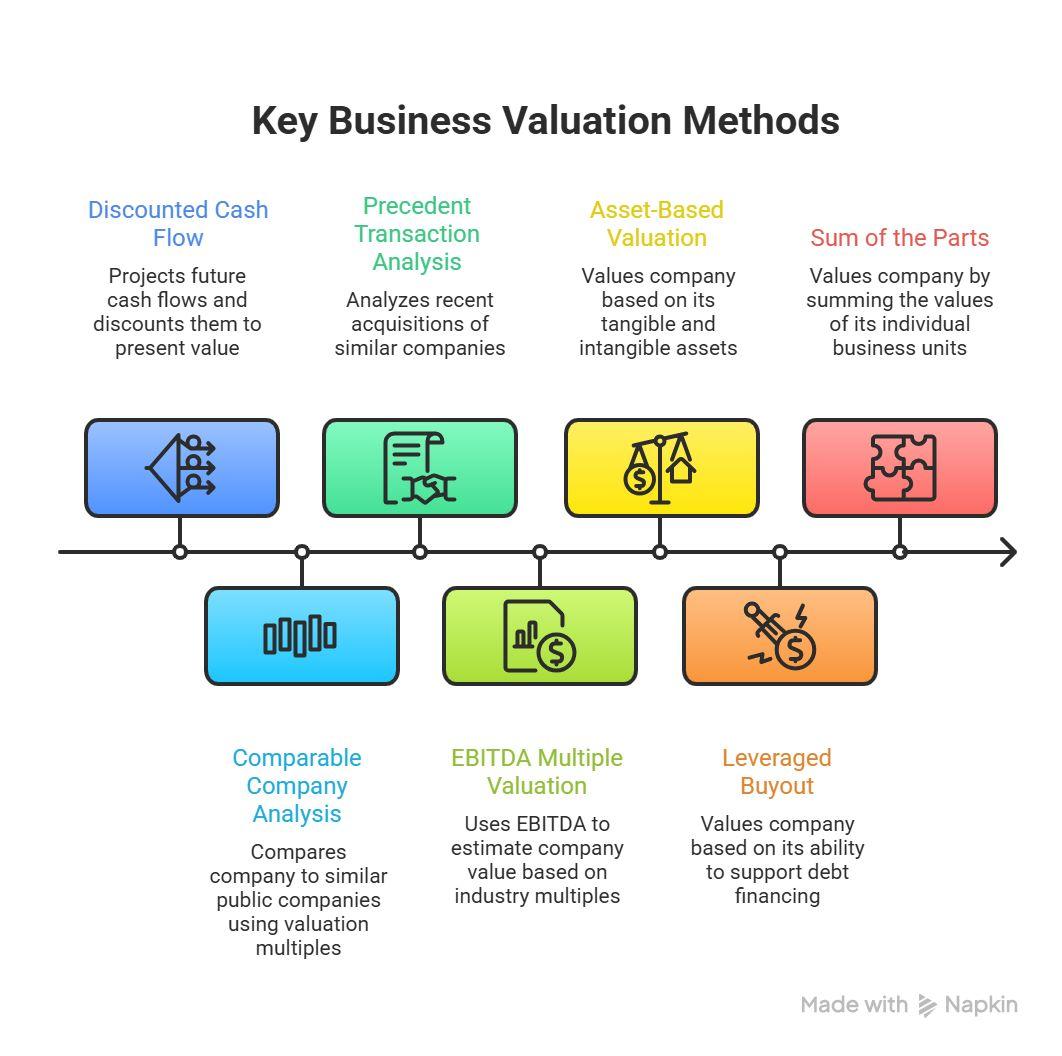
This guide outlines seven proven valuation methods used by investors, private equity firms, and corporate acquirers to evaluate target companies.
Understanding the Importance of Company Valuation for Acquisition
A structured approach to company valuation for acquisition ensures that investment decisions are based on financial fundamentals rather than market sentiment or competitive pressure.
Valuation plays a critical role in:
- Determining the maximum purchase price
- Structuring deal terms and payment mechanisms
- Assessing return on investment
- Identifying potential risks and synergies
- Supporting negotiation strategy
Without a robust valuation framework, buyers risk overpaying for assets or underestimating integration challenges.
Valuation also serves as a bridge between financial analysis and strategic intent. For example, a company may appear expensive based on traditional metrics but offer significant strategic value through technology acquisition or market expansion.
Organizations often complement valuation analysis with M&A due diligence checklist frameworks to validate financial assumptions and uncover hidden liabilities.
Discounted Cash Flow (DCF) Method
The Discounted Cash Flow method is one of the most widely used approaches in company valuation for acquisition. It estimates the present value of a company based on its expected future cash flows.
The core principle of DCF is that the value of a business is determined by its ability to generate cash in the future.
Key steps in DCF valuation include:
- EV/EBITDA
- Price-to-Earnings (P/E)
- Price-to-Earnings (P/E)
By analyzing how similar companies are valued in the market, buyers can estimate a reasonable valuation range for the target.
Key considerations include:
- Industry alignment
- Growth rate comparability
- Profitability metrics
- Market positioning
Comparable analysis provides real-time market perspective and reflects investor sentiment.
Organizations often combine this approach with procurement and supply chain intelligence services when evaluating supplier-driven acquisitions or manufacturing targets, where cost structures and supply dynamics influence valuation.
Precedent Transaction Analysis
Precedent transaction analysis evaluates valuation multiples based on historical acquisition deals in the same industry.
This method provides insight into:
- Premiums paid in past transactions
- Strategic buyer behavior
- Market consolidation trends
Key advantages include:
- Reflects actual transaction pricing
- Captures control premiums
- Accounts for strategic value
However, precedent transactions may be influenced by specific market conditions at the time of the deal.
Buyers should adjust historical multiples to reflect current market dynamics and sector-specific risks.
EBITDA Multiple Valuation
EBITDA multiples are one of the most commonly used valuation tools in acquisitions. This method values a company by applying a multiple to its EBITDA.
For example:
Enterprise Value = EBITDA × Industry Multiple
EBITDA multiples are widely used because they:
- Normalize earnings across companies
- Exclude capital structure differences
- Provide quick valuation benchmarks
However, EBITDA multiples should not be used in isolation. Factors such as growth potential, risk profile, and competitive positioning must also be considered.
Understanding EBITDA multiple explained concepts helps buyers avoid misinterpreting valuation benchmarks.
Asset-Based Valuation
Asset-based valuation focuses on the net value of a company’s assets after deducting liabilities.
This approach is commonly used for:
- Asset-heavy businesses
- Distressed companies
- Liquidation scenarios
Types of asset-based valuation include:
- Book value method
- Adjusted net asset value
- Liquidation value
This method provides a conservative valuation baseline, particularly when earnings are unstable or unreliable.
However, it may not fully capture intangible assets such as brand value, intellectual property, or customer relationships.
Leveraged Buyout (LBO) Analysis
LBO analysis is commonly used by private equity investors to evaluate acquisition opportunities.
This method determines the maximum price a buyer can pay while achieving target returns based on leveraged financing.
Key components include:
- Debt financing structure
- Equity contribution
- Cash flow projections
- Exit valuation assumptions
LBO analysis focuses on return generation rather than intrinsic value. It helps investors assess whether a deal meets internal rate of return (IRR) thresholds.
Organizations often integrate LBO analysis with post-merger integration strategy planning to ensure operational improvements support projected returns.
Sum of the Parts (SOTP) Valuation
The Sum of the Parts method values a company by separately evaluating each business segment and then combining the values.
This approach is useful for:
- Diversified companies
- Conglomerates
- Businesses with distinct operating units
Each segment is valued using the most appropriate method, such as DCF or comparables.
SOTP allows buyers to identify underperforming segments and unlock hidden value.
Key Factors That Influence Company Valuation for Acquisition
Beyond valuation methods, several qualitative and quantitative factors influence valuation outcomes.
These include:
- Industry growth trends
- Competitive positioning
- Management strength
- Customer concentration
- Regulatory environment
- Supply chain dependencies
For example, companies with strong supplier ecosystems and resilient operations may command higher valuations when assessed alongside strategic procurement intelligence insights.
Valuation must incorporate both financial metrics and strategic considerations.
Common Mistakes in Company Valuation
Even experienced investors can make valuation errors.
Common mistakes include:
- Overreliance on a single valuation method
- Unrealistic growth assumptions
- Ignoring risk factors
- Misinterpreting market multiples
- Failing to validate data through due diligence
Avoiding these mistakes requires disciplined analysis and cross-validation using multiple valuation frameworks.
Conclusion
Company valuation for acquisition is both an art and a science. While financial models provide structure, strategic judgment and market understanding are equally important in determining the right valuation.
By combining methods such as DCF, comparable analysis, precedent transactions, EBITDA multiples, asset-based valuation, LBO analysis, and SOTP, organizations can build a comprehensive valuation framework.
Companies that approach valuation systematically are better positioned to negotiate effectively, avoid overpayment, and achieve long-term value creation.
For organizations navigating complex transactions, engaging expert advisory support such as strategic M&A advisory services helps ensure that valuation is grounded in financial rigor and aligned with strategic objectives.