
Built to Deadline: Why Pharma's US Factory Pledges May Not Outlast the Tariffs that Prompted Them
Published on 05 Nov, 2026
Drugmakers have pledged more than USD 500 billion in US manufacturing investment to avoid Section 232 tariffs. But the zero-tariff deal that rewards those pledges expires on January 20, 2029, the last day of the current presidential term, while a new plant takes about four years to design, build, and qualify. This thought piece examines what this timing mismatch means for how much capacity actually gets built, where production really moves, and how manufacturers; contract manufacturers; and governments should plan.
Key Findings
The evidence so far points to four shifts as follows:
- Pledges are large and front-loaded.Commitments now exceed USD 500 billion, led by AbbVie, Pfizer, Merck, and Johnson & Johnson. Most are spread over four to ten years, and several bundle R&D spending with manufacturing.
- The reward is tied to the pledge, not the plant.Companies with an approved onshoring plan and an MFN pricing agreement do not pay any Section 232 tariff until January 20, 2029. The relief starts on signing, years before any new plant produces a dose.
- Most new plants will not be running before the window closes.A greenfield facility takes close to four years to design, build, and qualify. Suppliers expected groundbreakings in 2026 and 2027 at the earliest, so much of the pledged capacity will come online after 2029, when the policy that prompted it may have changed.
- The shift in production is smaller than the headlines suggest.Ireland's sharp fall in US exports in 2026 largely reverses the stockpiling surge of 2025. Existing sites in Europe are still supplying the US, and the real test of relocation will come when new US plants are ready to take over volumes.
1. The Pledges: Large, Long, and Loosely Defined
The Section 232 tariffs created a simple trade policy: commit to building in the US and to MFN pricing and pay zero tariff on patented imports. The industry's answer has been a wave of headline commitments. By mid-2026, the total exceeded USD 500 billion, up from an estimated USD 316 billion for 10 companies in July 2025.
Exhibit 1. The largest pledges mix manufacturing, R&D, and long time frames
| Company | Pledge | Scope and period as announced |
|---|---|---|
| AbbVie | USD 100 billion | US R&D over ten years, plus site investment |
| Pfizer | USD 70 billion | R&D and domestic manufacturing, tied to a three-year tariff moratorium |
| Merck | Over USD 70 billion | Includes a USD 3 billion facility in Virginia |
| Johnson & Johnson | USD 55 billion | Over four years |
| AstraZeneca | USD 50 billion | By 2030 |
| Roche | USD 50 billion | Over five years |
| Gilead | USD 32 billion | Not specified |
| GSK | USD 30 billion | Over five years |
| Eli Lilly | At least USD 27 billion | Four new plants |
| Novartis | USD 23 billion | Not specified |
| Sanofi | At least USD 20 billion | By 2030 |
Three aspects matter: the pledges run over four to ten years; several combine manufacturing with R&D, so the headline does not equal new factory capacity; it is often unclear how many sites are greenfield builds rather than expansions or acquisitions.
2. The Timing Mismatch
The incentive and the investment run on different clocks. Companies that hold an approved onshoring plan and MFN pricing agreement do not pay any Section 232 tariff from April 2, 2026 until January 20, 2029. This end date is also the last day of the current presidential term.
Building takes longer. Designing, building, and qualifying a greenfield pharmaceutical plant takes close to four years, and expanding an existing site is at least a three-year undertaking, largely due to equipment lead times. Even fast projects, such as Lilly's Houston plant, finish construction only in 2027, before validation and regulatory approval.
Exhibit 2. The tariff relief ends before most new plants can produce
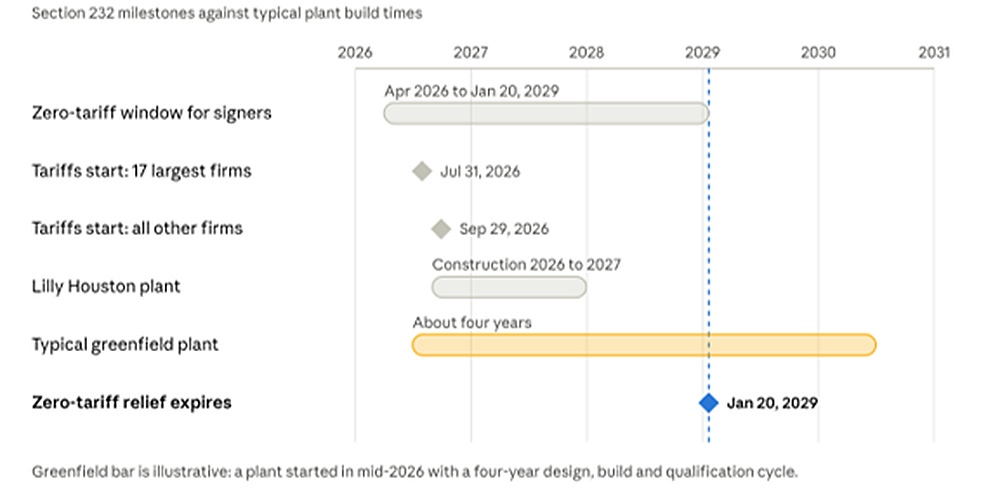
The result is an incentive structure that rewards the pledge immediately and the plant not at all, since relief is already in place before any new site produces. A company acting rationally will sign, start enough work to keep its agreement in good standing, and keep its options open on the largest investments until the policy after January 2029 is clear.
3. What the Evidence Says About Follow-Through
Some projects are clearly real. Eli Lilly broke ground on a USD 6.5 billion plant in Houston in 2026, with construction expected to finish in 2027, and says about 90% of its USD 57 billion in active and planned projects are in the US.
The wider picture is less clear. An analysis by the Council on Foreign Relations' Think Global Health looked for the signals that real construction would leave upstream:
- Equipment orders were thin.Little onshoring-related procurement appeared in suppliers' earnings calls, and most supplier share prices had not risen.
- Groundbreaking was some way off.One equipment supplier's chief executive estimated the earliest groundbreakings to occur in 2026 and 2027.
- Capacity constraints are real.If 15% of the pledged capital went to bioprocessing equipment, demand would exceed USD 75 billion, risking shortages like those seen during COVID-19. Experienced biomanufacturing staff are often not where new plants are planned.
None of this means the pledges are empty. It means the industry has every reason to announce at scale and good reasons to build at a measured pace.
4. Who Actually Loses Production and When
The headlines suggest production is already leaving Europe, while the data reveals something more nuanced.
Ireland's exports to the US fell 45.1% year-over-year in April 2026 to €5.1 billion. But this drop largely reverses the surge of early 2025, when companies front-loaded shipments ahead of the tariffs. Some companies also leaned on inventory already in the US, and others describe themselves as increasingly US-centric.
For now, existing plants in Ireland, Switzerland, and elsewhere in Europe continue to supply the US. The real decisions about moving volumes will come later.
| Phase | What happens to the existing ex-US sites |
|---|---|
| 2025 to 2026: Pledge and stockpile | Exports surge and then fall back. Sites keep running; companies sign onshoring and MFN agreements. |
| 2027 to 2029: Build | New US plants are under construction or in qualification. Ex-US sites remain the main source for most products. |
| 2029 onwards: Transfer | As US plants are approved, companies decide which products to move. By then, the tariff regime may have changed. |
The largest shifts in production are, therefore, likely to be decided after January 2029, under whichever trade policy is then in force.
5. What Each Group Should Do
Manufacturers:
- Stage capital to policy milestones. Phase spending so that the commitments needed to keep tariff relief are met, while larger capital decisions wait for clarity on what follows January 2029.
- Separate the pledge from the network plan. Decide which products truly need US supply for resilience or cost, independent of the tariff, and build for those first.
- Consider ex-US sites as an option, not a stranded cost. Plan for a period of dual supply and avoid premature closures that would be hard to reverse if policy changes.
- Secure equipment and talent early. Bioprocessing equipment and experienced staff are the binding constraints on build speed and not capital.
Contract manufacturers:
- Treat pledged demand as uncertain. Some sponsors will choose capacity agreements over owned plants. Offer flexible US capacity that can be committed to on shorter timelines than a greenfield build.
- Position existing ex-US capacity for transition. Sponsors will need supply while US plants are built and qualified.
Governments outside the US:
- Focus on retention, not reversal. Most existing plants will keep running for several years. Policies that make them part of companies' long-term networks will matter more than matching US incentives.
- Prepare for 2029. The greatest risk is when new US plants are approved and companies choose which volumes to move.
6. What To Watch Out For
| Signal | Why it matters | What would change the picture |
|---|---|---|
| Groundbreakings and construction starts | Distinguishes real projects from announcements | A rising share of pledged sites under construction by the end of 2027 |
| Equipment orders | Construction leaves a trace in supplier order books | Sustained growth in bioprocessing and fill-finish equipment orders |
| Policy beyond January 2029 | Determines whether the incentive outlasts the pledge | An extension of the zero-tariff treatment or its codification in law |
| First product transfers | The real measure of relocation | Regulatory filings to move commercial products to new US sites |
| Ex-US site decisions | Shows whether Europe loses capacity or maintains a dual role | Announced closures or downsizing of plants in Ireland, Switzerland, or elsewhere in Europe |
The Bottom Line
The tariff regime rewards pharmaceutical companies for promising to build in the US and not for producing them there. Relief arrives on signing. However, new plants arrive years later, and most will not be running before the zero-tariff window closes on January 20, 2029. This does not make the pledges hollow, but it means the headline figure is a poor guide to future capacity. The real decisions about where medicines are made will be taken after 2029, under whichever policy then applies. Manufacturers that stage their spending, contract manufacturers that offer flexible capacity, and governments that focus on retaining existing plants will be best placed for that moment.
