
The Complete Guide to the Mergers and Acquisitions Process in 2026
Published on 23 Apr, 2026

Mergers and acquisitions continue to redefine industries, accelerate strategic expansion and reshape competitive dynamics across global markets. In 2026, transaction activity is being driven by digital transformation, private equity capital deployment, ESG integration and sector consolidation. However, despite favorable capital conditions, deal failure rates remain high.
The reason is rarely lack of opportunity. The real challenge lies in execution across the structured mergers and acquisitions process. Organizations that approach transactions without a disciplined framework often encounter valuation misalignment, regulatory obstacles or post closing integration breakdown.
This guide explains the end to end mergers and acquisitions process, offering a strategic and financial lens across every stage. For organizations evaluating buy side or sell side transactions, understanding this framework before engaging in strategic M&A advisory services is critical.
The Strategic Importance of Mergers and Acquisitions
Mergers and acquisitions are strategic levers, not merely financial transactions. They allow organizations to accelerate scale, access new capabilities and defend competitive position in ways that organic growth cannot always achieve within desired timelines.
Companies typically pursue M&A to achieve:
- Market expansion into new geographies
- Acquisition of proprietary technology or intellectual property
- Vertical integration across the supply chain
- Portfolio diversification
- Cost efficiency through operational consolidation
- Access to specialized talent pools
In high growth sectors such as technology and renewable energy, consolidation is often essential for maintaining competitive relevance. Organizations tracking technology M&A trends 2026 frequently observe how strategic acquirers deploy capital to capture emerging capabilities rather than build them internally.
Strategic clarity at the outset determines whether an acquisition enhances enterprise value or simply increases revenue without improving margins or market positioning.
Stage One: Defining the M&A Strategy Framework
Every successful transaction begins with a clear acquisition thesis. Before identifying targets, leadership must articulate why an acquisition is necessary and how it aligns with long term corporate objectives.
A structured strategy framework includes:
- Clearly defined growth objectives
- Industry and sector focus
- Target revenue and EBITDA range
- Geographic expansion priorities
- Expected cost or revenue synergies
- Capital allocation thresholds
- Risk tolerance parameters
Without predefined criteria, companies risk pursuing opportunistic transactions that dilute strategic focus.
For example, an organization seeking geographic expansion must evaluate whether acquisition targets offer sustainable local market share or temporary revenue spikes. Similarly, capability driven acquisitions must assess whether intellectual property is defensible.
Boards often collaborate with experienced advisors such as Aranca to validate strategic assumptions and align acquisition criteria with shareholder expectations.
Companies evaluating divestiture readiness may also benefit from reviewing how to prepare your company for acquisition to understand investor expectations from the seller perspective.
Stage Two: Target Identification and Strategic Screening
Once acquisition criteria are defined, organizations move to target identification and screening. This stage requires structured research rather than informal networking.
Sources of target identification include:
- Industry intelligence databases
- Market research reports
- Investment banking networks
- Competitive landscape mapping
- Direct management outreach
Screening criteria typically include:
- Revenue stability and growth trajectory
- EBITDA margin sustainability
- Customer concentration risk
- Competitive positioning
- Operational scalability
- Cultural alignment
Cultural compatibility is frequently underestimated. Leadership philosophy, governance style and decision making speed can significantly influence post acquisition integration success.
Organizations that apply structured screening methodologies reduce waste of time and improve transaction efficiency. At this stage, early reference to company valuation methods in M&A ensures financial feasibility aligns with strategic ambition.
Stage Three: Valuation and Financial Modeling
Valuation determines not only purchase price but also return expectations and financing structure. It must combine quantitative rigor with strategic judgment.
Common valuation methods include:
- Discounted cash flow analysis based on projected free cash flows
- Comparable company analysis benchmarking sector multiples
- Precedent transaction analysis referencing historical deal data
- EBITDA multiple benchmarking aligned with industry norms
A disciplined valuation process includes:
- Earnings normalization adjustments
- Working capital sustainability review
- Capital expenditure forecasting
- Risk adjusted discount rate assessment
- Scenario sensitivity modeling
Overreliance on headline multiples without deeper analysis can result in overpayment, especially in competitive bidding environments.
Organizations seeking detailed financial frameworks often explore company valuation methods in M&A to strengthen negotiation readiness.
Valuation assumptions must withstand due diligence scrutiny. Financial projections unsupported by operational evidence frequently lead to renegotiation or transaction withdrawal.
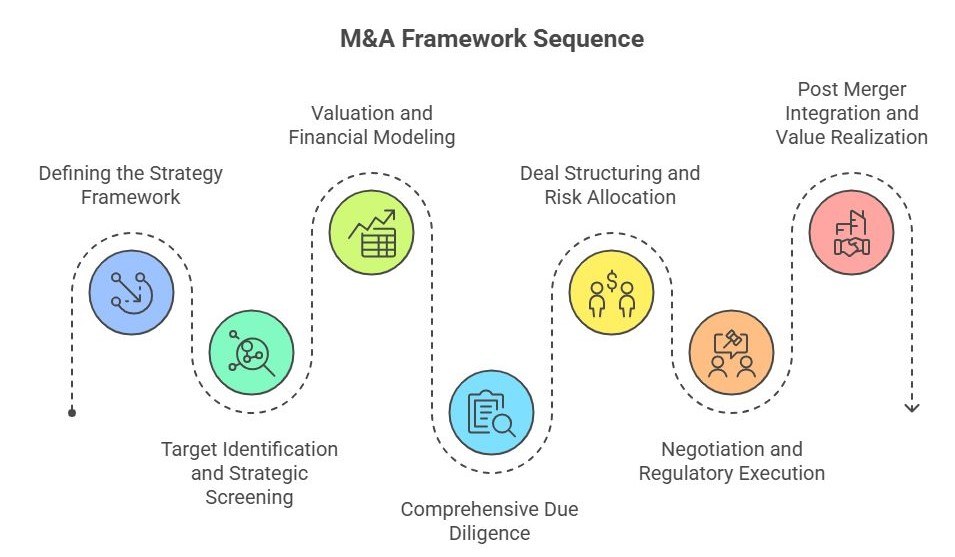
Stage Four: Comprehensive Due Diligence
Due diligence validates assumptions and uncovers risks. It is the most risk sensitive stage of the mergers and acquisitions process.
Financial due diligence focuses on:
- Revenue recognition policies
- EBITDA quality and adjustments
- Debt obligations
- Cash flow stability
- Working capital adequacy
Legal due diligence reviews:
- Corporate governance structure
- Contractual liabilities
- Intellectual property ownership
- Pending litigation
- Regulatory compliance
Commercial due diligence assesses:
- Market growth sustainability
- Competitive differentiation
- Pricing resilience
- Customer concentration exposure
Operational due diligence evaluates:
- Supply chain resilience
- Technology infrastructure
- Human capital stability
- Production scalability
A structured M&A due diligence checklist reduces transaction risk and enhances negotiation leverage.
Organizations that approach due diligence strategically rather than mechanically are better positioned to renegotiate pricing or structure based on identified risks.
Stage Five: Deal Structuring and Risk Allocation
Deal structuring determines how financial and legal risks are allocated between buyer and seller. The optimal structure balances tax efficiency, financing flexibility and liability protection.
Key structuring considerations include:
- Asset purchase versus share purchase
- Cash versus stock consideration
- Earn out mechanisms linked to performance milestones
- Escrow provisions
- Representations and warranties
- Indemnity caps and survival periods
Understanding asset vs share purchase in M&A helps organizations evaluate tax implications and liability exposure.
Structuring decisions also influence post acquisition governance and integration complexity. Collaborative alignment between legal, financial and strategic teams is essential at this stage.
Stage Six: Negotiation and Regulatory Execution
Negotiation extends beyond price. It encompasses:
- Purchase price adjustments
- Working capital true ups
- Representations and warranties
- Closing conditions
- Regulatory approvals
- Financing arrangements
In cross border transactions, additional complexity arises from:
- Foreign investment approvals
- Tax structuring across jurisdictions
- Currency risk exposure
- Multi regulatory compliance
Organizations exploring cross-border mergers and acquisitions strategy must account for jurisdictional nuances that affect transaction timelines and capital deployment.
Effective negotiation requires clarity on walk away thresholds and disciplined adherence to valuation boundaries.
Stage Seven: Post Merger Integration and Value Realization
Post merger integration determines whether projected synergies materialize. Many transactions fail not due to flawed valuation but because integration planning begins too late.
Integration priorities include:
- Leadership alignment
- Cultural integration
- Systems and technology consolidation
- Operational cost synergy realization
- Revenue synergy tracking
- Clear internal communication
Organizations often reference structured post-merger integration strategy frameworks to accelerate synergy capture and reduce disruption.
Integration planning should begin during due diligence. Early identification of cultural and operational friction points enables smoother execution post closing.
Experienced advisory support from Aranca enhances integration governance and synergy accountability.
Key Risks Across the Mergers and Acquisitions Process
Even disciplined transactions face inherent risks.
Common risks include:
- Overvaluation driven by competitive pressure
- Hidden liabilities undiscovered during due diligence
- Cultural incompatibility
- Regulatory delays
- Synergy overestimation
- Integration misalignment
Risk mitigation requires structured governance across all stages, from strategy formulation to integration execution.
Engaging experienced providers of strategic M&A advisory services early in the transaction cycle enhances decision quality and confidence.
Conclusion
The mergers and acquisitions process is a structured strategic journey rather than a single financial event. Each stage builds upon the previous one, and weaknesses in early planning often magnify during integration.
Organizations that apply disciplined strategy, rigorous valuation, comprehensive due diligence and structured integration planning significantly improve long term value creation outcomes.
For leadership teams considering acquisition, divestment or cross border expansion, a methodical approach supported by experienced advisors can transform transaction ambition into measurable competitive advantage.