
Why the GCC is key to Brazil’s poultry export shift?
Published on 29 Dec, 2025
Brazil’s poultry export mix is increasingly shifting toward GCC markets as China’s role as a key balancing destination has diminished. Following a decline in exports to China in 2024 and a temporary embargo in 2025, Brazil redirected volumes to the UAE and Saudi Arabia, which have emerged as the largest importers. Structurally strong demand, alignment with halal requirements, and logistical advantages continue to underpin GCC imports. Importantly, rising self-sufficiency targets in the GCC are unlikely to displace imports over the medium term, as demand growth is outpacing domestic capacity additions. As a result, Brazil’s poultry exports are likely to remain tilted toward GCC markets through 2027, supporting more stable export flows and earnings visibility for leading producers.
Brazil remains the world’s largest poultry exporter, accounting for 39.0% of global volumes in 2024, supplying major markets such as China, the UAE, Japan, Saudi Arabia, and South Africa. China has historically accounted for 11-14% of Brazilian poultry exports and has often served as a balancing market for incremental supply.
However, recent trade patterns indicate a notable shift in Brazil’s export mix. In 2024, poultry (primarily chicken) exports to China declined by 17.7% YoY to 562,208 tons. Furthermore, during 11M 2025, the country dropped out of Brazil’s top five export destinations for the first time, driven by the six-month (May–October 2025) embargo on Brazilian poultry following avian influenza detections, and higher sourcing from alternative suppliers approved by Chinese authorities.
Meanwhile, GCC markets, particularly the UAE and Saudi Arabia, have strengthened their position. Based on 11M 2025 data, the UAE became the largest export destination, with imports rising 2.1% YoY to 433,800 tons, while shipments to Saudi Arabia grew 6.3% YoY to 362,600 tons. Outside the GCC, Mexico expanded its share, with imports increasing 16.2% YoY to 238,200 tons, while Japan’s imports declined 10.8% YoY to 367,400 tons. These trends highlight a reallocation of Brazilian volumes away from China and parts of Asia toward GCC markets, supported by demand stability, halal requirements, and logistical advantages on the Brazil–GCC route.
Exhibit 1: Rebalancing of Brazil’s poultry exports toward GCC markets
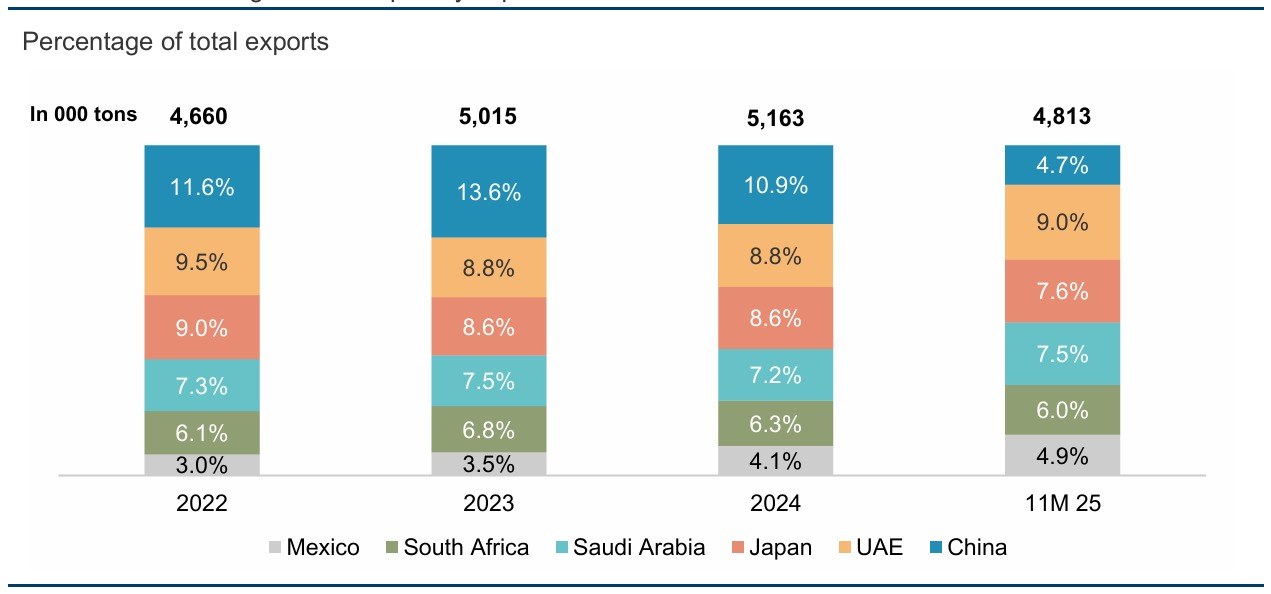
Source: Brazilian Animal Protein Association (ABPA), Aranca Research, *China’s 11M 25 share reflects exports limited to Jan-May 2025 due to import suspension.
Key drivers of the shift
1) China’s evolving import mix
Apart from the six-month embargo, China’s poultry imports from Brazil have softened due to:
- rising domestic production (+7.4% YoY in H1 2025), supported by large-scale integrated producers
- increased sourcing from the US following the approval of 83 poultry processing plants by China’s customs authority
As a result, Brazil’s incremental export volumes are now less reliant on China, as the latter broadens its supplier base and prioritizes reducing concentration risk.
2) GCC’s stable demand and halal alignment
GCC markets continue to play a growing role in Brazil’s export mix driven by:
- limited domestic production constrained by climate conditions and high dependence on imported feed
- strong preference for halal-certified poultry
- stable per capita consumption levels (around 43 kg/year)
Brazil’s large-scale halal-certified capacity makes it the most reliable supplier to the region. The UAE and Saudi Arabia together accounted for 16.5% of Brazil’s total export volumes in 11M 2025, up from 15.8% in 11M 2024.
3) Logistics and freight competitiveness
Shipping to the GCC is structurally shorter and cheaper than to East Asia, supporting better netbacks for Brazilian exporters. The Brazil–GCC route offers lower fuel costs and fewer routing risks compared with Asia-bound shipments, reinforcing the cost advantage to allocate volumes toward GCC markets.
Company positioning and strategic alignment with GCC demand
Brazil’s major poultry exporters have strengthened their presence in GCC markets, reinforcing the country’s capacity to meet the region’s rising demand.
- BRF S.A., one of Brazil’s largest poultry producers, expanded its partnership with Saudi Arabia’s Halal Products Development Company (HPDC) through a joint venture, acquiring a 26% stake in Addoha Poultry Company in 2024. Moreover, the company’s Sadia brand reached a 37.4% market share (2024) across GCC markets, reinforcing its strategic positioning in the region.
- JBS S.A., another leading producer, has expanded halal capabilities and strengthened distribution infrastructure in key GCC markets through its Seara division.
These strategic moves indicate that leading Brazilian companies are well positioned to serve stable, high-value halal markets and support a continued reorientation of poultry export volumes toward GCC markets.
Our view on the strategic shift
We believe GCC self-sufficiency efforts, including Saudi Arabia’s expansion plans, the UAE’s investments in modern broiler farms, and Kuwait’s capacity additions from a low base, are expected to progress gradually, thereby not materially reducing imports in the medium term. Accordingly, we expect Brazil’s poultry exports to remain tilted toward these major GCC markets, at least until 2027.
Specifically, despite Saudi Arabia targeting poultry self-sufficiency of 80% in 2025f (up from 72% in 2024) under the Vision 2030 agenda, strong growth in total poultry demand is outpacing domestic capacity additions, limiting the reduction in import requirements. As a result, Brazilian poultry imports to Saudi Arabia are expected to increase from ~371k tons in 2024 to ~394k tons in 2025f, reflecting continued reliance on imports despite rising domestic production. While we believe China remains an important market, it is no longer the primary destination for Brazil’s incremental poultry volumes. Instead, GCC markets are increasingly absorbing incremental supply.
Exhibit 2: Saudi poultry imports from Brazil vs. self-sufficiency rates
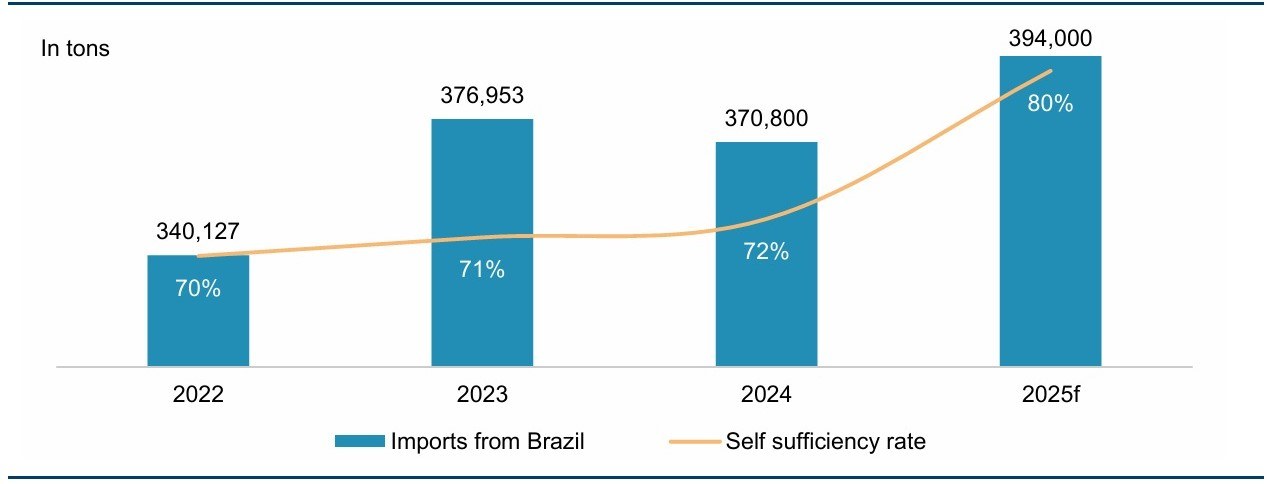
Source: ABPA, GASTAT, Aranca Research, 2025f self-sufficiency rate reflects Saudi Arabia’s Vision 2030 target.
Implications for investors
Export-oriented Brazilian poultry producers with large halal-certified capacity, such as BRF S.A. and JBS S.A., are well positioned for more stable earnings as GCC markets account for a larger share of their export mix. Moreover, long-term contracts with GCC buyers offer better margin visibility compared with the more volatile Asian markets. We believe investors should focus on producers with integrated feed operations, efficient cold-chain logistics, and strong exposure to the UAE, Saudi Arabia, and Kuwait.

Pratik Surve
