
The Billion-Dollar Bet: Venture Capital’s Race for Humanoid Robotics
Published on 17 Jun, 2026
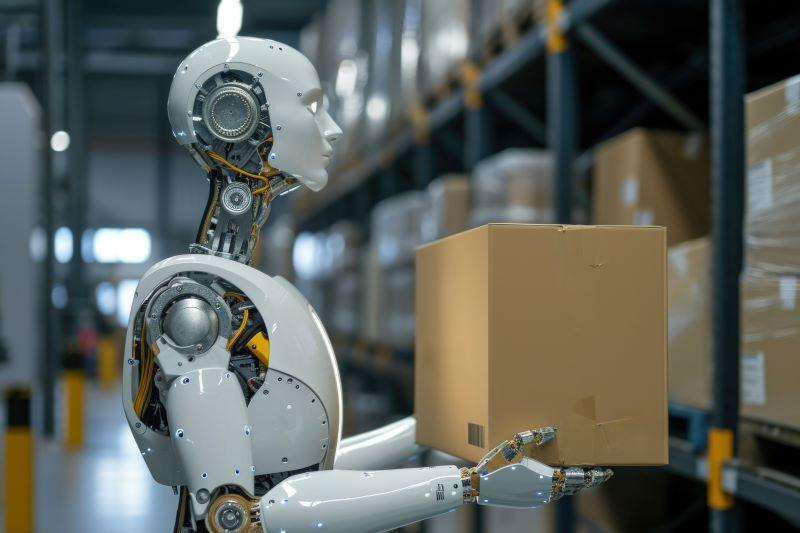
Humanoid robotics is moving beyond controlled pilot environments into real-world operations across logistics, manufacturing, and industrial settings. Backed by growing venture capital investment and advancements in AI, these systems are increasingly being viewed as a practical solution to labor shortages and operational complexity.
This article explores the investment trends, key industry deployments, and strategic factors shaping the evolution of humanoid robotics as the industry transitions from experimentation toward scalable commercial adoption.
From Fixed Automation to Adaptive Systems: The Rise of Humanoid Robotics
The boundaries of automation are shifting beyond controlled, repetitive settings into the complexity of everyday work environments. At the center of this transition are humanoid robots, engineered to operate within spaces designed for human activity without requiring reconfiguration. By combining humanlike mobility with the ability to seamlessly interact with existing tools, layouts, and workflows, humanoid systems unlock a significantly broader set of deployment scenarios. This spans high variability environments such as logistics facilities with constantly shifting inventory, clinical settings requiring assistive support, construction sites with evolving conditions, and service operations where standardization is inherently limited. As a result, these systems are emerging as a critical enabler for sectors facing labor constraints and operational complexity, materially expanding the scope of automation.
This shift is already moving beyond concept to real-world validation, with early deployments demonstrating tangible operational use cases.
| Company | Solution | Deployment Focus | Use-case Illustration |
|---|---|---|---|
| Agility Robotics | Digit | Logistics and warehouse operations | Piloted for material movement and handling within warehouse workflows, supporting order fulfillment without requiring layout changes |
| Tesla | Optimus | Industrial and semi-structured environments | Designed for general-purpose assistance across varied tasks, reflecting a move toward adaptable automation in dynamic work settings |
How Are Investors Positioning for the Next Robotics Breakthrough?
Sustained Growth in Investment Activity
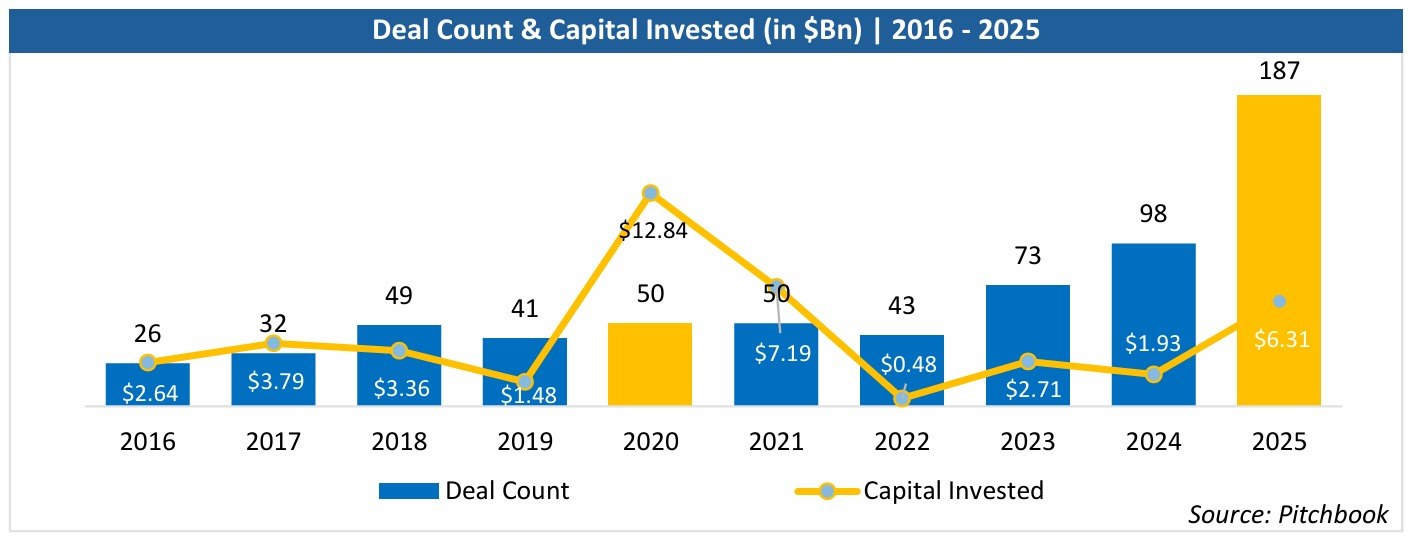
Over the past decade, investment flows have increasingly concentrated around frontier technologies, with humanoid robotics emerging as a visible area of venture capital engagement. This momentum is supported by consistent market participation rather than isolated funding events. Between 2016 and 2025, more than 140 companies executed over 650 investment deals, reflecting expanding investor confidence and growing recognition of humanoid robotics as a distinct technology category.
Deal volumes over 2016-25 illustrate the pace of market formation. Transactions increased from 26 deals in 2016 to 187 by 2025, indicating rising participation from venture investors, strategic backers, and technology-focused funds.
Capital Deployment Patterns
While deal activity followed a steady upward trajectory (period: 2016 – 2025), funding levels exhibited cyclical behavior, peaking at USD 12.84 billion in 2020, influenced by a limited number of large late-stage rounds, before entering a correction phase (2020 – 2021). Capital flows later stabilized, recovering to USD 2.71 billion in 2023 and expanding further to USD 6.31 billion in 2025. This rebound is also reflected in select large transactions recently, with Figure AI securing USD 1.5 billion in later-stage venture funding in 2025, highlighting continued investor appetite for scaled platforms.
Despite this recovery, a divergence between rising deal volumes and funding volatility indicates a shift toward more selective and disciplined capital allocation. Investor participation is broadening, yet capital deployment is increasingly concentrated on opportunities demonstrating clearer commercial pathways and scalability.
This selective approach is further evident in the distribution of investments across funding stages. Early-stage financing dominates, with seed and early-stage venture rounds accounting for most transactions, a pattern typical of markets characterized by technological uncertainty and extended innovation cycles. More than 100 companies raised early-stage venture rounds, followed by seed-stage funding, underscoring investor preference for formative positioning where long-term value creation potential is the highest.
Types of Companies Attracting Capital
A closer look at the deal data reveals two distinct categories of companies that are successfully capturing investor interest.
- Pure-play humanoid robotics developers: Pure-play robotics developers, such as Figure AI, Agility Robotics, and Sanctuary AI, are directly building humanoid robots.
- Adjacent technology and ecosystem enablers: Companies like XPeng are ecosystem enablers, which, while not strictly humanoid robotics firms, develop adjacent technologies such as autonomous driving, AI systems, and mobility platforms that underpin humanoid capabilities.
This diversity in funded companies shows that venture capitalists are hedging their bets, spreading their portfolios across both direct robotics innovation and the enabling technologies that make humanoid systems commercially viable.
Who’s Investing: Tech Giants and Strategic Backers
Microsoft has invested in humanoid robotics as part of its broader artificial intelligence strategy, while Nvidia is providing not only capital but also GPU-driven platforms essential for robot training and simulation. Amazon has been exploring humanoid applications for logistics and warehousing, reflecting its need for scalable automation across supply chains. Meanwhile, funds linked to OpenAI are playing a pivotal role by contributing expertise in AI alignment and general-purpose intelligence.
This mix of financial and strategic investors highlights that humanoid robotics is not an isolated bet. It is deeply intertwined with broader advancements in AI, cloud infrastructure, and automation, and the backers are ensuring that their investments shape these converging ecosystems.
Industry Pilots, Deployments, and Operational Testing of Humanoids
Despite these large capital inflows, broad commercial deployment of humanoid robots remains at an early stage. Industry progress is currently characterized by controlled pilots, supervised trials, and targeted operational experiments rather than scaled adoption. Notable examples include:
| Company | Initiative | Deployment Setting | Key Use Cases | Strategic Implication |
|---|---|---|---|---|
| Xiaomi | EV Factory Humanoid Trials (2026) | Electric vehicle manufacturing facility | Material handling and component installation on assembly lines | Robots deployed as “interns,” completing over 90% of assigned tasks within a three-hour shift while maintaining production line pace, indicating strong early-stage operational viability |
| BMW | Shop-Floor Humanoid Pilots (2026) | Manufacturing operations | Repetitive assembly and shop-floor support tasks | BMW successfully deployed Figure 02 humanoid robots in production workflows at its largest plant in Spartanburg, South Carolina, where robots supported production of over 30,000 BMW X3 vehicles |
| Mercedes-Benz | Investment and Factory Trials (2025) | Automotive manufacturing facilities in Germany and Hungary | Component handling and quality inspection tasks | Mercedes-Benz expanded operational testing of Apptronik’s (Texas-based robotics firm) Apollo humanoid robots within its digital factory ecosystem, including autonomous operations training |
| NTT DATA | Smart Robotics for Facility Inspection (2024) | Industrial facilities | Automated inspection, anomaly detection, and equipment monitoring | Implemented in collaboration with Mitsubishi Chemical Corporation, enabling autonomous navigation, improved safety, and reduced reliance on manual inspections in complex environments |
| Agility Robotics | Digit Commercial Deployment (2024) | Logistics warehouse (GXO Logistics) | Material movement and handling within warehouse workflows | Deployment indicates early integration of humanoids into live warehouse operations, demonstrating practical viability in logistics environments |
The Investment Case Going Forward
Where Will Capital Concentrate Next?
While early investments in humanoid robotics were broad-based, capital is increasingly concentrating on environments where humanoids can deliver measurable value. Industrial settings such as logistics, warehousing, and manufacturing remain the primary focus, driven by labor shortages and the need for flexible automation.
Investor interest is also extending to applications such as facility inspection, maintenance, and healthcare support, where tasks are repetitive yet require adaptability. Moreover, funding is gradually expanding beyond pure-play robotics to enabling technologies such as AI models and simulation platforms, reflecting a shift toward integrated, scalable systems.
Conclusion: Shift from Experimentation to Execution
The next decade will likely see humanoid robotics move from pilot projects to mainstream adoption. For investors, the opportunity is not just about betting on technology, it is about participating in the creation of entirely new markets and reshaping the future of work.
However, the path to scale will be defined less by technological breakthroughs alone and more by the ability to translate capability into repeatable, economically viable deployments. As a result, investor focus is expected to remain on companies that can demonstrate consistent performance in real-world environments, clear cost-to-value propositions, and the ability to integrate into existing operational workflows.
Aranca’s Perspective
From a strategic standpoint, the near-term opportunity in humanoid robotics is likely to be concentrated in applications where tasks are physically repetitive but operationally variable, such as warehouse picking, material movement, shop-floor assistance, and basic inspection activities. These environments do not require full autonomy but benefit significantly from human-like mobility and adaptability, making them more viable for early deployment.
Investors should therefore evaluate opportunities not just based on technological sophistication, but on how effectively solutions align with specific use cases, existing infrastructure, and enterprise adoption constraints. For instance, companies that can deploy humanoids within existing warehouse layouts without requiring process redesign, or those that can support inspection and maintenance workflows with minimal supervision, are more likely to achieve near-term commercial traction.
In this context, the most attractive investments are likely those that bridge the gap between capability and deployment, combining robust engineering with a clear understanding of where and how humanoid systems can be practically integrated.

Shreya Vanja
