
The Evolution of Global Sustainable Finance: From Scale to Credibility
Published on 16 Jan, 2026

Between 2020 and 2025, the global sustainable finance market underwent a clear transition. In its early phase, growth was driven by strong policy support, rising ESG awareness, and increasing investor participation.
Over time, the focus shifted away from how quickly sustainable finance could expand. Attention moved toward credibility—whether sustainability claims could be clearly defined, measured, and trusted. Regulators, investors, and issuers are increasingly aligned with the need for transparent frameworks and measurable outcomes.
This change marks the movement of sustainable finance from a rapid expansion phase to a mature phase, where trust and transparency play a significant role in capital allocation decisions.
What is Sustainable Finance?
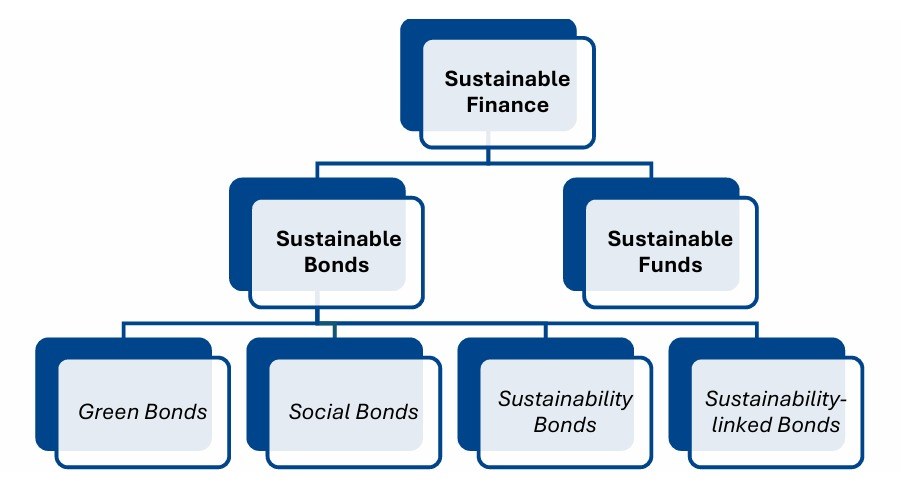
Sustainable finance refers to financial instruments and investment approaches that consider environmental, social, and governance (ESG) factors when allocating capital. In simple terms, it aims to directly fund activities that support climate goals, social development, and long-term economic stability.
At a broader level, the sustainable finance market is structured around two main components:
- Sustainable Bonds, where funds are raised specifically for environmental or social purposes, and
- Sustainable Funds, which integrate ESG considerations into investment decisions.
Among these two components, sustainable bonds have developed faster and currently account for the largest share of global sustainable finance activity. As a result, bond issuance trends provide the clearest view of how the market has evolved over time.
Sustainable Bond Issuance: From Rapid Growth to Stability
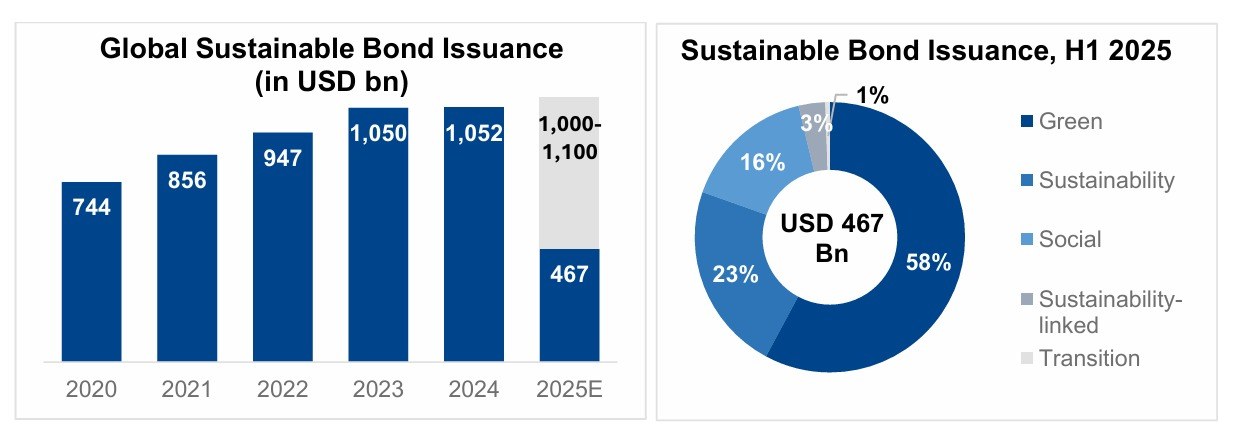
Global sustainable bond issuance grew rapidly between 2020 and 2022, supported by post-pandemic stimulus measures, large-scale fiscal programs, climate-related policy commitments, and strong investor demand.
From 2023 onward, issuance levels remained high, but the pace of growth slowed. According to the United Nations World Investment Report 2025, global sustainable bond issuance reached USD 1,052 Bn in 2024, broadly in line with 2023 levels. This moderation does not indicate weak demand. Instead, it reflects a mature market, where issuance decisions are increasingly shaped by strong disclosure standards, clear frameworks, and greater investor due diligence.
Recent data reinforces this pattern. According to ICE’s Sustainable Bond Report (H1 2025), sustainable bond issuance reached USD 467 Bn in the first half of 2025. Based on issuance levels in the first half of the year, full-year issuance in 2025 is projected to be in the range of USD 1.0–1.1 Tn, broadly in line with recent annual totals.
Overall, the data indicates that sustainable bonds have moved from being a niche financing tool to a regular feature of global capital markets, with future growth increasingly influenced by credibility, transparency, and framework quality rather than headline volumes.
Green Bonds: From Pricing Benefits to Trust-Based Demand
Within the sustainable bond universe, green bonds form the largest and most established segment. In 2024, they accounted for ~64% of total sustainable bond issuance, reflecting investor preference for instruments with clearly defined use of proceeds.
In earlier years, green bonds often benefited from a small pricing advantage, commonly referred to as the “greenium,” which allowed issuers to borrow at slightly lower costs. By the end of 2024, this advantage had narrowed significantly. In European markets, the yield difference between green and conventional bonds compressed to ~1 basis point.
As pricing benefits diminish, future issuance growth is becoming less dependent on cost advantages and more reliant on credibility factors. Clear taxonomy alignment, transparent reporting, and investor confidence now play a larger role in shaping the demand for green bonds.
Sector Allocation: Capital Focuses on Proven Areas
The allocation of green bond proceeds highlights where sustainable finance currently scales most effectively.
In 2024, ~72% of green bond proceeds were directed toward the energy, transport, and buildings sectors. These sectors benefit from well-defined eligibility criteria, established decarbonization pathways, and project-level outcomes that can be measured with relative confidence.
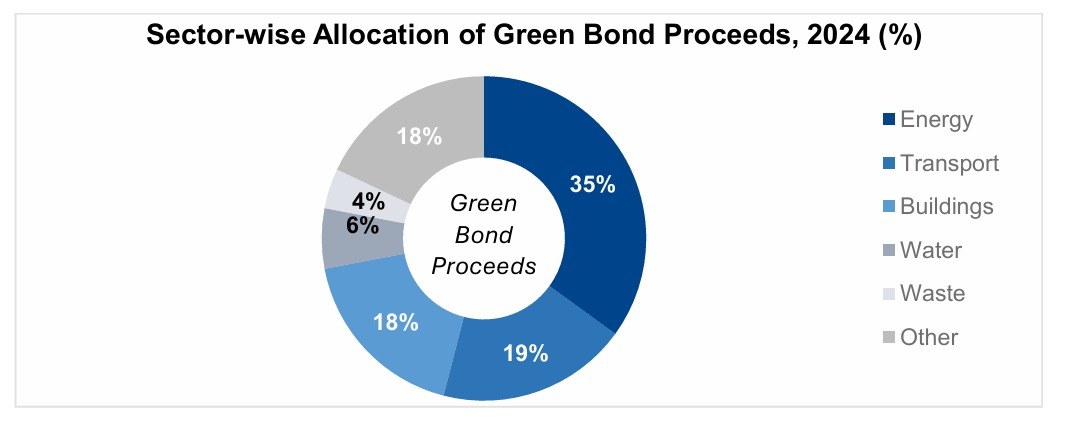
This concentration reflects a structural reality: sustainable finance flows readily to sectors where impact verification is straightforward. As capital increasingly targets harder-to-abate sectors, expectations around transition credibility, governance, and third-party verification are rising sharply.
Product Mix Rebalancing: Impact Over Promises
Beyond overall issuance volumes, changes in the product mix further illustrate the market’s shift toward credibility.
In 2024, sustainability bonds reached USD 206 billion, reflecting sustained demand for instruments with clear accountability and defined use of proceeds. Social bond issuance recovered steadily as markets normalized following pandemic-related programs.
In contrast, sustainability-linked bond (SLB) issuance declined sharply to USD 8 billion, the lowest since 2020. This contraction reflects growing investor discomfort with weak or poorly defined key performance indicators, inconsistent ambition levels, and limited penalties for missed targets.
As a result, investors are increasingly favoring instruments where impact is tied to funded projects rather than issuer-level promises. This rebalancing reinforces the broader market shift from narrative-driven claims toward measurable outcomes.
Sustainable Funds: Asset Growth with Slow Inflow
While sustainable bonds dominate issuance volumes, sustainable funds represent the second major channel through which capital is allocated.
In 2024, global sustainable fund assets under management reached ~USD 3.2 Tn, growing 8% year-on-year. This reflects the continued integration of ESG considerations into investment strategies.
Investor flows, however, tell a more cautious story. Net inflows, reflecting the difference between subscriptions and redemptions, declined to USD 37 Bn in 2024, more than 40% lower than in 2023, marking the third consecutive year of declining inflows. In the same period, sustainable funds recorded a median return of 0.8%, compared with 1.5% for traditional funds.
This divergence suggests that investors are becoming more selective, with performance considerations and clearer disclosure standards playing a greater role in allocation decisions.
Regional Trends: Regulation Drives Divergence
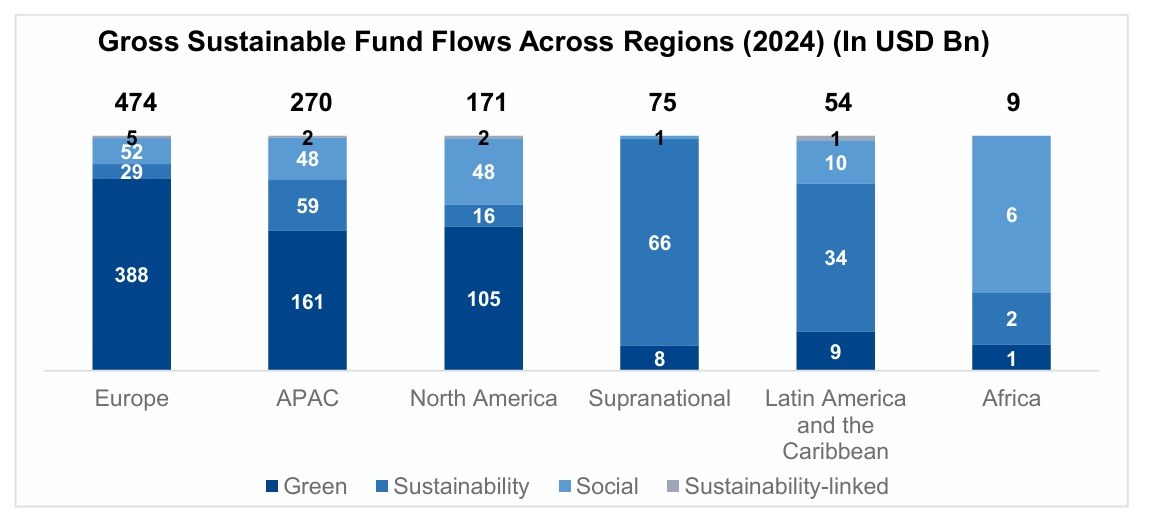
Regional patterns further illustrate how regulation is shaping outcomes in sustainable finance.
In 2024, Europe remained the dominant market for sustainable funds, while other regions showed subdued activity. It is important to note that regional figures reflect gross sustainable fund flows, which capture the geographic allocation of capital and are not directly comparable with global net inflow figures discussed earlier.
Regulatory developments are a key driver of this divergence. Europe introduced stricter ESG fund naming and disclosure requirements in December 2024, with implementation beginning in May 2025. While these measures aim to reduce greenwashing and improve market integrity, they have also prompted fund reclassification and consolidation, temporarily constraining flows.
Carbon Markets: Growth Limited by Quality Concerns
Alongside bonds and funds, carbon markets are increasingly interacting with sustainable finance through corporate climate strategies and emissions reduction commitments. However, challenges around quality and pricing continue to limit their scale.
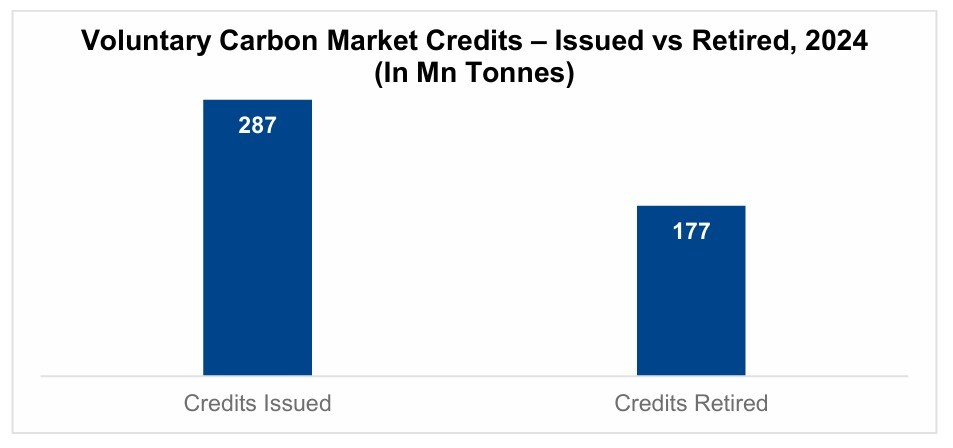
In voluntary carbon markets, 287 Mn tonnes of credits were issued in 2024, while only 177 Mn tonnes were retired. This imbalance points to oversupply and weak buyer confidence, highlighting the need for stronger standards and clearer demand signals.
Compliance markets have been expanding steadily. As of 2024, there were 36 emissions trading systems and 39 carbon tax schemes globally, covering ~24% of global greenhouse gas emissions. While coverage has been increasing, it remains insufficient to drive economy-wide emissions reductions on its own.
Outlook: A More Disciplined Phase Ahead
Sustainable finance has demonstrated its ability to scale. The next phase will be defined by whether it can scale credibly.
Three key themes are expected to shape this transition:
- Stronger taxonomies and verification, as growth increasingly depends on alignment with robust classification systems and transparent reporting
- Greater allocation discipline, with investors favoring fewer, higher-quality products over broad category expansion
- Market integrity, where trust, enforcement, and credible standards determine long-term participation
The future of sustainable finance will not be measured by how many instruments carry a sustainable label, but by how effectively capital supports real-world outcomes. In this more mature phase, credibility, not volume will define long-term leadership.

Rishika Kaushik
