
The Subcutaneous Shield: Why Switching Formats May Protect Less than Pharma Expects
Published on 27 Oct, 2026
As the biggest biologics approach loss of exclusivity, originators are moving patients to subcutaneous versions protected by newer patents. Keytruda, Opdivo, and Darzalex all follow this playbook. But the earlier precedent, the realities of combination therapy, and a new Medicare rule, suggest the shield is thinner than it looks. This thought piece examines where format switching holds, where it breaks, and what it means for originators, biosimilar developers, and payers.
Key findings
The evidence so far points to four shifts:
Format switching is now the default defense. Merck launched subcutaneous Keytruda at price parity with the IV version and aims to convert 30–40% of patients before biosimilars arrive. BMS and J&J have done the same with Opdivo and Darzalex: two drugs with combined 2025 sales of USD41 billion.
The precedent shows the shield wears thin. In the Netherlands, subcutaneous Herceptin peaked at a 50% share in 2017. By 2020, two years after biosimilars entered, it had fallen to 20%, as hospitals moved about 80% of treatments to cheaper IV biosimilars.
Combination therapy caps conversion. About 60–70% of Keytruda patients receive it alongside another IV medicine, so a faster injection saves scarce chair time. J&J converted about 85% of US Darzalex use, but Keytruda's ceiling is far lower.
Policy is closing the gap between formats. A proposed Medicare rule would treat subcutaneous and IV versions of the same drug as one product for price negotiation, calling format switching a form of evergreening.
1. The playbook: Change the format before the patent expires
The idea is simple. Before an IV biologic loses exclusivity, launch a subcutaneous version protected by newer patents, move as many patients as possible onto it, and leave biosimilars competing for a shrinking IV market.
Exhibit 1. The largest biologics facing biosimilars are all running the same play
| Product | Company | Subcutaneous version | What we know |
|---|---|---|---|
| Keytruda | Merck | Keytruda Qlex, using Alteogen's hyaluronidase | Priced at parity with IV. Merck targets 30–40% conversion; IV biosimilars expected from late 2028 |
| Opdivo | BMS | Opdivo Qvantig | Biosimilars of the IV version expected from December 2028 |
| Darzalex | J&J | Darzalex Faspro | 85% of US and 80% of European business converted by mid-2022 |
| Herceptin | Roche | Herceptin SC | The earlier precedent: launched ahead of biosimilars, with mixed results |
The commercial logic is strong. Keytruda generated USD31.7 billion in 2025, and its subcutaneous form carries patent protection reported to extend beyond 2030. A one-minute injection instead of an infusion of up to two hours also frees scarce chair time. In England, the NHS began rolling out subcutaneous Keytruda in May 2026 for the roughly 14,000 patients who start pembrolizumab each year.
The question is not whether the play makes sense but how much revenue it actually protects.
2. The precedent: What happened to Herceptin
Roche ran the same play with Herceptin in Europe, which makes it the best available test. A study of 73 Dutch hospitals tracked what happened once biosimilars arrived in June 2018.
Exhibit 2. Subcutaneous Herceptin held its share until a cheaper option appeared
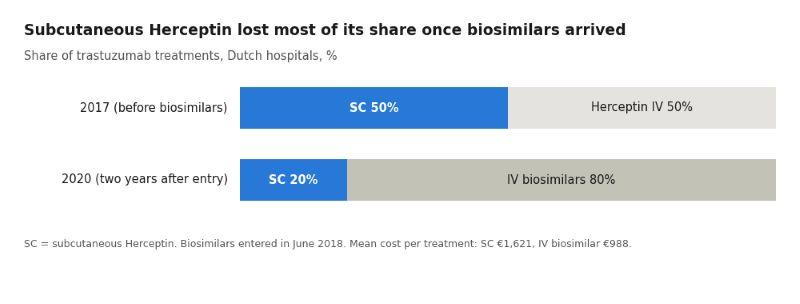
The subcutaneous version did its job in one sense: IV Herceptin entirely disappeared. But most of that volume went to IV biosimilars and not the protected format. By 2020, biosimilars and subcutaneous Herceptin accounted for about 80% and 20% of treatments, respectively.
The lesson is not that format switching fails. It is that the shield holds only as long as payers value convenience above a meaningful price gap, and in a budget-constrained hospital system, the gap was decisive.
3. Three cracks in the shield
Crack 1: Combination therapy caps conversion. A subcutaneous injection saves the most time when it replaces the whole infusion visit. About 60–70% of Keytruda patients receive it with another IV medicine, so the visit happens anyway, which is the reason why Merck targets only 30–40% conversion. Darzalex reached 85% conversion in the US, but it is a different clinical setting. The more a drug is used in IV combinations, the thinner its shield.
Crack 2: Payers follow price once a cheaper option is available. In the Dutch Herceptin case, a subcutaneous dose on average cost €1,621 against €988 for an IV biosimilar. Hospitals switched, and the authors estimated the format strategy had still added €28 million in costs, calling for "a more explicit societal debate" on whether the convenience is worth it. Keytruda Qlex is priced at parity with IV Keytruda today, so the gap will open only when IV biosimilars launch at a discount.
Crack 3: US policy is moving to treat formats as one drug. In June 2026, CMS proposed treating subcutaneous and IV versions of the same active drug as one product for Medicare price negotiation, explicitly to close an evergreening "loophole." Keytruda, Opdivo, and Darzalex are directly affected. CMS will announce the 2029 negotiation list by February 1, 2027, and analysts are unsure whether biosimilar entry in December 2028 will occur soon enough to keep the subcutaneous versions off it.
The payer's dilemma
For hospitals and payers, the cracks turn into a real choice.
Exhibit 3. Caption
| Factors | Lock in the branded subcutaneous version | Wait for IV biosimilars |
|---|---|---|
| What it gains | Faster administration and freed infusion capacity now | Lower drug prices once biosimilars launch |
| What it costs | Forgoes biosimilar savings for patients already converted | Infusion chair time, staffing, and patient time |
| Who it suits | Systems where infusion capacity is the binding constraint | Systems where drug budgets are the binding constraint |
| What to negotiate | Price commitments that track biosimilar prices after loss of exclusivity | Capacity planning and tender timing for biosimilar entry |
The Herceptin evidence suggests that in most budget-constrained systems, price wins once a credible cheaper option is available.
4. How biosimilar developers are responding
The pembrolizumab biosimilar race is crowded and moving fast. At least 13 companies have programs in development, all targeting the IV version (Pharmint).
Exhibit 4. Caption
| Developer | Program | Latest status |
|---|---|---|
| Formycon along with Zydus for the US and Canada markets | FYB206 | Pharmacokinetic equivalence with Keytruda reported in February 2026 |
| Samsung Bioepis | SB27 | Met primary endpoints in Phase 1 and Phase 3 in July 2026; filed in Korea in August 2026 |
| Celltrion | CT-P51 | US Phase 3 ongoing, primary completion expected February 2027; filed in Korea in August 2026 |
| Others | Amgen, Sandoz, mAbxience, Henlius, Bio-Thera, and others | Earlier stages |
No developer has yet disclosed a subcutaneous pembrolizumab biosimilar, and Keytruda Qlex is protected by its own patents. For now, the competitive answer is not to match the format but to beat it on price and target the 60–70% of patients who receive Keytruda alongside another IV drug. This is the segment where the subcutaneous version offers the least advantage and where an IV biosimilar has the clearest case.
Over time, we expect a second wave: biosimilar developers partnering for their own delivery technologies and payers asking whether a subcutaneous biosimilar can follow once the relevant patents allow.
5. What each group should do
Originators:
- Size the shield by usage pattern and not by headline sales. Estimate conversion separately for monotherapy and combination use. A drug mostly given with other IV medicines will protect far less revenue than one given alone.
- Plan for price convergence. Parity pricing works only until IV biosimilars launch at a discount. Decide in advance how far the subcutaneous price can move toward biosimilar levels without undermining the strategy.
- Build the value case beyond convenience. Payers will ask what the faster injection is worth. Quantified evidence on chair time, staffing, and patient time will matter more than the format.
- Model the US policy scenario. Run forecasts with and without the proposed Medicare rule treating both formats as one product.
Biosimilar developers:
- Target the combination segment first. Patients who receive the originator alongside another IV drug are the easiest to win.
- Compete on total cost per patient. Show payers the full cost of the branded subcutaneous version against the IV biosimilar, including administration.
- Prepare the second wave. Assess delivery technology partnerships and the patent path to a subcutaneous biosimilar.
Payers and hospitals:
- Identify the binding constraint. Decide whether infusion capacity or drug budget limits the system and choose the format strategy accordingly.
- Negotiate for the post-patent world now. Agreements on subcutaneous versions should include terms that track biosimilar prices once they launch.
- Avoid locking in by default. Converting patients before biosimilars arrive should be a deliberate choice and not a side effect of convenience.
6. What to watch out for
Exhibit 5: Caption
| Signal | Why it matters | What would change the picture |
|---|---|---|
| Keytruda Qlex conversion rate | Shows how much revenue the shield can hold | Conversion well above Merck's 30–40% target would strengthen the case |
| Medicare rule and the 2029 list | Decides whether format switching protects US pricing | The rule finalized, or Keytruda Qlex and Opdivo Qvantig selected by February 1, 2027 |
| First pembrolizumab biosimilar approvals and prices | Sets the price gap payers will weigh | Deep launch discounts in Europe would test parity pricing quickly |
| Payer tender terms in Europe | Shows whether systems lock in or wait | Tenders that link subcutaneous prices to biosimilar prices |
| Subcutaneous biosimilar programs | Signals the second wave of competition | A developer announcing a subcutaneous pembrolizumab or nivolumab program |
The bottom line
Moving patients to a subcutaneous version is a rational response to loss of exclusivity, and it works well for some products. But the shield is only as strong as three aspects: how often the drug is given alone, how long payers will pay for convenience once a cheaper option exists, and whether regulators treat the new format as a new product. For Keytruda, all three point to a thinner shield than the headline strategy suggests. Originators that plan for price convergence, biosimilar developers that target the combination segment, and payers that negotiate for the post-patent world now will be best placed when the IV patents expire.
