
What's Next After Memory Leadership? South Korea's Race to AI Infrastructure Dominance
Published on 03 Jul, 2026

The AI era is redefining semiconductor leadership. For South Korea, the opportunity extends beyond memory leadership to becoming one of the foundational infrastructure hubs powering the global AI economy.
In 2026, the world's largest hyperscalers — Amazon, Alphabet, Meta, and Microsoft — are collectively deploying an estimated USD 600+ billion in capital expenditure, with the dominant share flowing into AI data centers, compute infrastructure, and the chips that power them. Underlying every GPU cluster and AI model running at scale is a memory and packaging supply chain which runs, in large part, through South Korea. This is not incidental.
Long before AI became the defining technology race, South Korea had secured a commanding position in the parts of the semiconductor value chain that AI now depends on most: high-bandwidth memory (HBM), advanced packaging, and memory manufacturing. What is changing now is the context: AI has permanently altered what semiconductors are for, who needs them, and at what scale. South Korea is responding, and the scale of that response is significant.
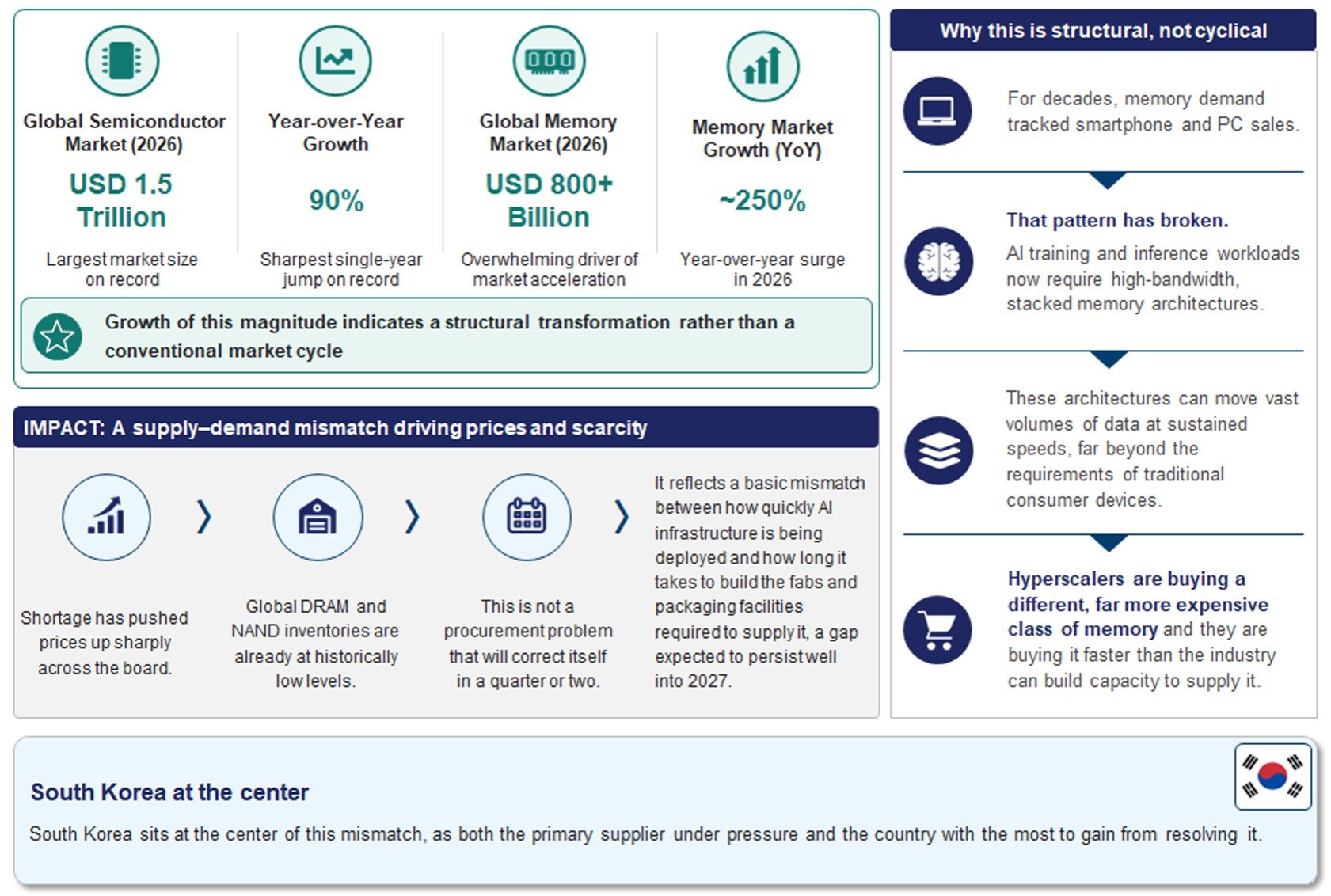
A Market in Structural Shift, Not a Cyclical Upswing
The AI Semiconductor Belt: Building an Ecosystem, Not Just Capacity
South Korea's response to this structural opportunity involves designing an ecosystem, not just individual factory expansions.
The Yongin Semiconductor Cluster, which is to serve as a key anchor of the South Korean strategy, is already in development, with SK Hynix's first plant expected to come online in 2027. But the more consequential development is what is being planned beyond Yongin. Under South Korea's newly announced semiconductor initiative, Samsung Electronics and SK Hynix will each establish two large-scale semiconductor fabrication facilities in the country's southwest, together underpinning an ~USD 520 billion AI semiconductor ecosystem spanning manufacturing, advanced packaging, and supporting infrastructure. Samsung has separately outlined domestic investments extending to ~USD 1.6 trillion through 2040, including ~USD 1.4 trillion dedicated to its Yongin and Pyeongtaek semiconductor clusters, and ~USD 260 billion for new fabrication facilities in Gwangju.
The deliberate integration of capabilities, including fabs, advanced packaging, AI data centers, and supplier ecosystems, is not merely a matter of logistical convenience. It is the creation of an industrial architecture designed to reduce interdependencies, accelerate technology iteration, and create practically irreplicable ecosystem depth. A semiconductor factory typically takes around seven years from site selection to production. With SK Hynix's first Yongin fab expected to come online in 2027 and Samsung continuing to expand capacity across its Pyeongtaek and Yongin campuses through the decade, the industry has already recognized that the next generation of semiconductor sites must be planned now, because the timeline to meet AI-era demand is already narrowing faster than plans can be drawn.
What distinguishes this from prior investment cycles is the breadth of what is being built. The planned facilities are not purely fab expansions, but integrate AI data center capacity directly into the semiconductor cluster. This results in South Korea hosting both the chips that feed AI and part of its infrastructure.
Policy Impact: Korea's Structural Advantage in the Global Chips Race
Every major economy is now running a semiconductor industrial policy. Through the CHIPS and Science Act, the US has committed over USD 30 billion in direct funding to several semiconductor leaders, with TSMC, Samsung, and Micron anchoring efforts to localize advanced-node logic and memory production within the country. Japan has unveiled a growth strategy targeting over USD 2.54 trillion in strategic industries by 2040, with over USD 450 billion allocated specifically to semiconductors. The EU has approved around USD 36 billion in state aid decisions under the European Chips Act framework. This aid is provided through member-state subsidies for semiconductor manufacturing, though execution remains uneven across the bloc.
South Korea's position in this race is structurally different from its peers, as it does not need to build capability from scratch. The government's ~USD 456 billion semiconductor blueprint targets 10 new fabs by 2047, raising production capacity to 7.9 million 200-millimeter-equivalent wafers per month. Within this, targeted R&D allocations include ~USD 827 million for AI chip development, ~USD 235 million for advanced packaging technologies, and USD 141 million for next-generation memory, all aimed at expanding beyond memory fabrication into AI processor and system semiconductor manufacturing. Additionally, South Korea's K-Chips Act, passed in 2023, offers R&D tax credits of 30–40% for large enterprises, one of the most competitive incentive structures for semiconductor investment globally.
The government's 2026 budget includes ~USD 7 billion earmarked for AI-related investments, spanning manufacturing infrastructure, research, and talent. Amazon Web Services has separately committed to investing approximately USD 5 billion in South Korea by 2031, adding AI cloud infrastructure alongside the domestic manufacturing push. What Korea brings to the global chips race that is difficult to replicate is a combination of existing major companies, proven manufacturing know-how, and policy that is accelerating and co-investing.
The Race Is On, But So Are the Constraints
While South Korea's strategy is ambitious, scaling AI infrastructure at this pace will test execution as much as capital.
A single leading-edge semiconductor fab takes five to seven years to become operational and requires reliable access to extra-high-voltage power, hundreds of thousands of tons of industrial water daily, and a dense ecosystem of suppliers and skilled engineers. As new investments expand into regions such as Honam, these supporting systems will need to scale at the same pace as the fabs themselves — a far harder problem than building the factories alone.
Competition is intensifying on multiple fronts at once. China's CXMT continues to expand its memory ambitions and has been actively recruiting semiconductor talent from South Korea, while the United States, Japan, and Europe are all accelerating domestic chip manufacturing through their large-scale industrial incentives. Closer to home, South Korea's USD 520 million on-device AI chip program faces the unique challenge of commercial adoption of its resultant technologies.
Aranca's Perspective
The AI era is reshaping the foundations of semiconductor leadership. For decades, competitive advantage was largely determined by manufacturing scale, process technology, and market share. Increasingly, it will be shaped by something broader: the ability to build integrated ecosystems that combine advanced memory, packaging, AI chips, manufacturing capacity, digital infrastructure, talent, and policy into a platform capable of supporting AI on a global scale.
South Korea enters this transition with a combination of strengths that few countries can replicate. Its leadership in memory has provided a powerful foundation, but the current wave of investments suggests a larger ambition—to extend that leadership across the AI infrastructure value chain rather than solely a single segment.
Whether this becomes South Korea's next semiconductor supercycle will be determined not only by the size of today's investments, but by how effectively they reshape the country's role in the global technology ecosystem. If executed successfully, the next decade will be remembered as the period when South Korea not only strengthened its position in memory, but evolved from a semiconductor leader into a foundational infrastructure hub powering the global AI economy.
