
Key Trends in Private Equity Fundraising – Q3 2026
Published on 19 Nov, 2026

Private equity fundraising continues to evolve amid changing investor priorities and market conditions. The September 2026 edition of the Global Private Equity Fundraising Report examines how these shifts are reflected in capital raised across fund sizes, regions, and investment strategies, alongside trends in fundraising during YTD September 2026. This analysis provides a view of the factors influencing fund formation and the considerations likely to shape fundraising activity in the coming months.
Summary
Fundraising Remains Selective: PE firms raised USD 540 Bn across 768 deals in YTD September 2026, with fundraising activity remaining concentrated within established fund platforms amid continued emphasis on investor liquidity and realized returns.
Capital Concentrated in Larger Funds: Funds above USD 1 Bn accounted for nearly 80% of capital raised, with the single largest USD 1–5 Bn segment increasing its share to 43% from 41% in 2025. This points to the continued importance of scale and established fundraising platforms, while the relative resilience of the USD 1–5 Bn segment suggests that capital concentration is not limited to the largest mega funds.
North America Retains Its Fundraising Lead: North America accounted for 62% of capital raised in YTD September 2026, retaining its position as the leading fundraising region. Compared to full year 2025, Europe’s share declined to 23% from 30%, while Asia’s share increased to 12% from 7%; other regions contributed a small share. Although Asia gained ground, the overall distribution remained centered on North America.
Buyout Strategies Account for a Larger Share: Buyout funds accounted for 88% of capital raised in YTD September 2026, up from 79% in 2025, while growth and expansion funds’ share declined to 11% from 16% during full year 2025. Diversified private equity and restructuring/turnaround strategies contributed less than 1%, further concentrating fundraising in buyouts. This pattern is broadly consistent with LPs’ focus on established strategies and managers with demonstrable investment performance and exit histories.
Fundraising Duration Edges Lower: The average time to close a fund shortened to 13 months in YTD September 2026, compared with 14 months in 2025. While this indicates a modest reduction in fundraising timelines, outcomes may vary depending on the mix of funds reaching a close. We believe fundraising timelines may remain longer for less-established managers, while those with a proven history of performance and capital returns are typically better placed to attract investor commitments.
PE Fundraising Activity
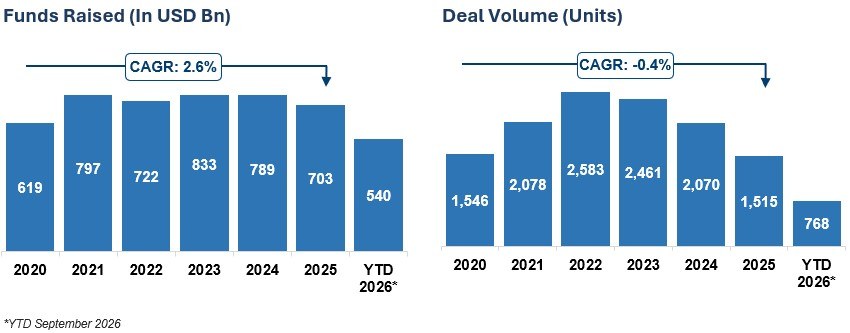
PE firms raised USD 540 Bn across 768 deals in YTD September 2026, reflecting continued capital formation amid a selective fundraising environment. However, subdued distributions from existing portfolios continue to constrain limited partners’ (LPs) capacity to make new commitments. With liquidity remaining a key consideration, investors are placing greater emphasis on realized returns and fund managers’ ability to convert portfolio value into cash through exits. Consequently, managers with a demonstrated history of capital returns and consistent execution are better positioned to attract fresh commitments.
Industry research indicates that LPs remain committed to private markets, but are increasingly prioritizing established managers with proven performance, clear investment strategies, and credible exit pathways. This raises the bar for fund managers seeking new capital, particularly those without a well-established history.
PE Fundraising by Fund Size
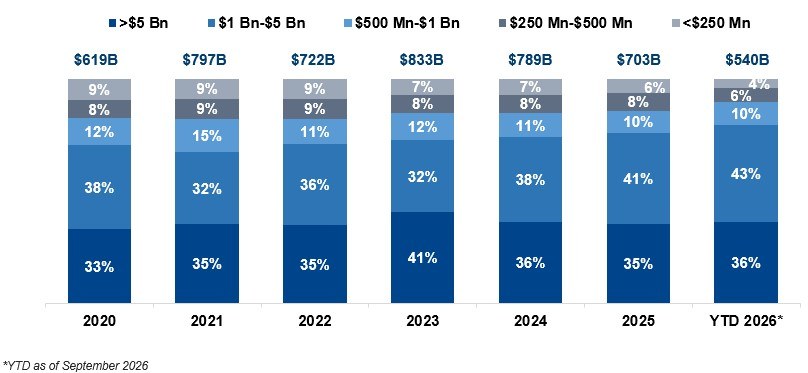
Funds above USD 1 Bn accounted for 80% of capital raised in YTD September 2026, highlighting the importance of scale, established LP relationships, and proven performance in securing commitments. While larger platforms continued to attract significant capital, the increased share of funds sized USD 1–5 Bn indicates that established mid-to-large managers also remain well positioned.
This is consistent with broader industry commentary on LPs’ preference for managers with specialist capabilities, differentiated strategies, and a demonstrable record of exits. For smaller and emerging managers, these factors raise the bar for attracting capital, making a focused investment proposition and credible history increasingly important.
The shift in fundraising share toward the USD 1–5 Bn segment does not necessarily indicate a move away from larger funds. The timing of a few large fund closings can materially influence the overall fundraising mix, making the distinction between changes in relative share and absolute capital raised important. The current trend therefore points to a stronger contribution from mid-to-large funds rather than a broad-based shift toward smaller fund vehicles.
PE Fundraising by Region
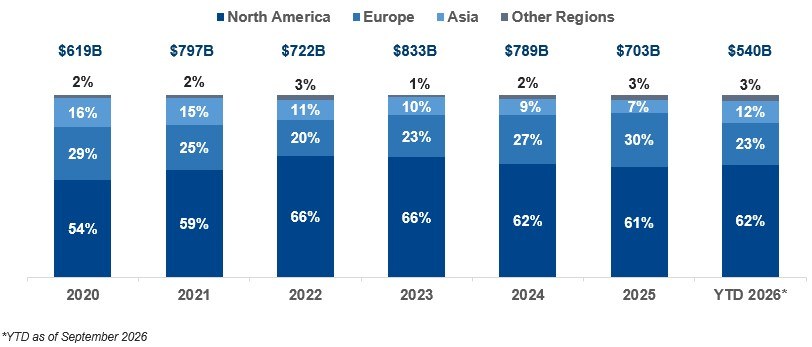
North America accounted for 62% of capital raised in YTD September 2026, maintaining its position as the leading fundraising region. Europe's share declined to 23% from 30% in 2025, while Asia's increased to 12% from 7% in 2025.
North America's continued dominance in global PE fundraising reflects the depth of its private equity ecosystem, established institutional investor base, and concentration of large fund platforms. These structural advantages support its ability to attract significant capital, even as LPs remain selective about new commitments.
In contrast, Europe's lower fundraising share reflects both a more challenging fundraising environment and the cyclical nature of large fund closings. Several flagship buyout funds completed fundraising in 2023 and 2024, creating a high base for comparison, while subdued exit activity and slower capital distributions have further constrained new commitments.
Asia's increased share points to a stronger contribution to global fundraising, although the region continues to face challenges from geopolitical uncertainty and more cautious allocations to China-focused strategies. The shift also highlights the importance of regional diversification as investors assess opportunities beyond established markets.
For general partners (GPs), these dynamics underscore the need to align fundraising strategies with regional investor preferences and liquidity conditions. For LPs, regional allocation decisions increasingly require considering market maturity, exit opportunities, and the ability of fund managers to generate and realize returns, rather than fundraising momentum alone.
PE Fundraising by Fund Type
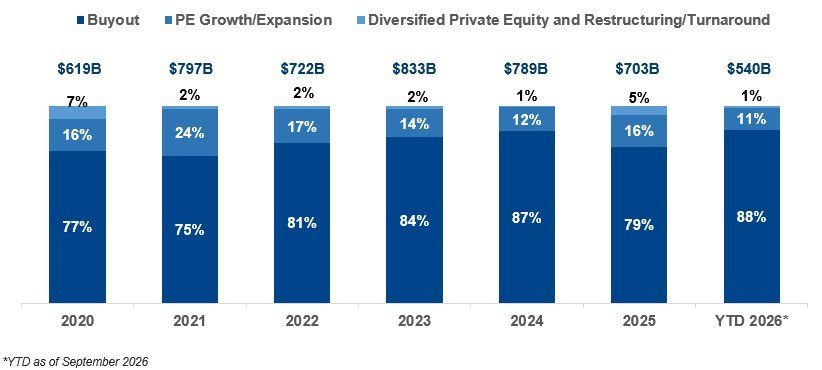
The growing share of buyout fundraising (88% share of the total capital raised) reflects the importance of control-oriented investment strategies in a return environment where multiple expansion and inexpensive leverage are less dependable sources of returns. Thus, the emphasis on operational improvements, disciplined underwriting, and active portfolio management to drive value creation is increasing. While these capabilities can support a clearer investment thesis and greater control over portfolio outcomes, they do not eliminate execution or exit risks.
Consequently, GPs are under greater pressure to demonstrate their ability to improve portfolio company performance and deliver realized returns, making established managers with credible exit track-records better positioned to attract LP commitments.
The reduced share of growth and expansion funds points to a more selective allocation environment, with investors placing greater scrutiny on growth assumptions, valuations, and exit visibility. Similarly, the limited contribution from diversified private equity and restructuring/turnaround strategies underscores the growing concentration of fundraising in buyout vehicles. These strategies accounted for a smaller proportion of overall capital raised, indicating a shift away from investing in underperforming companies and improving their operations over time.
For fund managers, this pattern reinforces the importance of demonstrating clear value-creation capabilities and credible exit strategies, while LPs are increasingly distinguishing between managers based on their ability to translate investment performance into realized returns.
PE Fundraising Duration (Months)
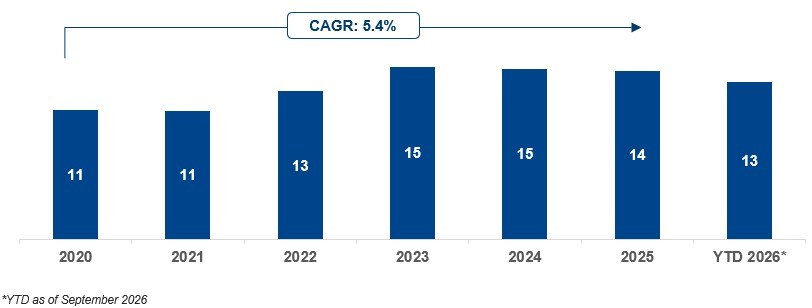
The average time to close a fund shortened to 13 months in YTD September 2026, compared with 14 months in 2025. This modest reduction may reflect a combination of improving fundraising conditions for established managers and the composition of funds reaching a final close, particularly the contribution of larger fund platforms.
Fundraising outcomes remain broadly differentiated by fund manager performance and access to LP relationships. Fund managers with demonstrated realized returns, a history of capital distributions, and established investor relationships are better positioned to secure commitments, while those with less-established histories may face longer fundraising cycles as they work to build investor confidence.
Consequently, the shorter average duration may coexist with continued challenges for a wider segment of the market. For GPs, this reinforces the importance of demonstrating a credible history and maintaining strong LP relationships to secure commitments within a more selective fundraising environment.
Top PE Funds
| Largest PE Funds Closed in YTD Sep 2026 (By Fund Size) | ||||
|---|---|---|---|---|
| Fund Name | Fund Manager | Fund Size (USD Bn) |
Region Focus | Fund Close Date |
| KKR North America Fund XIV | Kohlberg Kravis Roberts | 23.0 | North America | 02-Apr-2026 |
| Baring Asia Private Equity Fund IX | EQT, EQT Private Capital Asia | 15.6 | Asia-Pacific | 20-Apr-2026 |
| TPG Rise Climate II | The Rise Fund, TPG | 10.0 | Multi-Region | 30-Sep-2026 |
| Triton Fund VI | Triton Partners | 6.5 | Europe | 31-Jan-2026 |
| 26N Private Equity Partners I | 26North Partners | 5.9 | Europe | 13-Apr-2026 |
| Patient Square Equity Partners II | Patient Square Capital | 4.4 | Multi-Region | 09-May-2026 |
| Court Square Capital Partners V | Court Square | 3.8 | North America | 01-Apr-2026 |
| CVC Catalyst III | CVC Capital Partners | 3.4 | Multi-Region | 06-Jul-2026 |
| Warburg Pincus Financial Sector III | Warburg Pincus | 3.0 | Multi-Region | 07-Jan-2026 |
| Warren Equity Partners Fund V | Warren Equity Partners | 2.8 | North America | 13-Jul-2026 |
| Lightyear Fund VI | Lightyear Capital | 2.5 | North America | 14-Apr-2026 |
| BV Investment Partners Fund XII | BV Investment Partners | 2.5 | North America | 06-Jan-2026 |
| New Mountain Azuria Continuation Fund | New Mountain Capital | 2.4 | North America | 23-Apr-2026 |
| Cerberus Capital Subsea Communications Continuation Fund | Cerberus Capital Management | 2.3 | North America | 20-Apr-2026 |
| Constellation Generation V | Wafra, Capital Constellation | 2.0 | Multi-Region | 14-Jul-2026 |
Outlook
Private equity fundraising is likely to remain selective as LPs balance their strategic asset class allocations with liquidity requirements. A recovery in dealmaking and exit activity could support distributions, although the build-up of older portfolio assets and longer holding periods may delay a broader improvement in cash returned to investors. Until distributions become more consistent, LPs are likely to continue emphasizing realized returns, DPI, and GPs’ ability to convert portfolio value into cash. Secondary transactions and continuation vehicles will remain important liquidity mechanisms, increasing the need for transparent valuations, sound governance, and alignment between existing and incoming investors.
Fundraising is also likely to remain concentrated within established managers and larger platforms, supported by their long-standing LP relationships, broader product offerings, and established records across market cycles. However, opportunities will remain for smaller and specialist managers that can demonstrate differentiated investment strategies and repeatable value-creation capabilities. While the current fundraising mix highlights the importance of funds above USD 1 Bn in aggregate capital formation, the ability to establish a clear investment proposition will remain important across segments.
Regional fundraising patterns will continue to be influenced by the maturity of local private equity markets, institutional investor appetite, and the availability of exit opportunities. North America is likely to remain an important source of global fundraising, although the timing of flagship fund closings may influence its share. Europe's lower contribution and Asia's increased share warrant monitoring, but their persistence will depend on future fund closings, LP allocation decisions, and the pace of regional distributions. These developments will be important in determining whether the current regional movements represent sustained changes in fundraising patterns.
For GPs, securing commitments will increasingly depend on demonstrating return generation in an environment where leverage and valuation multiple expansion are less reliable sources of value creation. Disciplined underwriting, active portfolio management, operational improvements, and credible exit pathways will remain central to investor evaluation. Meanwhile, LPs will need to balance liquidity requirements with access to managers and strategies capable of delivering differentiated long-term returns.

Deepak Rajput
