
Premiumization in India – How foreign markets are looking at India as a premium market
Published on 16 Oct, 2026
India’s consumption narrative is undergoing a structural shift from a market historically defined by affordability and scale to one increasingly driven by value and aspiration. While price sensitivity remains embedded in consumer behavior, a growing segment of Indian consumers is demonstrating a clear willingness to trade up for better quality, enhanced functionality, and stronger brand associations. This transition is not simply a result of higher incomes. Greater exposure to global brands, digital platforms, travel, and changing lifestyles is also influencing what consumers consider worth paying for. As a result, India is no longer just a volume play; it is emerging as a critical market for premium growth, prompting global companies to rethink their long-standing strategies centered on cost and penetration.
For years, global companies mainly approached India with affordability and scale in mind, building portfolios around products that could reach a large, price-conscious consumer base. Strategies were built around affordability, with product portfolios often skewed toward entry-level offerings.
This narrative is now changing. Today, India is increasingly being seen as not just a mass consumption market but a market where consumers are willing and increasingly able to pay more for better products. The shift is subtle in some categories and more pronounced in others, but the direction is clear: India is moving toward a more value-oriented consumption model, where quality, experience, and brand play a larger role than before.
For global companies, this is prompting a rethink. The question is no longer just how to win volume in India but how to capture value through premiumization.
A changing consumer mindset
One of the biggest reasons this shift is gaining momentum is the sheer scale of India’s consumption story.
As per Deloitte India and Retailers Association of India, India’s household consumption reached ~$2.1 trillion in 2024, having nearly doubled over the past decade, and is expected to continue expanding rapidly.
At the same time, the middle class is expanding at an unprecedented pace. ESSEC Business School suggests it could reach ~580 million people by 2030, making it the primary engine of consumption growth.
Looking further ahead, middle- and high-income households are expected to account for over 50% of the total consumption and drive the majority of incremental spending.
A larger and more affluent consumer base creates more room for premium products to scale beyond a narrow luxury audience.
From a need-based to an aspiration-led consumption
What is changing is not just income levels but the mindset behind consumption. Indian consumers today are far more exposed to global products, trends, and lifestyles than they were a decade ago. Digital platforms, travel, and social media have reshaped expectations.
As incomes rise, spending is shifting from essentials to discretionary categories. As per Franklin Templeton’s 2025 analysis, the share of non-essential consumption in India is expected to increase from ~36% to ~43% by 2030, reflecting a clear move toward premium and lifestyle spending.
This is where premiumization takes root: not as a luxury phenomenon but as a gradual shift in how consumers define value.
The rise of “affordable premium”
India’s premiumization is being driven less by luxury and more by “affordable premium” products that bridge the gap between mass and luxury. These offerings provide an upgrade in quality, design, or experience while remaining accessible to a much larger consumer base. This is why premiumization is visible in not just high-end segments but across everyday categories, from food and beverages to personal care and apparel.
Even in traditionally price-sensitive markets, the shift is evident. For instance, in India’s FMCG sector, companies are seeing premium products grow faster than mass segments, indicating a structural change rather than a short-term trend.
Premiumization across sectors
The trend is no longer confined to a few categories. It is visible across the economy:
- In food and beverages, consumers are moving toward healthier, functional, and higher-quality products. Reliance Consumer Products entered the functional beverage segment in August 2025 through a majority stake in Naturedge Beverages, adding Shunya (a zero-sugar, zero-calorie herbal-functional drink) to its portfolio.
- Global beauty players are increasingly betting on India’s premium skincare opportunity. La Roche-Posay entered India through Nykaa in November 2025, while Amazon added 100+ premium beauty brands in 2026, including La Roche-Posay, CeraVe, Avène, Eucerin, and Paula’s Choice, with premium beauty sales on the platform growing 50% YoY.
- In alcoholic beverages, premium segments are rapidly expanding. Premium beer volumes, for instance, have grown significantly faster than the overall market.
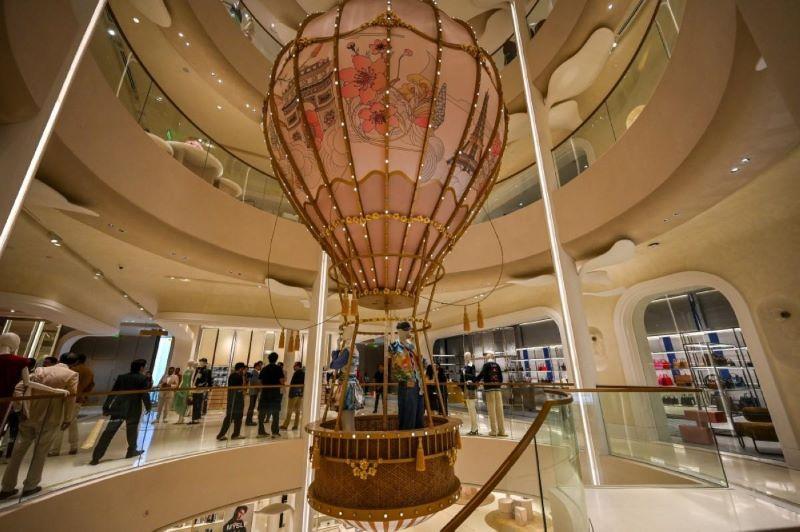
- In luxury and retail, mid-premium brands are aggressively expanding to tap aspirational consumers. In November 2025, Galeries Lafayette opened a 90,000 sq. ft. flagship store in Mumbai with 250+ brands. Trent is rapidly expanding Zudio into smaller cities; more than 75% of the new stores opened in the nine months since December 2025 were outside metros.
Importantly, this shift is not limited to metros. Retailers are expanding into new cities, while premium brands are using e-commerce and modern retail to reach a broader aspirational consumer base. CBRE notes that India’s retail leasing reached a record ~8.9 million sq. ft. in 2025, supported by expansion from domestic and global retailers.
Balancing opportunity with reality
Despite the strong momentum, India’s premiumization story is not without complexity. Consumption remains uneven. A large portion of the population is still highly price-sensitive, and in some segments, mass demand continues to lag.
This creates a dual-speed market:
- A premium segment growing rapidly in value
- A mass segment that remains volume-driven and price-conscious
For companies, this means premiumization cannot be pursued in isolation. It must be balanced with affordability and accessibility.
Aranca’s take
India’s evolution into the premium consumption market is not a sudden shift. It is the result of structural changes in income, demographics, and consumer behavior. What was once a market defined primarily by cost is increasingly being shaped by aspiration, quality, and experience. For global companies, this changes the conversation. India is no longer just a volume-driven market; it is increasingly a value-driven opportunity, emerging as one of the most compelling premium growth markets globally.
