
Paying for Certainty: How the Patent Cliff Playbook is Thinning Pharma's Future Pipeline
Published on 27 Oct, 2026

More than USD 300 billion in branded drug revenue will lose exclusivity by 2030, and big pharma is filling the gap on two tracks: paying full price for late-stage certainty and buying early assets as low-cost options. As capital moves to both ends, the Western early-stage pipeline in between is thinning. This thought piece examines what that means for the late-stage assets buyers will need next, and what it will take to manage the risk.
Key findings
The evidence so far points to four shifts:
Buyers are paying in full for certainty. Biopharma M&A reached USD 96 billion in upfront value across 80 deals in the first half of 2026, skewed toward Phase II, Phase III, and approved assets. The median approved-stage target was valued at USD 7.3 billion.
Early assets are being bought as options. Announced licensing value reached USD 166.7 billion in the same period, but only 6% was paid upfront. China-origin assets made up 42% of big pharma deals with USD 50 million or more upfront.
The early-stage pipeline is thinning. Seed and Series A financing fell to its lowest first-half round count in a decade in 2026, even as total venture investment rose 22%. Fewer Western start-ups funded today means fewer Western Phase II and Phase III targets later.
Future supply is shifting to China, and so is the risk. China's share of licensing deals rose from 3% in 2020 to 28% in 2025. As more late-stage assets trace back to Chinese originators, the late-stage track depends on the source most exposed to US policy. Meanwhile, MFN pricing weighs on late-stage valuations from the other side.
1. Patent cliff sets the clock
The late-2020s patent cliff is the largest the industry has faced. Evaluate estimates that more than USD 300 billion in global prescription drug revenue will lose exclusivity between 2025 and 2030. GlobalData puts US exposure alone above USD 230 billion.
The exposure is concentrated in a few franchises, and it clusters in the second half of the decade.
Exhibit 1. A handful of franchises carry much of the exposure
| Product | Company | Expected loss of exclusivity | Scale |
|---|---|---|---|
| Keytruda | Merck | 2028 to 2029 | USD 31.7 billion in 2025 sales |
| Eliquis | BMS and Pfizer | 2026 to 2028, varying by market | Over USD 13 billion for BMS and USD 7.4 billion for Pfizer in 2024 |
| Opdivo | BMS | 2028 | BMS's largest immuno-oncology product |
| Cosentyx | Novartis | 2029 (US) | Novartis's leading immunology product |
| Darzalex | J&J and Genmab | 2029 to 2031 | J&J's leading oncology franchise |
The timing matters more than the total. A molecule discovered in-house today will not reach the market before most of these products lose protection. For the companies most exposed, the gap now has to be bought or licensed. The question is no longer whether to deal, but how to structure the deals.
2. Two tracks in the numbers
The 2026 deal record shows buyers spending at both ends of the development curve.
- Late stage, paid in full. Biopharma M&A reached USD 96 billion in upfront value across 80 deals in the first half of 2026, skewed toward Phase II, Phase III, and approved targets. The median approved-stage target was valued at USD 7.3 billion. As recently as 2024, more than half of the deals targeted Phase I or earlier programs.
- Early stage, bought as options. Announced licensing value reached USD 166.7 billion, but only 6% was paid upfront. China-origin assets made up 42% of big pharma deals with USD 50 million or more upfront, and the largest were multi-program platforms such as AstraZeneca/CSPC (USD 18.5 billion total, USD 1.2 billion upfront).
- The middle, underfunded. Seed and Series A financing fell 15% YoY to USD 4.4 billion, with the fewest first-half rounds in a decade.
Exhibit 2. Late-stage acquisitions rose while early-stage financing fell
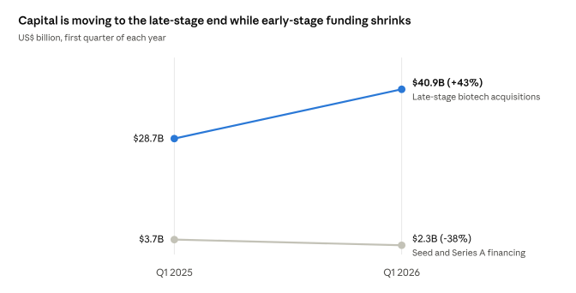
Investors cite a preference for companies with established data packages, de-risked development, and nearer-term catalysts. That preference mirrors what acquirers are paying for.
3. Two-track playbook
Together, these patterns describe a two-track playbook. Buyers pay a premium for assets that have already answered the hard clinical questions and pay little upfront for the right to own assets that have not.
Exhibit 3. Two tracks, two kinds of risk, and a thinning middle
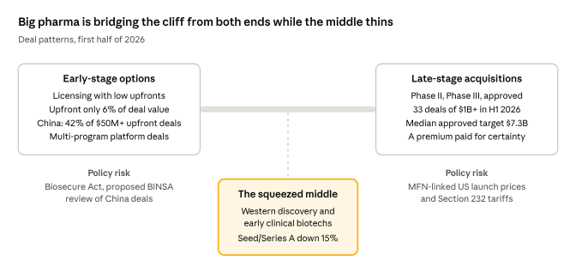
Exhibit 4. How the main deal structures compare
| Structure | Typical stage | Upfront cost | What the buyer gets | Main risk |
|---|---|---|---|---|
| Late-stage acquisition | Phase II to approved | High: full company value | Near-term revenue to fill a specific gap | Overpaying, now compounded by MFN-linked pricing |
| Single-asset license with milestones | Phase I to II | Low: a small share of headline value | Rights to an asset, with payments tied to progress | Attrition before milestones pay off |
| Multi-program platform deal | Discovery to Phase I | Low relative to total value | Options on several programs from one partner | Concentration, particularly where policy may restrict China deals |
| NewCo built on licensed assets | Phase I to II | Shared with investors | An asset in a separately funded company; Kailera, built on four obesity assets licensed from Jiangsu Hengrui in 2024, raised USD 625 million in its April 2026 IPO | Execution and follow-on financing |
Each of these structures is rational on its own terms. The issue arises when they are added up across the industry.
4. Blind spot: strategy erodes its own supply
The two-track playbook works for each buyer individually. Across the industry, it sets up a loop that narrows the supply of the very assets buyers value most.
Exhibit 5. A reinforcing loop that shifts future supply toward China
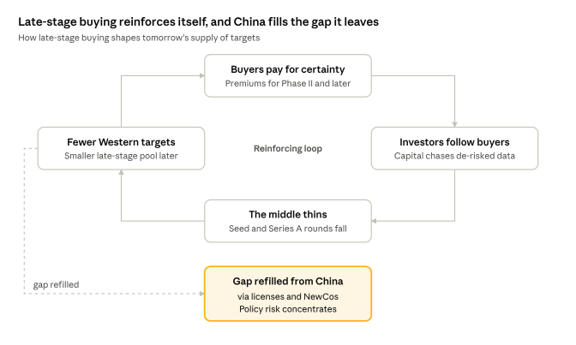
How the loop works. Acquirers pay most for clinical validation: 68% of M&A transactions now target assets in Phase II or later. Investors follow that demand, prioritizing "later-stage companies with established data packages, de-risked development paths, and nearer-term catalysts". The result is that seed and Series A rounds fell to a 10-year first-half low in 2026, even as total venture investment rose 22%. Today's seed and Series A companies will form the pool of tomorrow's Phase II and Phase III targets. A thinner cohort now means fewer Western late-stage targets later.
Who fills the gap. China's share of licensing deals rose from 3% in 2020 to 28% in 2025. NewCos such as Kailera, built on obesity assets licensed from Jiangsu Hengrui, now carry Chinese molecules into Western capital markets. More of tomorrow's late-stage targets are therefore likely to trace back to Chinese originators.
Why it matters. The late-stage track appears to be the safer option. In practice, it increasingly depends on the early-stage China pipeline, which is the part most exposed to US policy. A restriction on China deals would not only hit early options. With a lag, it would also shrink the pool of late-stage assets available to buy and could push premiums for the remaining Western assets higher.
5. Different policy risk at each end
The two-track playbook was built for a world of free US launch pricing and open cross-border licensing. Both assumptions are now under pressure, and each one hits a different track.
At the late-stage end, MFN changes the price of certainty. Section 232 tariffs of up to 100% now apply to imported patented medicines, and companies avoid them through MFN pricing and onshoring agreements. MFN agreements extend to future launches, so an acquirer of an approved or Phase III asset is now buying a US price that may be tied to prices in other wealthy countries. Valuation models built on unconstrained US launch pricing need a second scenario.
At the early-stage end, China licensing carries rising political risk. The Biosecure Act became law in December 2025, while the proposed Biotech Investment National Security Act (BINSA) would subject licensing deals, joint ventures, and equity investments in Chinese biotech to Treasury review. A buyer that sources a large share of its early pipeline from China is concentrating policy risk in one place.
Across both ends, ex-US rights are worth less to give away. Under MFN, a partner's low price in a reference market can lower what the licensor earns in the US. Regional out-licensing, once a simple way to share costs, now needs pricing governance written into the deal.
These risks are unrelated, so they do not hedge each other. And because of the loop in Exhibit 5, a shock at the early end would reach the late end too, only later.
6. Implication for buyers and sellers
For big pharma business development teams
The two tracks work only if they are managed as one portfolio, not as separate M&A and licensing pipelines.
| Move | What it means in practice |
|---|---|
| 1. Size each end to the gap | Map the revenue gap by year and decide how much late-stage M&A and how many early options each year requires, given typical attrition |
| 2. Price policy in every model | Run each late-stage valuation under at least two US pricing scenarios, with and without MFN-linked launch prices |
| 3. Cap concentration on the China track | Set a ceiling on the share of the early pipeline sourced from any one jurisdiction, and keep a Western or partner-built alternative for key mechanisms |
| 4. Keep control of ex-US pricing | Write pricing governance and transfer-price terms into regional out-licenses so a partner's price cannot erode US value |
| 5. Build an option-exercise discipline | Define in advance the data that triggers exercise, expansion, or exit for each licensed asset, so low upfronts do not become a drawer of unmanaged options |
| 6. Keep the middle alive | Use corporate ventures, seed-stage options, and academic partnerships to fund a pipeline of Western early-stage assets, so future late-stage supply does not depend on one jurisdiction |
For biotech sellers
For Western biotech companies in discovery or early clinical stages, the squeezed middle is the real risk. The following three responses stand out:
- Reach the data that buyers pay for. Capital and acquirer interest are concentrated around Phase II and later readouts. Plans and financing should be built around reaching a clean proof-of-concept readout, not around platform breadth.
- Compete on differentiation, not cost. Chinese developers can often run early studies faster and more cheaply. Western early-stage assets need a clear edge in mechanism, data quality, or regulatory path to justify their price.
- Use structure to bridge the gap. Option deals, co-development, and regional partnerships can fund a program to its value inflection point without a full sale, provided ex-US pricing terms are handled carefully.
7. Signals to watch
Five signals will show whether the two-track playbook holds or breaks over the next 12 to 18 months.
| Signal | Why it matters | What would change the picture |
|---|---|---|
| Late-stage premiums | Show whether buyers keep paying up for certainty | Premiums falling as MFN is priced into launch forecasts |
| Upfront share in licensing | Shows how cheaply early options are being bought | A rise above 6–7% would signal more competition for early assets |
| BINSA and China deal flow | Tests the durability of the China track | Treasury review enacted, or China's share of large-upfront deals falling |
| Seed and Series A recovery | Tests whether the middle refills | Early-stage rounds recovering as public markets and IPOs stay open |
| China-origin share of new start-ups | Shows how much future late-stage supply traces back to China | A rising share of Series A capital going to NewCos built on licensed Chinese assets |
The bottom line
The patent cliff has made dealmaking a necessity for most big pharma companies, and the two-track playbook is a rational way to bridge it. Its blind spot is time. By paying full price for certainty and little for early science, the industry is thinning the Western pipeline it will need to buy from next. That shifts more of future supply to the jurisdiction carrying the most policy risk. The companies that manage both tracks as one portfolio, price policy into every deal, and invest to keep the middle alive will bridge this cliff and be ready for the next one. For Western biotech companies, the message is just as clear: reach meaningful data or find a structure that funds the journey there.
