
How MFN is Reordering the Global Launch Queue
Published on 07 Oct, 2026

The US’s most-favored-nation (MFN) pricing has split the world into two kinds of markets: those whose prices feed US benchmarks and those whose prices do not. As manufacturers delay launches in the first, the second gains an opening. This thought piece examines how the Gulf, which is already among the first in the world to approve new medicines, shows what this opening looks like and what it will take to hold on to it.
Key findings
The evidence so far points to four shifts:
- Reference markets are pulling back. New drug launches in Europe fell by about 35% in the 10 months after the May 2025 MFN executive order. One in three new innovative medicines was not submitted for Swiss reimbursement.
- The Gulf is moving to the front of the queue. In the first half of 2026, the UAE was the first country in the world to approve AstraZeneca’s Baxfendy and the second to approve Lilly’s Foundayo and Lexicon’s Inpefa. No GCC state sits in any US reference basket.
- Gulf pricing still leans on the markets now launching late. Saudi Arabia’s 16-country reference basket includes six of the eight countries the US uses for Medicaid MFN pricing, and the UAE caps prices against GCC and European benchmarks. As those benchmarks arrive later, Gulf regulators must price new medicines with fewer external anchors.
- Holding advantage will require new capability. Regulators that price on evidence rather than reference offer confidential agreements. Link access to localization will attract earlier launches, while those that do not will see the window close.
1. The new fault line: referenced and unreferenced markets
US drug pricing now runs through two linked levers. Section 232 tariffs of up to 100% apply to imported patented medicines, and companies avoid them by signing MFN pricing and onshoring agreements. By September 2026, 26 companies had announced MFN agreements.
The reference basket behind each scheme matters for the launch strategy. A price set in a basket country becomes an input to the US price, whereas a price set outside it does not.
Exhibit 1. The Gulf sits outside every US basket, but its own baskets lean on the same countries
| Basket | Status | Countries referenced | Gulf states included? |
|---|---|---|---|
| US GENEROUS (Medicaid) | Live since January 2026 | The UK, France, Germany, Italy, Canada, Japan, Denmark, Switzerland; second-lowest net price, GDP-adjusted | No |
| US GLOBE (Part B) and GUARD (Part D) | Proposed | 19 OECD countries with GDP per capita being at least 60% that of the US, with 14 of them in Europe | No |
| Saudi Arabia (SFDA) | In force | 16 countries, including Canada, France, Germany, Italy, Japan, and the UK (six of the eight GENEROUS countries) | Not applicable |
| UAE (EDE) | In force | GCC and European prices; UAE price may not exceed GCC prices and may vary by at most 20% from other reference markets | Not applicable |
This creates an asymmetry that much of the MFN debate overlooks. For a US-focused manufacturer, a Gulf price carries little direct risk to US revenue. For a Gulf regulator, the prices it relies on to set its own are increasingly the ones manufacturers are holding back.
2. Reference markets are receding
The evidence that manufacturers are holding back launches in referenced markets is now consistent across sources:
- Europe. GlobalData’s price intelligence database shows a 35% drop in European launches after the MFN policy was introduced alongside a sharp rise in product withdrawals.
- Switzerland. Between January 2025 and June 2026, Interpharma members did not submit seven of 22 new innovative medicines for reimbursement, citing MFN. Three more were not filed for Swiss approval at all. Submissions fell to 15, against a historical average of 24 for the same period.
- Europe and Japan. Insmed postponed launching Brinsupri in both regions until MFN pricing rules become clearer.
- The UK. Even after agreeing to raise the National Institute for Health and Care Excellence’s threshold to GBP 25,000 to GBP 35,000 per quality-adjusted life year, analysts expect specialty manufacturers may secure approval but still delay commercial launch.
The logic is simple. A low price in Bern or Berlin can lower what a company earns in the US for the life of the product. A modest market is rarely worth that risk.
3. The Gulf is moving up the queue
While Europe recedes, the UAE has become one of the first places in the world where new medicines are approved. The Emirates Drug Establishment (EDE) approved 942 products in the first half of 2026, several of them ahead of almost every other regulator.
Exhibit 2. Recent UAE approvals that placed it first or second globally
| Reported | Medicine (company) | Indication | UAE's position |
|---|---|---|---|
| Aug 2026 | Rinvoq (AbbVie) | Non-segmental vitiligo | First in the world |
| Aug 2026 | Oral Wegovy (Novo Nordisk) | Weight management | Second in the world |
| May 2026 | Baxfendy (AstraZeneca) | Uncontrolled hypertension | First in the world |
| H1 2026 | Inpefa (Lexicon) | Heart failure | Second in the world |
| Apr 2026 | Foundayo (Eli Lilly) | Chronic weight management | Second in the world |
The same pattern shows up in commercial planning. Rare disease executives now describe Saudi Arabia and the UAE as phase one early-launch markets rather than secondary ones.
Three caveats keep this honest. First, the Gulf’s acceleration predates MFN: regulatory reform and industry efforts to shorten the gap with the FDA were underway in 2025. Second, approval is not an actual launch or a reimbursement. Third, no public dataset yet isolates MFN as the cause. The incentives now point in the same way as the Gulf’s own ambitions.
4. The referencing paradox
Gulf pricing systems were designed to follow Europe. Saudi Arabia benchmarks new medicines against a 16-country basket dominated by European markets, and the UAE caps its prices against GCC and European references. The SFDA’s own stated ambition is to become the price reference for the wider region.
MFN breaks that sequence. The markets the Gulf references are the ones manufacturers now hold back, so a Gulf regulator asked to price an early launch may find few or no basket prices to anchor on.
Exhibit 3. MFN inverts the launch sequence the Gulf’s pricing rules assume
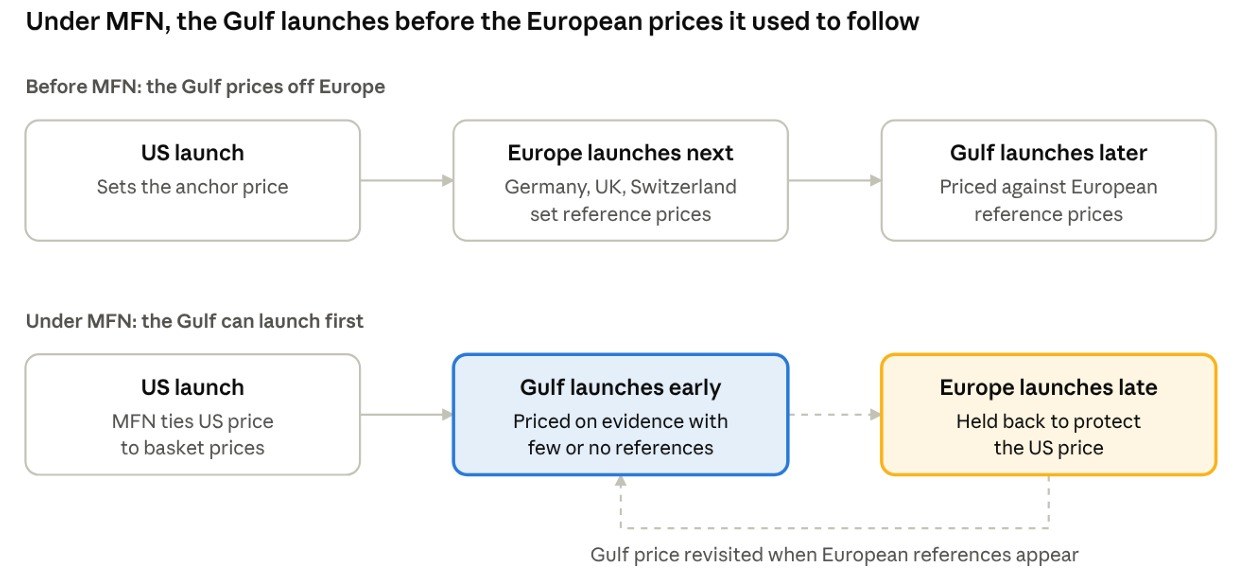
The Gulf moves from the end of the sequence to the middle and Europe from the middle to the end, with its prices arriving after the Gulf has already set its own.
This creates two risks for regional systems. The first is information: pricing without external anchors puts far more weight on local health technology assessment, comparator choice, and budget impact analysis. The second is contagion: since many MENA systems reference Saudi Arabia, an early Saudi price becomes the benchmark for markets that never negotiated it.
5. What Gulf regulators and payers should do
| Move | What it means | Building blocks already in place |
|---|---|---|
| 1. Price on evidence and not reference | Build a health technology assessment (HTA) and economic evaluation capacity strong enough to set a defensible first price with no external benchmark | SFDA rules already allow pricing against registered therapeutic alternatives and economic studies when a product is not marketed in reference countries |
| 2. Offer confidentiality by design | Use managed entry and confidential net price agreements so a Gulf price does not cascade into the many MENA systems that reference Saudi Arabia | SFDA's stated aim is to be a regional price reference |
| 3. Trade price stability for localization | Pair early launch with predictable pricing for companies that manufacture locally | SFDA draft rules fix a product's price for seven years if manufacturing moves fully to Saudi Arabia |
| 4. Set clear rules for late references | Define in advance how prices are revisited when European prices finally appear so first-to-launch is not penalized later | SFDA draft rules cap any repricing decrease at 30%; the UAE is reviewing its pricing rules |
The Gulf can turn a policy accident into a lasting advantage, but only if its pricing systems work without the European anchors they were built around. We see four moves as outlined below.
The fourth move matters the most. A manufacturer will only launch early in Riyadh or Abu Dhabi if it trusts that the price will not be cut sharply once Germany or the UK sets a lower one later.
6. What regional and affiliate leaders should do
For GCC general managers and regional access teams, MFN changes the internal conversation with the headquarters. The Gulf is no longer a market that waits for Europe. It can make the case to launch alongside or ahead of it.
- Build the early-launch case asset by asset. Show the headquarters that a Gulf price carries no direct US reference risk and quantify the revenue gained by launching before the European sequence resolves.
- Prepare a value dossier that stands alone. With fewer European prices and HTA outcomes to cite, Gulf submissions need local or regional evidence on burden, comparators, and budget impact.
- Model the regional cascade. Map which MENA markets reference Saudi or UAE prices before agreeing on a list price and use confidential terms where that cascade creates risk.
- Use localization as a pricing lever. Where a partner or contract manufacturer can produce locally, weigh it against Saudi Arabia’s price-stability incentive.
- Plan for the repricing moment. Agree with regulators, in writing where possible, how the price will be treated when European references appear.
The affiliates that move first will set the regional benchmarks others follow.
7. Testing the thesis: Aranca’s Gulf launch-lag tracker
| Metric | What it measures | Primary sources |
|---|---|---|
| Gulf approval lag | Days between FDA approval and SFDA or EDE approval per new molecular entity | FDA novel drug approvals; SFDA and EDE registers and announcements |
| Gulf ahead of Europe | Share of new medicines approved in Saudi Arabia or the UAE before EMA approval | EMA authorization records |
| Pricing without references | Share of Gulf pricing decisions made with no basket-country price available | SFDA pricing decisions; company disclosures |
| Repricing outcomes | Change in the Gulf price once European prices appear | SFDA and EDE repricing records |
| Access uptake | Time from approval to formulary or payer listing | NUPCO, CCHI, Abu Dhabi DOH, and Dubai DHA listings |
The signals in this piece are directional. To turn them into evidence, Aranca proposes a tracker that compares new medicine launches in the Gulf with the US and Europe, before and after the May 2025 MFN executive order.
Comparing the pre- and post-MFN cohorts will show whether the Gulf’s rise reflects MFN, its own reforms, or both. The first results will form a follow-up to this piece.
The bottom line
MFN was designed to change what Americans pay. Its quieter effect is to change where the world sees new medicines first. Markets outside the US reference baskets now have a rare opening, but the Gulf’s pricing systems were built to follow Europe and not lead it. The regulators that learn to price confidently on evidence and the affiliates that make the case to launch early will decide whether this becomes a lasting shift or a mere passing window.
