
Key Trends and Challenges Shaping M&A in 2025: Insights for Business Leaders
Published on 03 Feb, 2026

Global M&A in 2025 marks a clear shift away from volatility and excess toward discipline and selectivity. After several uneven years, dealmaking has stabilized, with buyers returning to the market cautiously and capital being deployed with a sharper focus on strategic fit, fundamentals, and downside protection. While activity remains below the 2021 peak, the rebound in deal value and steady transaction volumes point to a market that is recovering methodically rather than speculatively.
This report examines how that recovery is unfolding across regions, deal sizes, sectors, and buyer types. Europe has emerged as the largest contributor to global deal value, Asia continues to gain momentum, and the Americas’ dominance has moderated, signaling a more balanced geographic mix. At the same time, deal activity is tilting toward larger transactions, corporate buyers remain the anchor of the market, and sector trends reflect enduring themes of consolidation, digitization, and portfolio optimization.
Valuations reinforce this new phase of M&A. Multiples have reset from their 2021 highs, with buyers clearly prioritizing profitability, cash flow, and earnings quality over topline growth. Looking ahead to 2026, the outlook points to gradual improvement rather than a sharp rebound, with premium pricing concentrated in assets offering margin resilience, clear synergies, and credible value creation pathways.
Summary
Global M&A activity in 2025 reflects a measured recovery, with buyers returning selectively and capital deployed more cautiously than in prior cycles. Activity has stabilized, but dealmaking remains driven by strategic fit, fundamentals, and downside protection rather than broad risk appetite.
Deal value rebounded to approximately $1.8 trillion, still below the 2021 peak but meaningfully higher than recent years, while deal volume held steady at over 27,000 transactions, indicating resilient underlying demand. Regionally, Europe emerged as the largest contributor at around 39% of deal value, as the Americas’ share declined to 38% and Asia increased to 16%, supported by technology and manufacturing activity. The deal mix also shifted toward larger transactions, with sub-$25 million deals declining and higher-value brackets gaining share, signaling renewed confidence among scaled buyers.
B2B transactions remained the core of activity, accounting for 36% of volumes, while B2C and IT continued to reflect consolidation and digitization themes. Valuations showed a clear reset: EBITDA multiples recovered to roughly 9.1x in 2025, while revenue multiples fell to about 1.4x, reinforcing a stronger focus on profitability and cash flow.
Looking ahead to 2026, conditions point to a gradual improvement rather than a sharp rebound. Deal activity is expected to broaden modestly, with premium pricing concentrated in assets offering margin resilience, synergies, and clear value-creation potential.
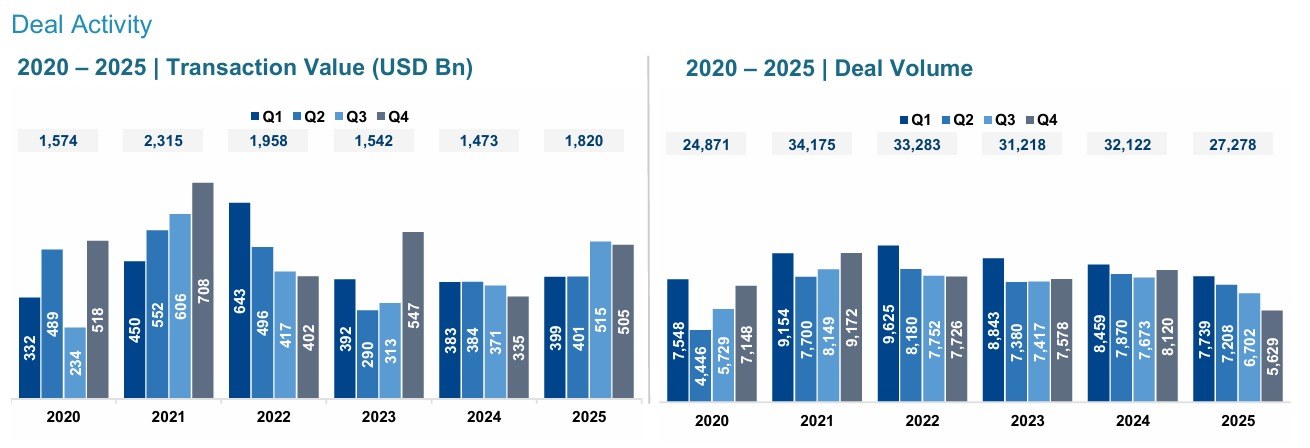
After a period of uneven activity earlier in the cycle, global M&A regained its momentum, supported by improving deal values and steady transaction volumes. While annualized deal value remains below the post-pandemic peak of 2021, the rebound in 2025 to ~$1.8 trillion reflects a renewed willingness among buyers to transact amid a still-complex macro backdrop. Importantly, this recovery has been driven by consistent quarterly execution rather than a concentration of outsized megadeals, signaling a disciplined phase of market participation.
Deal volumes have remained resilient, reinforcing the view that underlying M&A demand has stayed intact despite high financing costs and geopolitical uncertainty. With over 27,000 transactions in 2025, activity continues to run above pre-pandemic norms even as investors apply greater selectivity around valuation, asset quality, and strategic fit. This sustained level of deal flow suggests that corporates and financial sponsors are prioritizing portfolio realignment, bolt-on acquisitions, and capability-driven transactions over scale-led expansion. Taken together, recent quarters point to a market that has moved beyond the volatility-driven pullback of prior years and into a measured recovery phase. While deal value is unlikely to revisit the exceptional highs of 2021 in the near term, the combination of stabilizing macro conditions, easing monetary policy, and persistent strategic imperatives is aiding a healthy and durable M&A environment; one defined by conviction, execution discipline, and long-term positioning rather than excess.
Deal share in the Americas is declining, while Asia is steadily gaining ground, signalling a gradual shift in global M&A momentum. The Americas fell from 45% in 2020 to 38% in 2025, suggesting a relative slowdown in deal concentration driven by high financing costs, tight regulatory scrutiny, and a selective deal environment. In contrast, Asia’s share rose from 12% to 16%, indicating growing confidence in the region’s growth outlook and an increase in strategic and capability-led acquisitions, especially in technology, manufacturing, and consumer.
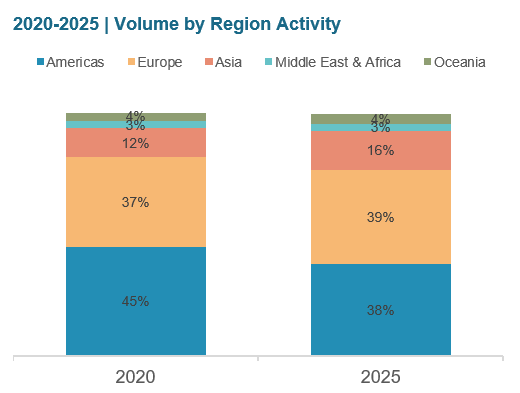
Simultaneously, Europe strengthened slightly (37% to 39%), effectively overtaking the Americas as the largest contributor by 2025. This points to Europe’s resilience as a deal market, supported by cross-border interest, consolidation plays, and corporate portfolio reshaping, despite macro uncertainty. Overall, the mix suggests global M&A is turning less Americas-centric and more balanced across regions, with investors and corporates looking to Asia and Europe for scalable growth and diversification.
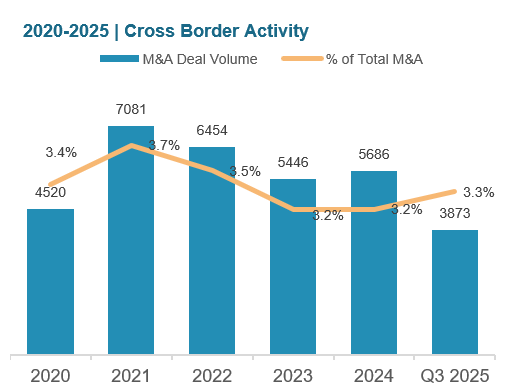
Cross-border M&A activity has remained structurally steady as a share of overall dealmaking, even as absolute volumes have fluctuated through the cycle. Deal count peaked in 2021 and moderated through 2023–2024, reflecting tight financing conditions, more regulatory scrutiny, and increased geopolitical friction impacting international transactions. However, the cross-border share has remained within a narrow band (3.2–3.7%), indicating that while fewer deals are being completed in weaker years, cross-border activity has not collapsed and continues to represent a consistent, strategically relevant layer of global M&A.
The deal-size mix in 2025 shows M&A activity remains skewed toward smaller transactions, but with a clear shift toward mid-to-large deals compared to 2020. Sub-$25M deals still dominate, but their share declined from 61% in 2020 to 56% in 2025, indicating that market activity is becoming less reliant on very small-ticket transactions. Meanwhile, the $25M–$99M segment held steady at 19%, suggesting a consistent appetite for lower mid-market deals despite broader macro volatility.
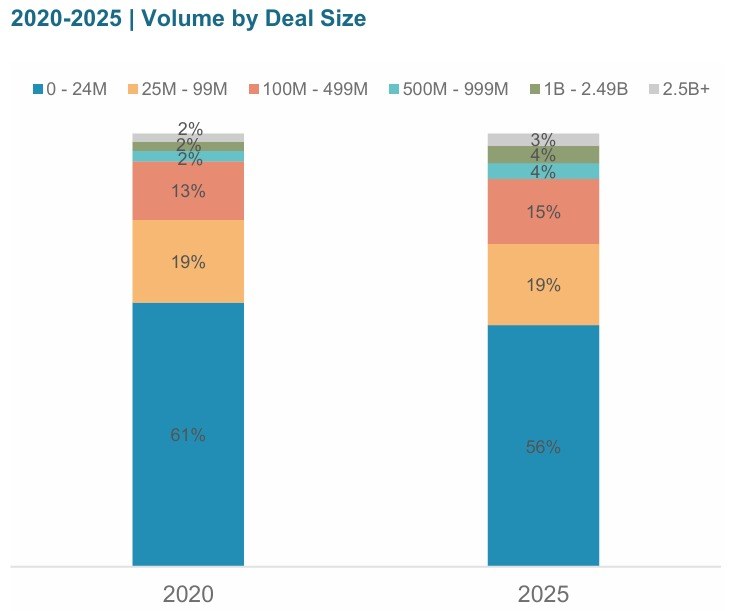
The most notable change is the expansion in larger deal brackets, pointing to an improving risk appetite and a return of strategic, scaled acquisitions. Deals in the $100M–$499M range increased from 13% to 15%, while the $500M–$999M segment doubled from 2% to 4%, signalling a strong pipeline of platform and consolidation plays. Mega-deals also saw a modest increase, with $1B–$2.49B rising from 2% to 3% and $2.5B+ moving from ~2 to 4%. This development suggests that while transformational transactions are still a small share of the overall volume, they are turning incrementally more prevalent as financing conditions stabilize and strategic confidence improves.
Global M&A activity in 2025 remains heavily concentrated in business-led sectors, with B2B accounting for 36% of the total deal volume (27,278 deals). This reflects continued consolidation across industrials, services, and enterprise-oriented business models where scale, distribution, and capability acquisition remain key drivers. B2C follows at 23%, highlighting a sustained deal flow in consumer-facing categories. However, the mix suggests buyers are prioritizing defensible demand pockets and brand-led assets rather than broad-based discretionary exposure.
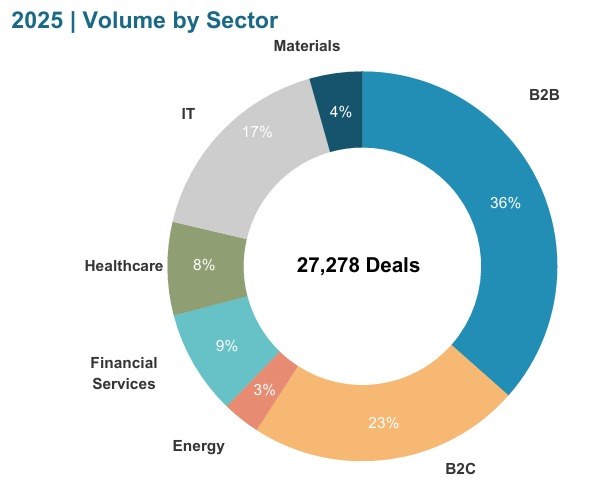
Beyond B2B and B2C, IT represents 17% of the deal volume, reinforcing technology’s role as a core enabler across industries; particularly through software, data, and automation-led acquisitions. Importantly, this sector split has remained broadly consistent over the years, suggesting that while the macro cycle influences deal size and regional mix, the underlying sector allocation continues to be driven by structural themes such as digitization, consolidation, and portfolio optimization.
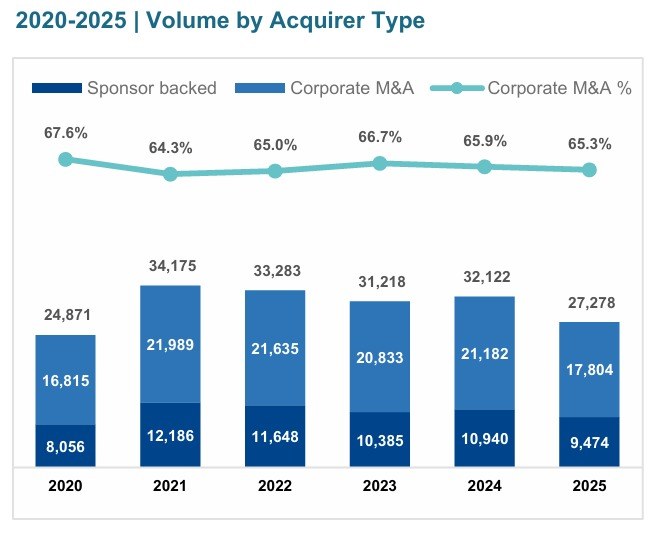
The buyer mix stability is the key structural signal, with corporates consistently representing two-thirds of global deal activity across the period. This indicates that rather than being overly dependent on financial sponsors, M&A remains driven by capability acquisition, consolidation, and portfolio optimization. Sponsor-backed volumes are more sensitive to credit conditions, and the post-2021 moderation points to selective deployment such as add-ons, platform buildouts, and operational value creation instead of leverage-driven expansion. Overall, the data supports a market narrative of low volume but high selectivity, anchored by corporates as the most resilient source of deal flow.
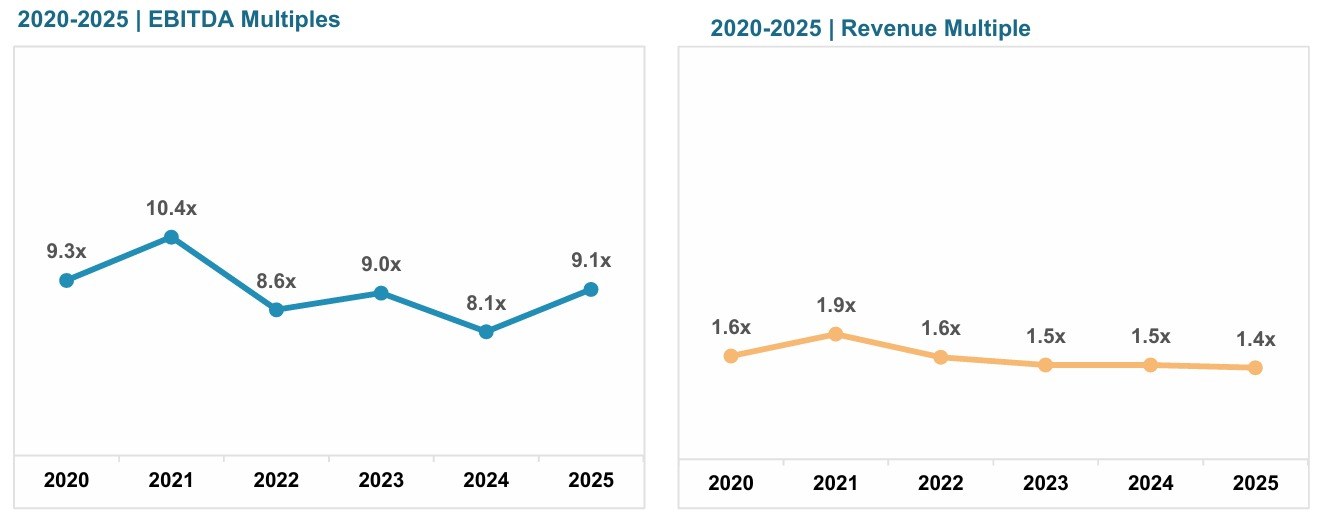
Valuations across 2020–2025 show a clear “peak-and-reset” pattern, with multiples expanding into 2021 and compressing as market conditions normalized. EBITDA multiples peaked at 10.4x in 2021, dropping through 2022–2024 and recovering modestly to 9.1x in 2025. This trajectory is consistent with the broader shift from liquidity-driven pricing to a more fundamentals-led environment, where buyers have been disciplined on entry valuations.
Revenue multiples show a clean compression trend, moving from 1.9x in 2021 to 1.4x by 2025, with limited recovery. The sustained decline suggests that investors are placing less value on topline growth alone and are instead demanding clear profitability paths, strong unit economics, and more cash conversion visibility. In practice, this typically results in a wider valuation gap between high-quality assets with durable margins and weaker businesses that require heavy reinvestment to sustain growth. The divergence between the two metrics is critical: while revenue multiples drifted lower, EBITDA multiples stabilized and rebounded in 2025, indicating a market that is selectively rewarding earnings quality. This implies deal pricing is increasingly driven by profitability, resilience, and operational efficiency, rather than growth narratives. For acquirers, the current environment favours targets with defensible margins and synergy potential, while the sellers of growth-heavy assets may face pressure to demonstrate credible near-term EBITDA expansion to achieve premium outcomes.
Deal Multiples of Key Sectors
| Sector | EBITDA Multiple | Revenue Multiple |
|---|---|---|
| B2B | 7.43x | 1.04x |
| B2C | 10.43x | 1.16x |
| Energy | 7.05x | 1.44x |
| Financial Services | 10.59x | 4.06x |
| Healthcare | 10.91x | 2.59x |
| Information Technology | 12.33x | 2.13x |
| Materials and Resources | 9.38x | 1.45x |
| Other / Unknown | 4.57x | 1.23x |
*Includes Median multiples of deals completed in 2025
2025 Top Deals
| Date | Target Company | Target Sector | Deal Value | Key Investors | Sales Multiple (x) |
|---|---|---|---|---|---|
| Jul-25 | Hess | Energy | 60.0 | Chevron | 4.80 |
| Dec-25 | Kellanova | B2C | 35.9 | Mars | 2.83 |
| May-25 | Discover Financial | Financial | 35.3 | Capital One Financial | 1.96 |
| Jul-25 | Ansys | IT | 35.0 | Synopsys | 13.55 |
| Mar-25 | X | IT | 33.0 | xAI | 12.22 |
| Feb-25 | Chemist Warehouse | B2C | 21.1 | Sigma Healthcare | 2.06 |
| Dec-25 | Exact Sciences | Healthcare | 21.0 | Abott | 6.81 |
| Dec-25 | Groq | IT | 20.0 | Nvidia | 40.00 |
| Sep-25 | Mediobanca | Financial | 18.7 | Banca Monte dei Paschi di Siena | 5.09 |
| Nov-25 | The Interpublic Group | B2B | 15.9 | Omnicom Group | 1.56 |
| Apr-25 | Berry Global Group | Materials | 15.4 | Amcor | 1.37 |
| Jul-25 | Juniper Networks | IT | 15.2 | Hewlett Packard Enterprise | 2.92 |
| May-25 | Veren | Energy | 15.0 | Whitecap Resources | 4.66 |
| Feb-25 | Summit Materials | Materials | 14.4 | Quikrete Holdings | 3.83 |
| Oct-25 | Mr. Cooper Group | Financial | 14.2 | Rocket Mortgage | 4.59 |
| Apr-25 | Intracellular | Healthcare | 13.9 | Johnson & Johnson | 20.46 |
| Mar-25 | Haitong Securities | Financial | 13.8 | Guotai Junan International | 7.60 |
| Aug-25 | AssuredPartners | Financial | 13.5 | Arthur J. Gallagher & Co | 5.38 |
| Apr-25 | Beacon Roofing | B2B | 11.3 | QXO | 1.16 |
| Jul-25 | Viterra | B2B | 10.7 | Bunge Global | 0.38 |
| May-25 | Altair Engineering | IT | 10.6 | Siemens | 15.92 |
| May-25 | Nordstrom | B2C | 10.5 | El Puerto de Liverpool | 0.70 |
| Dec-25 | Blaise Holding | Financial | 10.3 | Helvetia Holding | 1.49 |
| Oct-25 | Verona Pharma | Healthcare | 10.1 | Merck & Co. | 45.34 |
| Oct-25 | LA Lakers | B2C | 10.0 | Mark Walter | 16.16 |
Outlook
Looking ahead, global M&A is likely to remain active but selective, with momentum driven less by a broad “risk-on” cycle and more by company-specific catalysts. Expect continued portfolio rationalization, carve-outs, and capability-led acquisitions as corporates pursue growth in priority segments and simplify non-core exposure. With corporate buyers still anchoring most transactions, deal flow should remain resilient even if macro volatility persists, particularly in sectors where consolidation and technology enablement are structural imperatives.
The key swing factors for 2026 will be the financing conditions and valuation convergence. While EBITDA multiples have begun to stabilize, revenue multiples remain under pressure, implying that buyers are still underwriting toward cash generation and margin durability. As a result, the market should increasingly bifurcate: high-quality assets with defensible earnings and synergy potential will continue to clear at premium pricing, while growth-heavy or execution-dependent businesses may face longer processes, heavier structure, or deferred consideration. Mega-deals will remain opportunistic, but the base case is a market led by mid-sized strategic transactions where certainty of close and value creation is clear.
What to Watch Out For in 2026
Financing conditions and confidence reset: If rates ease further and credit spreads tighten, the market could see a broad expansion in mid-to-large deal activity. If not, dealmaking will remain biased toward transactions with high certainty of close and strong strategic logic.
Valuation convergence (the bid–ask gap). EBITDA multiples have shown early stabilization. However, revenue multiples remain compressed, suggesting buyers are still pricing risk tightly. A narrowing gap between buyer underwriting and seller expectations will be one of the biggest determinants of process velocity and conversion rates.
Regulatory scrutiny and execution friction. Even in a recovery, large-scale and cross-border transactions will continue to face long timelines and high diligence requirements. This increases the premium on clean deal structures, strong narratives, and proactive stakeholder management.
Mega-deal selectivity vs mid-market breadth. The return of larger deals is visible. However, the base case still points to a market led by mid-sized strategic acquisitions rather than a full megadeal cycle. Watch whether the top end expands meaningfully or remains opportunistic.

Shashwat Kakkar
