
The Low-Cost Comparator Trap: Why Replacing Keytruda Gets Harder Once Biosimilars Arrive
Published on 05 Nov, 2026

Key Findings
The evidence so far points to four shifts:
- Big pharma has bet heavily on the class.BMS committed USD 1.5 billion upfront to BioNTech, Pfizer paid USD 1.25 billion to license an asset from 3SBio, and Merck paid USD 588 million for its own candidate. Pfizer alone has launched a 1,500-patient Phase III against Keytruda in first-line lung cancer.
- The clinical case is promising but unsettled.Summit's ivonescimab improved progression-free survival in its global HARMONi trial but has not shown a statistically significant overall survival benefit, and a first-line interim analysis against Keytruda missed significance in May 2026.
- Launch timing collides with Keytruda biosimilars.IV pembrolizumab biosimilars are expected from late 2028. The class's large first-line indications are unlikely to reach market much before then, so they will be priced against a far lower-cost comparator than the one they were tested against.
- Payer rules make the gap matter.In Germany, a drug without proven added benefit cannot cost more per year than its comparator. As the comparator's price falls, the premium a bispecific can command depends entirely on demonstrated benefit, and most of all, on survival.
1. The Race to Replace Keytruda
PD-1×VEGF bispecifics combine immune checkpoint blockade with inhibition of the blood-vessel growth signal VEGF in a single molecule. The thesis is that one antibody can outperform Keytruda, either alone or with chemotherapy, and become the new backbone across solid tumors. Every leading candidate originated in China.
Exhibit 1. Four large companies now hold a PD-1 or PD-L1×VEGF bispecific
| Asset | Owner (originator) | Deal terms | Status |
|---|---|---|---|
| Ivonescimab | Summit (Akeso) | Licensed from Akeso | Approved in China. First US application under review, decision date November 14, 2026. |
| PF-08634404 | Pfizer (3SBio) | USD 1.25 billion upfront | 1,500-patient Phase III against Keytruda plus chemotherapy in first-line lung cancer; Phase III in colorectal cancer. |
| Pumitamig (BNT327) | BioNTech and BMS | USD 1.5 billion upfront, up to USD 11.1 billion in total | Phase III in small cell and non-small cell lung cancer. |
| LM-299 | Merck (LaNova) | USD 588 million upfront | Phase I at the time of licensing in November 2024. |
Merck's inclusion on the list matters. The company that owns Keytruda is also hedging against its replacement, and its patent expiry is the event the rest of the class is racing toward.
The data so far is encouraging but not decisive. In China, ivonescimab with chemotherapy extended the median overall survival to 27.9 months against 23.7 months for a PD-1 antibody with chemotherapy in first-line squamous lung cancer. In the global HARMONi trial, it improved progression-free survival, but the overall survival benefit (hazard ratio 0.79) was not statistically significant, and an interim analysis of HARMONi-3 against Keytruda missed significance on progression-free survival in May 2026.
2. The Timing Problem
The class is arriving in stages. Ivonescimab's first US application in EGFR-mutated lung cancer after targeted therapy has a decision date of November 14, 2026, which may slip by three months after a major amendment. The large first-line indications, where Keytruda earns most of its revenue, depend on Phase III trials that are still running. Pfizer's 1,500-patient study against Keytruda only began in late 2025.
Meanwhile, IV Keytruda biosimilars are expected from late 2028. The likely result is that the trials will compare the new class with branded Keytruda but payers will price it in a market where the PD-1 component is available as a biosimilar.
Exhibit 2. The benchmark shifts between the trial and the payer
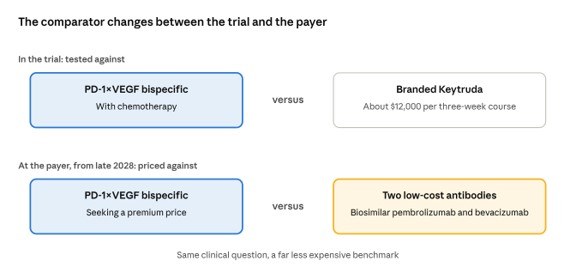
The shift is easy to miss when the debate focuses on whether the new class can beat Keytruda. It may matter more for the class's commercial value than any single trial result.
3. How Payers Will Judge The Premium
Health technology assessment bodies and payers price a new drug against the treatment it replaces. For PD-1×VEGF bispecifics, this comparator is about to become far less expensive.
The comparator's price is falling.Keytruda currently costs about USD 12,000 per three-week course. At least 13 companies are developing pembrolizumab biosimilars, with IV biosimilars expected from late 2028. Precedent suggests sizable discounts: in the Netherlands, IV trastuzumab biosimilars cost on average 43% less than IV Herceptin.
VEGF inhibition is already low-cost.Bevacizumab, the established VEGF antibody, has faced biosimilar competition for years; Pfizer launched its US biosimilar at a 23% discount in 2019.
Rules link price to proven benefit.In Germany, if a new drug shows no added benefit, its annual treatment cost must not exceed that of the appropriate comparator. Other systems apply similar logic through cost-effectiveness thresholds.
Together, these create the trap. A bispecific tested against branded Keytruda will be priced in a market where the PD-1 component is a biosimilar and the VEGF component has been off-patent for years. Payers are likely to ask a pointed question: does one bispecific antibody do more than a biosimilar PD-1 antibody plus a biosimilar VEGF antibody and by enough to justify the price difference? The bispecific may well be clinically different, for example, by concentrating activity in the tumor. But the burden of proving this difference will fall on the developer.
This is a sharper version of a problem already noted for combination regimens, where Keytruda's loss of exclusivity could either ease or worsen pricing.
4. What Clinical Evidence Must Show
In a world of low-cost comparators, the evidence needed for a premium price changes.
| Evidence | Enough to win approval | Enough to win a premium against biosimilars |
|---|---|---|
| Progression-free survival | Often sufficient, depending on regulator and setting | Rarely sufficient on its own |
| Overall survival | The FDA has said a significant benefit is needed for ivonescimab's current application | Central to any premium; the size of the benefit sets the price ceiling |
| Population | Trial populations, sometimes largely Asian | Data that holds true for Western patients, as payers and HTA bodies will test this aspect |
| Comparator | Branded Keytruda plus chemotherapy | Evidence against, or credible indirect comparison with, PD-1 plus VEGF combinations |
| Safety and convenience | Acceptable safety profile | A clear tolerability or administration advantage that offsets cost |
The Western overall survival data for ivonescimab illustrates the stakes. The hazard ratio in Western patients improved from 0.98 at the primary analysis to 0.76 with longer follow-up but remained statistically insignificant. A signal like this may support approval. It is a weaker basis for asking payers to pay a premium over a biosimilar backbone.
5. What Each Group Should Do
For developers of PD-1×VEGF bispecifics
- Plan the value case against the post-patent comparator. Model pricing and HTA outcomes assuming biosimilar pembrolizumab and bevacizumab, not branded Keytruda.
- Power trials for survival. Progression-free survival may win approval; a clear overall survival benefit supports a premium.
- Address the "two low-cost antibodies" question early. Generate direct or indirect evidence that the bispecific outperforms a PD-1 plus VEGF combination and mechanistically explain why.
- Prioritize indications where the gap is the largest. Settings where Keytruda performs poorly, such as EGFR-mutated lung cancer after targeted therapy, offer a clearer case than settings where Keytruda is already strong.
For payers and HTA bodies
- Set the comparator early. Signal whether assessments will use biosimilar prices and PD-1 plus VEGF combinations as references, so developers can generate the right evidence.
- Use outcomes-based terms where survival data is immature. Link price to confirmed survival benefit rather than paying a full premium on early signals.
6. What To Watch Out For
| Signal | Why it matters | What would change the picture |
|---|---|---|
| FDA decision on ivonescimab | The first US decision for the class | Approval with or without significant survival benefit; the date may slip by three months |
| First-line Phase III readouts against Keytruda | The core test of the replacement thesis | Clear overall survival wins in HARMONi-3 or Pfizer's 1,500-patient trial |
| First pembrolizumab biosimilar prices | Sets the comparator payers will use | Deep launch discounts in Europe from 2028 |
| Early HTA scoping | Shows how assessors will frame the comparison | Comparators that include biosimilar PD-1 and VEGF combinations |
| Western subgroup data | Tests whether Chinese results translate | Consistent survival benefits in Western patients |
The Bottom Line
The PD-1×VEGF class may well prove clinically better than Keytruda. But the test it faces is not only clinical. By the time most of its major indications reach payers, Keytruda's IV form will be facing biosimilar competition, and VEGF inhibition will have been low-cost for years. A bispecific will then be priced against two inexpensive antibodies rather than one expensive one. Developers that design trials for survival, prepare evidence against PD-1 plus VEGF combinations, and plan their value case for the post-patent market will be best placed to earn a premium. Those that build their case on beating branded Keytruda may find the comparator has moved by the time they arrive.
