
Carbon Fiber Composites: India’s Next Industrial Leap and the Opportunity Ahead
Published on 21 May, 2026

India currently relies on imports to meet its carbon fiber needs, even as the demand continues to expand across wind energy, aerospace manufacturing, and electric mobility. Most of the carbon fiber consumed domestically is sourced from global suppliers in countries such as Japan, France, and the US.
This dependency is no longer just a trade imbalance. It is a structural vulnerability in sectors that India has identified as strategic. As global carbon fiber demand accelerates and domestic consumption grows at more than twice the global rate, the question is no longer whether India will build a carbon fiber industry. It is where in the value chain should Indian companies position themselves to capture value.
Market Momentum:
Market Momentum: Around 10 years ago, carbon fiber in India was a niche material used mainly in aerospace and defense, with limited industrial adoption due to high costs and low domestic processing capability.
Now, the market is entering a different phase. Light weighting, wind energy, drones, and pressure vessels are pushing carbon fiber from a specialty material toward a strategic industrial input. The shift is not just about higher consumption volumes, but rather about carbon fiber becoming increasingly integrated across multiple growth industries simultaneously.
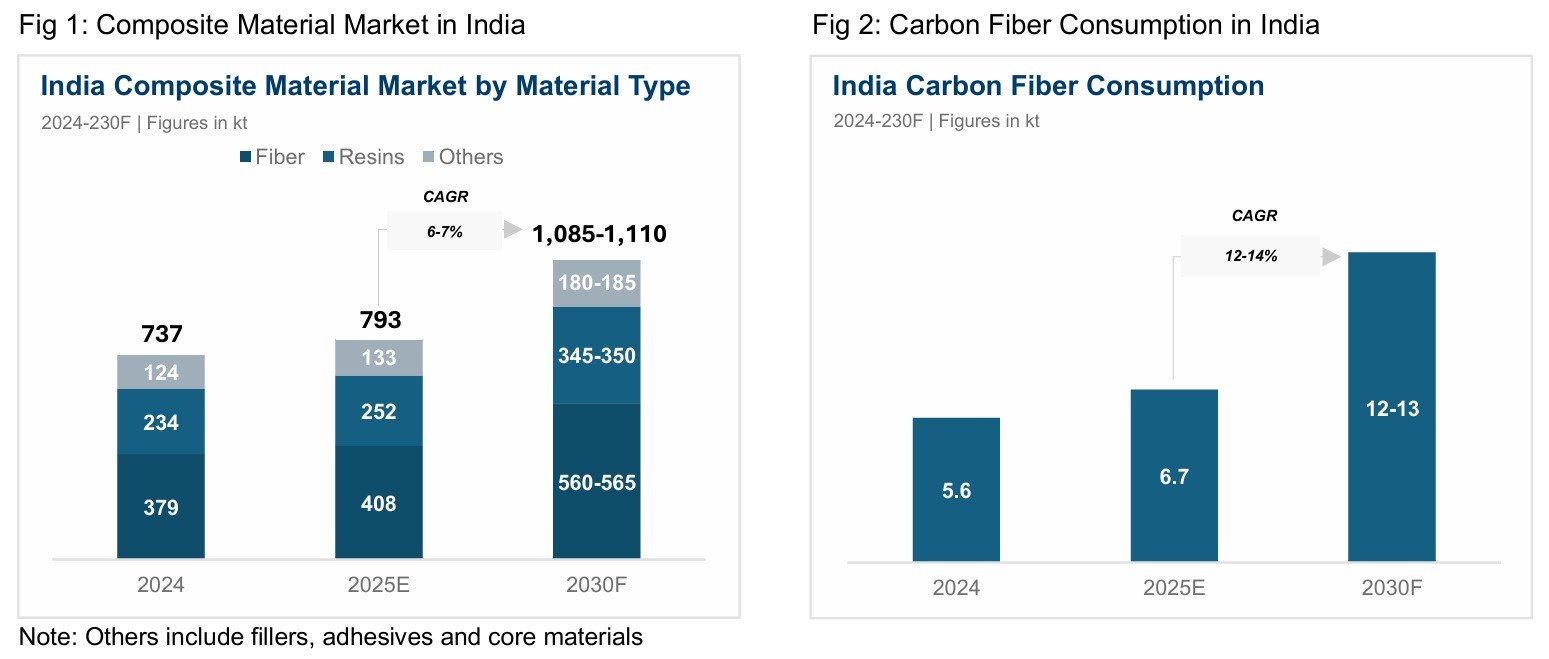
What makes this growth particularly significant is that carbon fiber composites are no longer driven by niche adoption alone, but by structural shifts across strategic and high-growth industries that increasingly require lightweight, high-strength, and performance-oriented materials.
- India’s expanding aerospace, defense, and drone manufacturing ecosystem is slowly increasing the use of advanced composite materials in structural and high-performance applications.
- Renewable energy growth, especially larger wind turbine blades, is accelerating demand for carbon fiber reinforcement due to its superior stiffness-to-weight characteristics.
- Government initiatives such as PLI schemes, defense indigenization programs, and renewable energy targets are strengthening long-term demand visibility for advanced composites.
The dynamic is increasingly evident: although the market is relatively small today, carbon fiber is set to become significantly more strategic across India’s industrial landscape in the following decade.
Current Market Dynamics in India?
India’s composites materials industry remains structurally skewed toward cost-driven applications such as FRP pipes, construction panels, wind blade components, and industrial storage tanks, which continues to limit large-scale adoption of advanced materials such as carbon fiber composites. The market is still dominated by fragmented small- and medium-scale fabricators relying on conventional manufacturing technologies, resulting in glass fiber reinforced polymers accounting for nearly 98.5% of total composite volumes. Carbon fiber and aramid composites together remain largely confined to high-performance sectors such as aerospace, defense, and specialized industrial applications.
India’s role in the global carbon fiber ecosystem today is therefore mostly downstream. The country imports carbon fiber tow and selectively converts it into fabrics, prepregs, and composite components for domestic and export applications. Global suppliers such as Toray Industries, Teijin Limited, Hyosung Advanced Materials, and Syensqo continue to play a vital role in supplying carbon fiber materials to India.
This has created a structural imbalance in the value chain: India has developed capabilities in downstream conversion and component manufacturing; however, control over upstream material supply, technology, and pricing largely remains overseas. As carbon fiber adoption accelerates across strategic sectors, the importance of this gap is expected to rise materially
Value Chain:
India’s carbon fiber value chain is shaped more by its gaps than its capabilities. While the country has built strengths in resins, prepregs, fabrics, and downstream composite manufacturing, it lacks meaningful domestic carbon fiber production- the market’s biggest structural gap and long-term opportunity driver.
Although the value chain spans fiber production, intermediates & composites, and end-use applications, value capture and strategic control remain highly uneven across these layers.
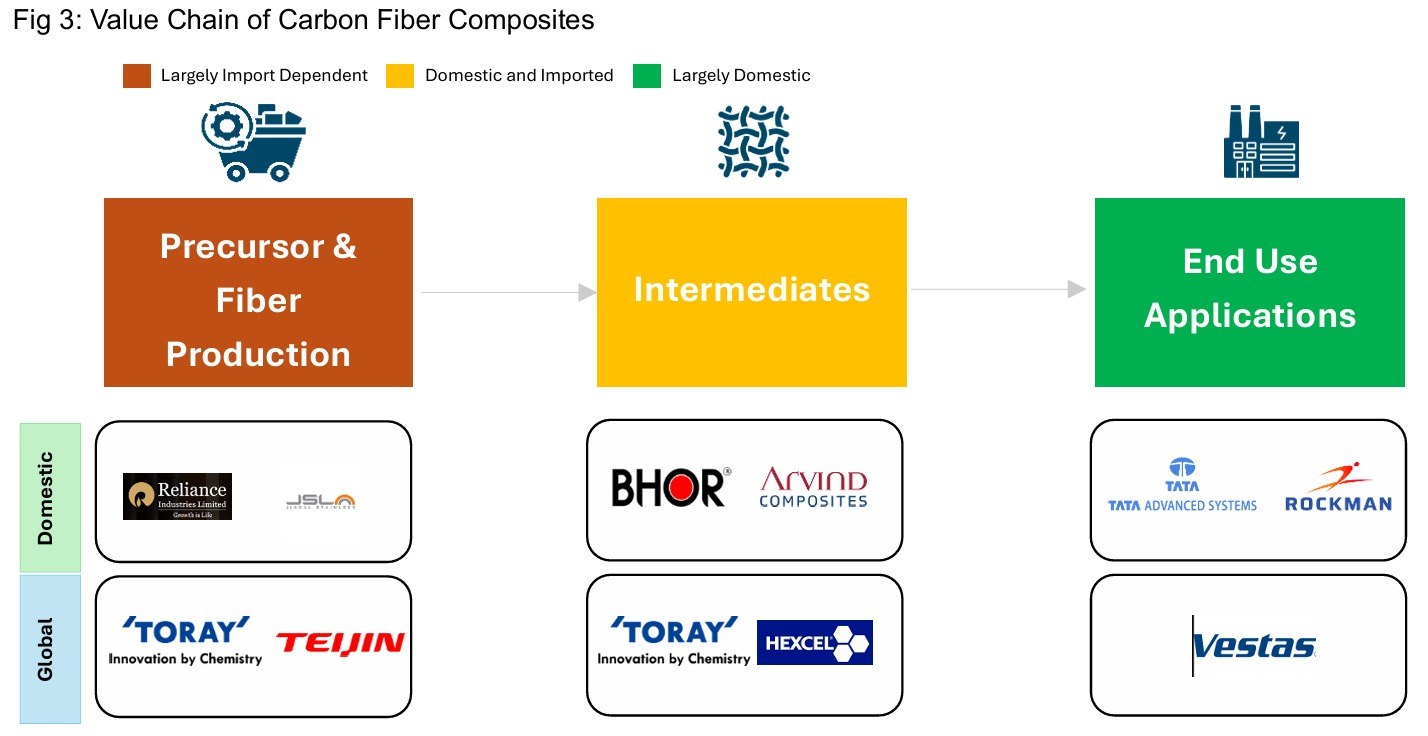
1. Precursor and Fiber Production: Precursor and fiber production- the most capital-intensive and technologically complex segment. This is where cost structures are defined and supply chains are anchored.
India’s Current Position: The upstream segment-precursor and carbon fiber manufacturing-remains the most strategically important part of the value chain. It is also the most capital intensive and technologically difficult segment to enter.
Historically, India has had almost no presence in this layer due to the absence of a PAN precursor ecosystem, high process sensitivity, energy intensity, and restricted technology access. As a result, the country is fully dependent on imported carbon fiber.
Key Indian Players: Reliance Industries | Jindal Advanced Materials
- Reliance Industries (RIL) is building India’s first carbon fiber facility at Hazira, Gujarat – with a planned capacity of 20,000 MTPA
- Jindal Advanced Materials (JAM) has committed USD 327 million in a JV with Italy’s MAE S.p.A. for a 3,500 MT plant, expandable to 10,000 MT by 2027
White Spaces:The larger whitespace lies in PAN precursor and fiber manufacturing. This is almost entirely absent domestically and represents one of the most critical points of control in the ecosystem. The challenge is that this is unlikely to be a short-term play-success here will require patient capital, technology partnerships, and long qualification cycles
2. Intermediates: The intermediates segment-including fabrics, prepregs, molding compounds, and reinforcement systems-represents the most commercially accessible opportunity in the value chain.
India has a small but emerging ecosystem converting imported fiber into usable intermediate materials for aerospace, defense, mobility, and industrial applications.
India’s Current Position: Woven fabrics continue to dominate India’s intermediate segment due to lower costs and easier processing; however, prepregs and thermoplastic molding compounds are the fastest-growing categories.
Demand is driven by aerospace, defense, drones, pressure vessels, and high-performance mobility applications. Strategically, prepregs offer higher margins, stronger OEM relationships, certification-based entry barriers, and greater customer lock-in compared with commodity fabrics.
Key Indian Players: BHOR Chemicals | Arvind Composites
- Agnee Vasthraa signed an MoU with the Indian Army to develop and supply advanced carbon fabrics and composite materials tailored for critical defense applications
White Space: Aerospace-grade prepregs, thermoplastic tapes for EVs, and specialty molding compounds continue to see limited domestic development. At the same time, a large part of India’s composites ecosystem still depends on manual manufacturing processes, even as global players increasingly shift toward automated fiber placement and advanced RTM technologies
This is opening up a meaningful opportunity for companies that invest early in process automation, certification capabilities, and application-focused engineering expertise.
3. End-Use Applications: India is currently the strongest at the downstream end of the value chain, where demand visibility is already robust across aerospace, defense, wind energy, pressure vessels, drones, and industrial applications.
India’s Current Position: The opportunity is shifting beyond conventional component manufacturing. The next phase of value creation will likely come from specialized application focused systems- including drone structures, hydrogen pressure vessels, EV lightweighting, and defense-grade composites- where engineering capability and process sophistication matter more than the scale alone
Key Indian Players: Hindustan Aeronautics Limited | Tata Advanced Systems
- Tata Advanced Systems Ltd. (TASL) has signed a contract with Boeing Commercial Airplanes to manufacture and supply advanced composite assemblies for Boeing 737 MAX
White Space: India lacks large-scale aerospace-grade composite manufacturing, automated processing capability, and advanced tooling infrastructure. The biggest opportunities exist in drone structures, pressure vessels, EV lightweighting, and specialized defense composite systems.
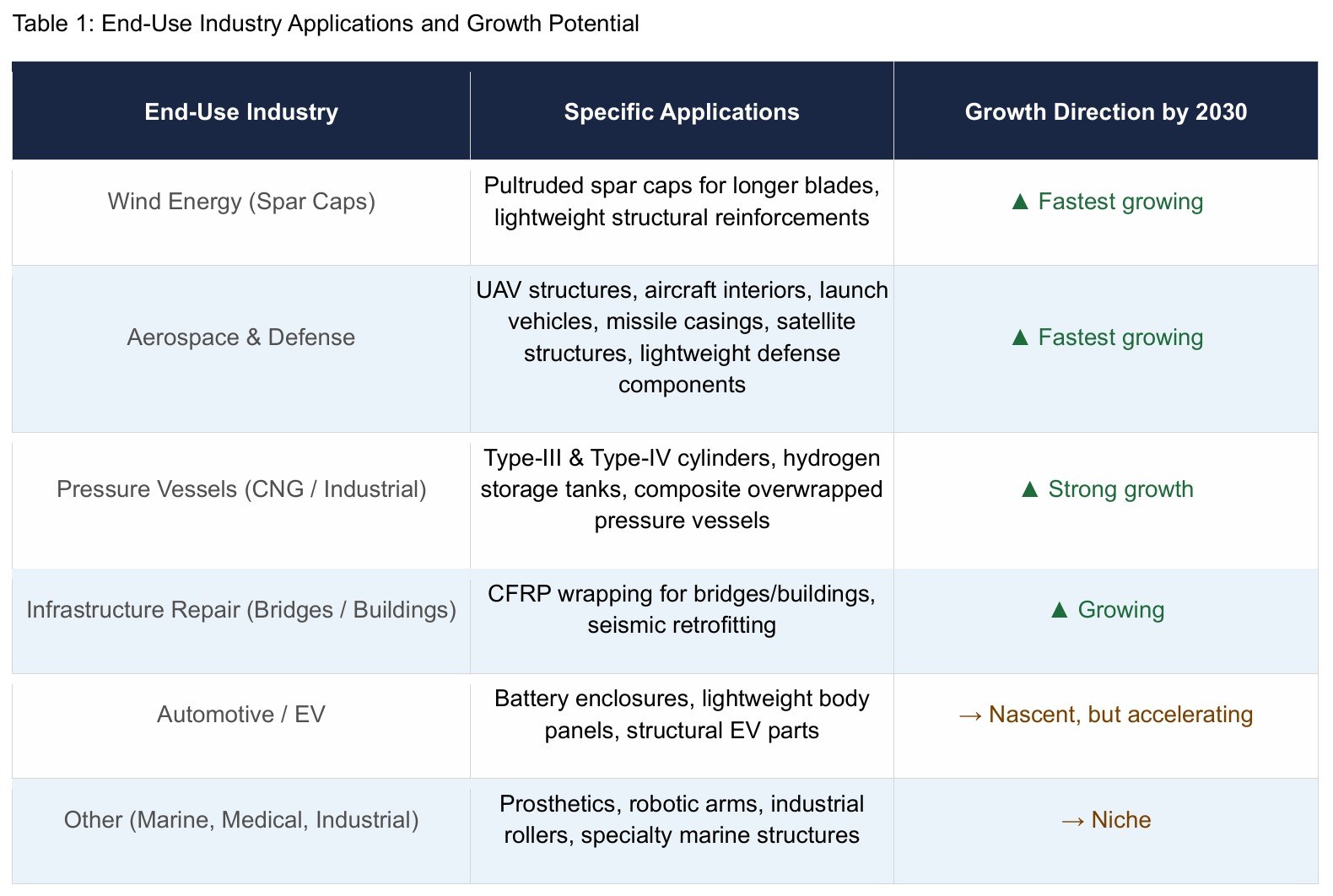
Aerospace continues to anchor India’s carbon fiber demand, with composite components increasingly used in launch vehicles and aircraft structures. At the same time, wind energy is emerging as the largest volume driver due to rising adoption of carbon fiber in turbine blades, while industrial equipment, pressure vessels, and UAV applications are creating new high growth demand pockets.
As the application base broadens across both strategic and commercial sectors, the demand mix for carbon fiber composites is also getting diversified.
Where Should a New Entrant Play?
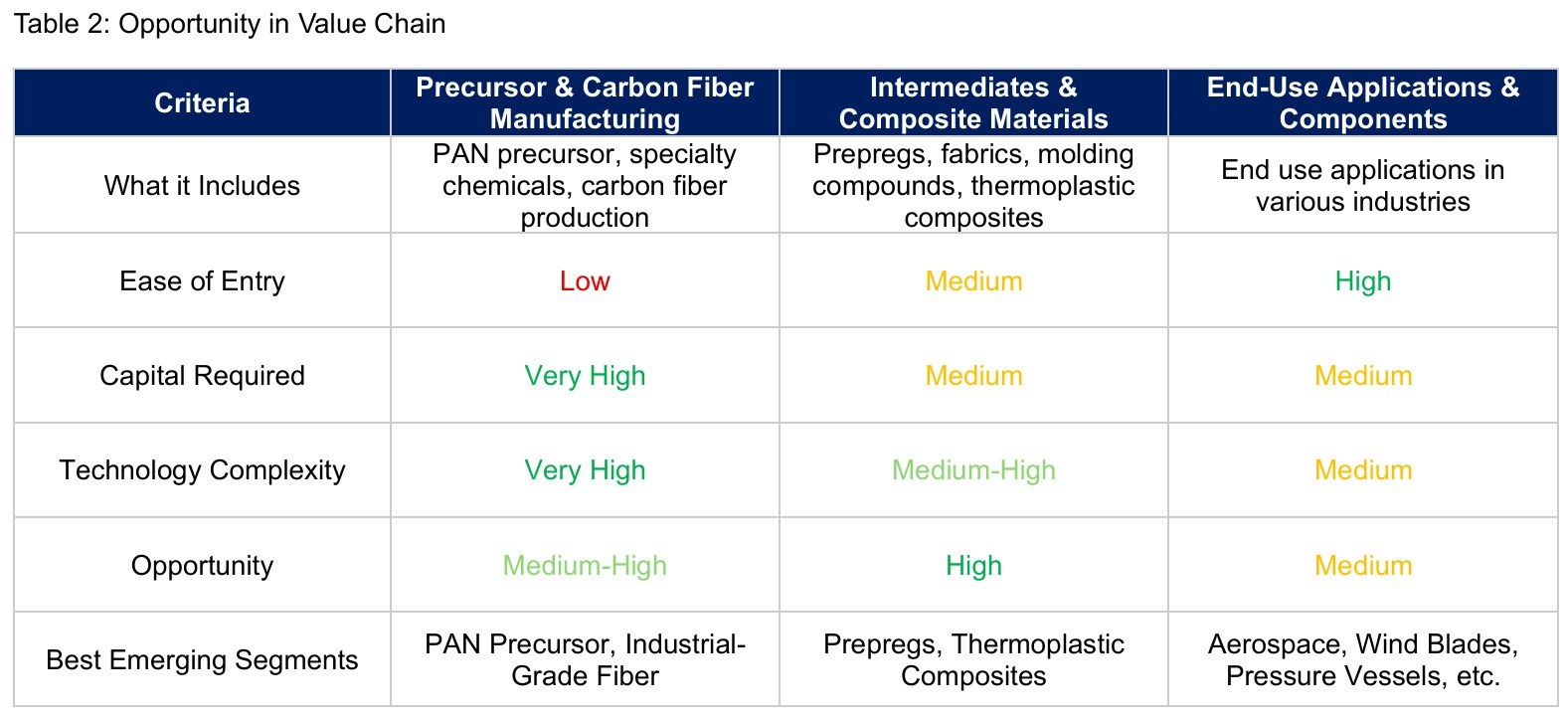
The most attractive near-term opportunity for new entrants is emerging in intermediate materials and composite fabrication, where India offers a favorable mix of rising demand, scalable commercialization potential, and comparatively lower entry barriers than upstream carbon fiber production.
Meanwhile, upstream carbon fiber manufacturing remains a longer-term play given its high capital intensity, technological complexity, and extended qualification cycles. Large investments announced by Reliance Industries and Jindal Advanced Materials underscore that participation at this stage requires scale, patient capital, and long-term strategic commitment. The smarter 2025–2030 play is intermediates and application specific materials. A player with qualified products, consistent resin chemistry, and cold-chain capability can build sticky, high-margin customer relationships once embedded into certified manufacturing processes.
For global players in particular, India offers a combination that few emerging markets currently match at scale: a defense indigenization push, a large wind energy repowering cycle, and an accelerating green hydrogen buildout- policy-supported demand drivers simultaneously developing within a single market.
Conclusion
Although India’s carbon fiber opportunity is becoming increasingly tangible and strategically important, but success will require a calibrated and well-sequenced approach. Demand visibility is strengthening across multiple sectors, while early upstream investments indicate a gradual shift toward greater domestic capability creation. Yet value capture across the value chain remains uneven, with control over technology, materials, and advanced processing capabilities still concentrated in select segments.
The companies best positioned to succeed will be those that identify the right control points within the value chain, build capabilities in a phased manner, and align capital deployment with long-term market evolution. In a material as strategically important as carbon fiber, sustainable competitiveness will depend on not only scale, but also where a company chooses to participate and how effectively it builds differentiated capabilities over time.

Sejal Sarolkar
