
Agrochemicals: India’s Global Export Ambition and the Formulation Gap
Published on 29 Jun, 2026
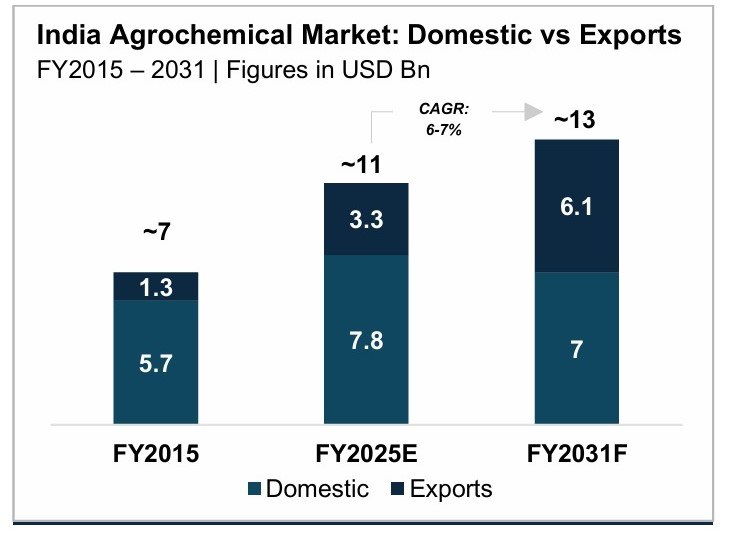
India has emerged as the world’s third-largest agrochemical exporter, with exports nearly tripling over the past decade to USD 3.3 billion in FY25. Yet beneath this headline lies a structural tension: India dominates generic technical-grade production but remains heavily import-dependent for critical intermediates and high-value formulations, the very segments where global margins are built.
This dependency is no longer just a trade imbalance. As global supply chains recalibrate away from China per a China+1 mandate, and a wave of patent expiries unlocks new molecule opportunities through 2028, the question for Indian manufacturers is not whether to grow, but where in the value chain to position themselves for sustainable value capture.
Market Momentum
A decade ago, India’s agrochemical ambitions were largely domestic, anchored by staple crop cycles such as rice, cotton, and wheat, with a modest global footprint. Today, the picture has changed materially. India’s agrochemical market stood at roughly USD 9–10 billion in FY25, and exports now contribute about 51% of industry value, a structural shift unthinkable 15 years ago. The market is projected to record a CAGR of 6–7% to reach ~USD 13 billion by 2031.
What makes this growth significant is its direction and expanding reach. India now exports to over 150 countries, principally Brazil, the US, Japan, Vietnam, and Indonesia. The Brazil relationship is strategically important as India has become a key and increasingly reliable supplier to one of the world’s most agrochemically intensive economies. Meanwhile, domestic consumption remains structurally underpenetrated: India’s usage of 0.38–0.6 kg per hectare lags the global average of 2.0–2.6 kg per hectare, signaling a long runway for growth in the home market alongside a strong export engine.
Fig 1: Agrochemical Market in India
Current Market Dynamics in India
India’s agrochemical industry is structurally bifurcated. A robust, cost-competitive generic technical-grade manufacturing ecosystem contrasts a fragmented formulation landscape that is import-reliant at the higher end and concentrated in commodity products.
Roughly 80% of pesticides used in India are generics, of which 65–75% are made domestically. The country has credible capability in commodity formulations such as emulsifiable concentrates, wettable powders, and suspension concentrates, but the sophisticated end of the spectrum (capsule suspensions, microencapsulated and nano-formulations, water-dispersible granules, and drone-compatible systems) remains underdeveloped. The import challenge is equally real upstream. India sources approximately 50% of its technical-grade active ingredients from China, from which agrochemical imports have grown over 54% in four years to INR 14,315 crore in FY23 from INR 9,267 crore in FY18-19. Notably, 53% of these imports are now finished formulations, reflecting the willingness of MNCs with China-based plants to supply the Indian market directly rather than source locally. Global suppliers such as Syngenta, Bayer, BASF, Corteva, and FMC remain influential, while Indian majors such as UPL, PI Industries, Rallis, Insecticides India, and Meghmani Organics are investing in backward integration to close the gap.
The Margin Equation: Indian. vs Chinese Players
The contest with China is not only about volume but also increasingly about margins, which is where the structural picture becomes sharpest. India’s export surge in FY23 was driven substantially by value factors: formulation prices rose 7–8% and a strong dollar lifted realizations. When these tailwinds reversed, the sector entered a painful destocking cycle that exposed how thin the margin buffer is for players reliant on commodity generics.
Chinese producers retain two structural advantages that compress Indian margins. First, scale and backward integration into intermediates lets them price aggressively. Chinese pesticide output rose roughly 23% year-on-year in early 2026 despite tighter domestic regulation, sustaining a global supply glut. Second, Chinese suppliers have reportedly executed 30–33% targeted price cuts on molecules which India is trying to localize specifically to suppress the return on Indian investment. These cause persistent dumping pressure that Indian regulators have met with anti-dumping duties across several chemical segments.
Where Indian players win on margin: The Indian advantage is real but selective. Contract Research and Manufacturing Services (CRAMS) and contract manufacturing for global innovators (PI Industries) carry IP protection and structurally higher, more durable margins. Registration-led formulation businesses in regulated markets (Sharda Cropchem) build dossier-based moats that commodity competition cannot easily erode. Additionally, post-patent molecules, if captured early, offer a high-margin window before generic crowding sets in. The principle underlying these three opportunities is that margin is defended by chemistry complexity, regulatory capability, and customer lock-in, not by competing with China on commodity price.
The Value Chain: Six Stages, Uneven Control
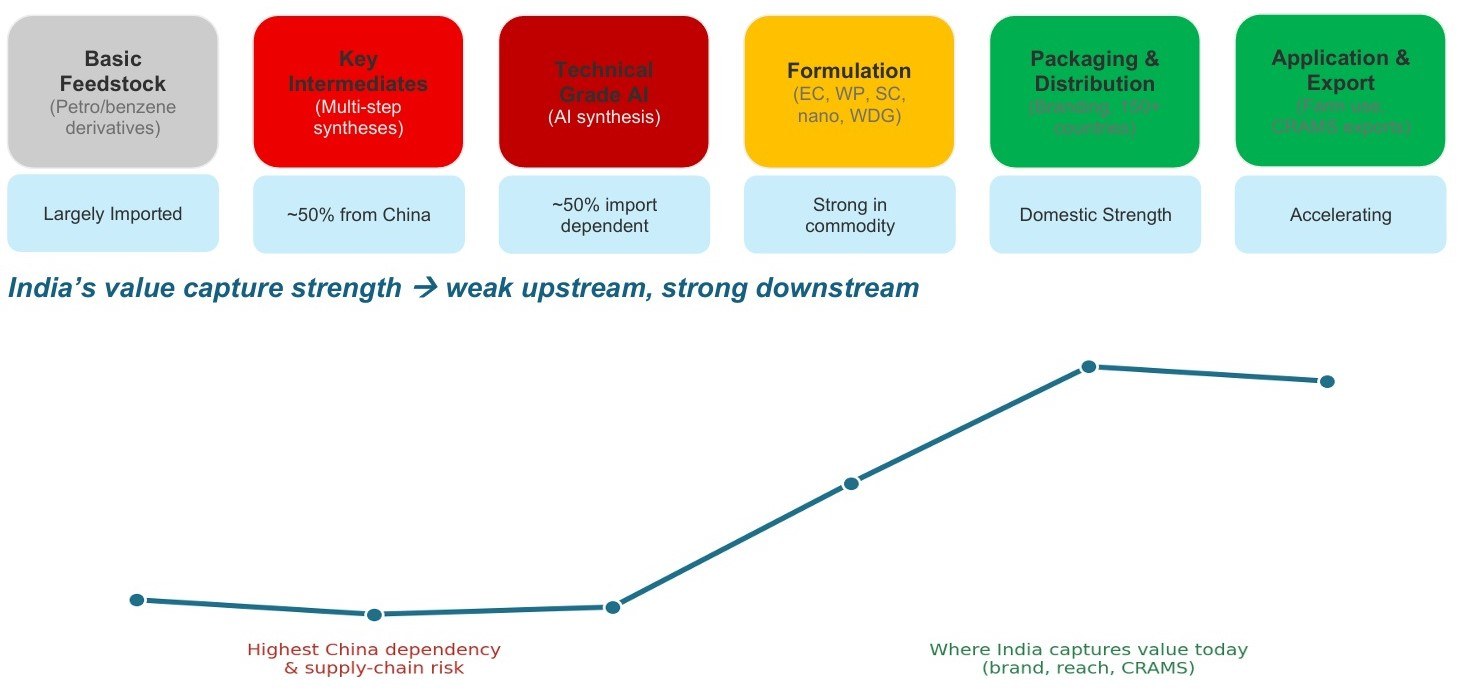
Unlike a simple upstream-to-downstream split, the agrochemical chain runs through six distinct stages, from basic petrochemical feedstock, through key intermediates and technical-grade active-ingredient (AI) synthesis, into formulation, packaging & distribution, and finally application and export. India’s control over these stages is strikingly uneven: weak and import-dependent at the chemistry-intensive upstream end and strong at the brand-, reach-, and service-led downstream end. The curve in Fig 2 traces the location of that value-capture strength.
Upstream (Stages 1–3): The Import-Dependent Core
India’s Current Position:The most critical vulnerability sits upstream. Despite being the fourth-largest agrochemical producer globally, India imports roughly half of its technical-grade active ingredients and a large share of the key intermediates that feed them, primarily from China, exposing the chain to supply shocks, price volatility, and quality risk. The economics are punishing — basic intermediates and generic technicals carry indicative gross margins of only 6–22%. Scale and backward integration, not price, are the only routes to a viable return here.
Key Indian Players: PI Industries | Aarti Industries | UPL Limited | Meghmani Organics
- PI Industries has built strong CRAMS capabilities, manufacturing complex molecules for global innovators; this is a high-margin model that has proven commercially resilient through the downcycle.
- Aarti Industries and UPL launched a specialty-chemicals joint venture in January 2025, combining agrochemical and intermediate manufacturing expertise.
- Meghmani Organics is committing about USD 100 million in capex for expansion and new-molecule introduction, signaling confidence in upstream viability.
White Space: Import substitution of high-volume technical molecules such as chlorantraniliprole, currently sourced almost entirely from China, is the largest upstream prize. In addition, several patented molecules become off-patent in 2026, including cyantraniliprole, sulfoxaflor, and Pinoxaden, opening near-term opportunities worth USD 1.15+ billion for players with the chemical expertise to move quickly.
Fig 2: India’s six-stage agrochemical value chain and where domestic players capture value
Midstream (Stage 4): Formulation — The Sophistication Gap
India’s Current Position: Formulation holds the highest near-term opportunity and the most visible sophistication gap. India is strong in commodity formulations (Emulsifiable Concentrates, Wettable Powders, and Suspension Concentrates) but weak in the advanced delivery systems global markets increasingly demand. Commodity formulation margins are thin (8–15%), which is precisely why progressing to advanced and specialty formats matters. Herbicide formulations are the standout growth category, with farm-labor shortages driving about 20% CAGR since FY20.
Key Indian Players: Rallis India | Sharda Cropchem | Insecticides India | Bharat Rasayan
- Sharda Cropchem pursues a registration-first strategy in Europe and other regulated markets, building a dossier-based moat rather than just manufacturing capacity.
- The biologicals sub-segment, including biopesticides, biofungicides, and biostimulants, is expanding at a CAGR of roughly 14%. It is expected to increase from USD 242 million in 2025 to USD 381 million by 2030.
White Space: Nano-formulations, water-dispersible granules, microencapsulated active ingredients, and drone-compatible systems remain underdeveloped. Regulated-market registrations (EU, Japan, US) are scarce for Indian formulators, limiting access to premium pricing. Early investment in registration capability, cold-chain handling, and formulation science builds sticky advantages.
Downstream (Stages 5–6): Distribution, Application, & Export
India’s Current Position: This is where India is strongest — branding, distribution reach, and export momentum are real and accelerating, with a powerful position in Latin America and Southeast Asia. Eight crop segments — rice, cotton, wheat, soybean, chilies, grapes, sugarcane, and gram — account for about 65% of the domestic market, giving a concentrated demand base. Branded and specialty formulations rebuild margins (22–35%) after the thin commodity stages.
Key Indian Players: UPL Limited | PI Industries | Coromandel International | Bayer India
- UPL operates distribution across over 130 countries, making it one of the most globally integrated Indian agrochemical companies.
- Coromandel International acquired a 53% stake in NACL Industries in 2025, expanding its crop-protection and contract-manufacturing footprint.
White Space: India’s export profile skews toward generics. The next phase of value comes from patented-equivalent formulations in post-patent windows, CRAMS for innovators, and registrations in high-value regulated markets. Crop-specific specialist formulation, precision fungicides for viticulture, and insecticides optimized for Brazilian soybean are differentiation pathways few Indian players pursue at scale.
Reading the Margin Gap
If the value chain shows where India can play, the margin structure shows where it is worth playing. Profit pools are not spread evenly along the chain but form a distinct “smile.” The commodity middle is thin, while the real money is made at the ends, which rely on chemistry complexity, IP, and regulatory capability.
Fig 3: Indicative gross margin ranges in the agrochemical industry
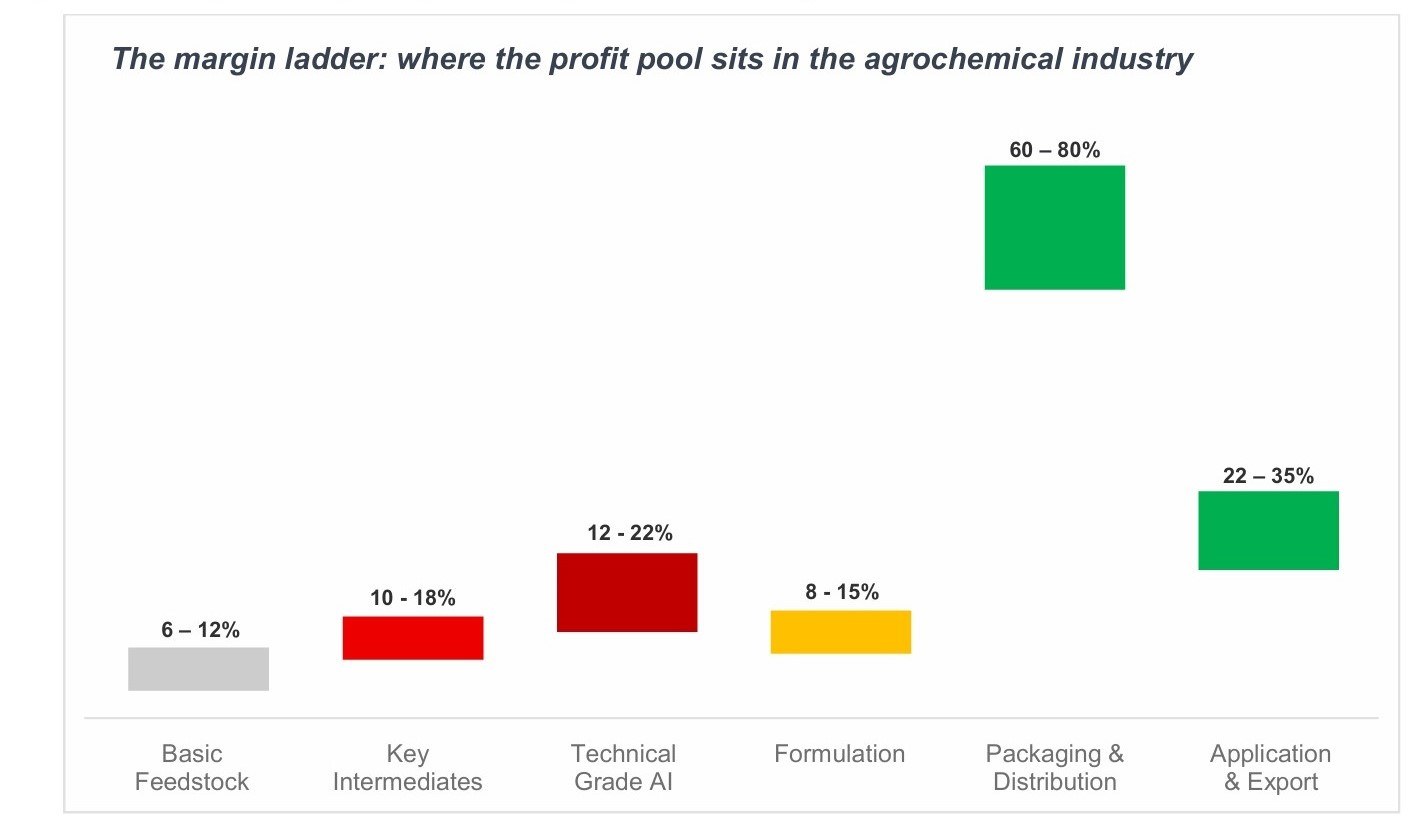
The pattern is unambiguous. Basic intermediates and generic technicals (6–22%) and commodity formulations (8–15%) are crowded, price-driven, and exposed to Chinese competition. By contrast, patented-AI and CRAMS manufacturing command 60–80% gross margins, and branded or specialty formulations recover to 22–35%. The strategic recommendation for an Indian player is to treat the thin middle as a volume base while deliberately migrating profit toward the high-margin ends.
Table 1: The margin gap in practice - listed-player EBITDA
| Company | Primary model | EBITDA margin | Read-across |
|---|---|---|---|
| PI Industries | CRAMS / innovator contracts | 22–25% | IP-led, most durable |
| Rallis India | Core agrochemicals + emerging CRAMS | 14–16% | Mid-tier, scaling up |
| Coromandel Intl. | Fertilizer + crop-protection volume | 8–10% | Scale, thin margin |
The contrast illustrates the argument. PI Industries, anchored in CRAMS, earns more than double the margin of volume-led Coromandel, not because it makes more product, but because it occupies a more defensible point on the chain. That is the gap Indian strategy must close.
Where Should a New Entrant Play?
The most attractive near-term opportunity for new and mid-tier players lies in advanced formulations and selective backward integration into post-patent technical molecules, where rising demand, China de-risking tailwinds, and comparatively low capital thresholds create a favorable entry window.
Upstream technical-grade manufacturing for high-volume molecules remains a long-term play, demanding heavy capital, deep chemistry, and long qualification cycles. Backward-integration investments by UPL and PI Industries confirm the direction, but the timing and capital intensity make it unsuitable for most new entrants over three to five years.
The smarter 2025–2030 play is formulation sophistication paired with registration strategy. A company that builds herbicide formulation capability for export in rice, soybean, and corn while pursuing EU, Brazil, and US registrations can build sticky, margin-accretive relationships. The CRAMS model offers another high-value pathway: manufacturing complex molecules for global innovators under long-term contracts provides IP-protected revenue and chemistry learning. For global players, few emerging markets can match at scale India’s combination of China+1 mandate compliance, a domestic patent cliff, and a large, underpenetrated home market.
Conclusion
India’s agrochemical story is one of genuine progress alongside persistent structural gaps. The export ambition is real - the country has earned its position as the world’s third-largest exporter through sustained investment in manufacturing and chemistry. But value capture at the high end, sophisticated formulations, proprietary molecule manufacturing, and regulated-market registrations remain disproportionately offshore, and the margin contest with China makes closing that gap urgent rather than optional.
The window for correction is opening, with the unprecedented simultaneous convergence of patent expiries, China supply-chain de-risking, rising domestic consumption, and growing policy attention. The companies best positioned to succeed will move beyond commodity generics, build differentiated formulation capability, and establish the registration and relationship infrastructure needed to compete in premium markets. In agrochemicals, as in most specialty-chemical segments, sustainable advantage is built not on scale alone, but on where in the value chain a company chooses to compete and how deeply it builds its technical and regulatory capability once it gets there.

Vivek Gorle
