
From Bailout to Buyout: What the IDBI-Fairfax Deal Signals for Indian Banking
Published on 21 Oct, 2026

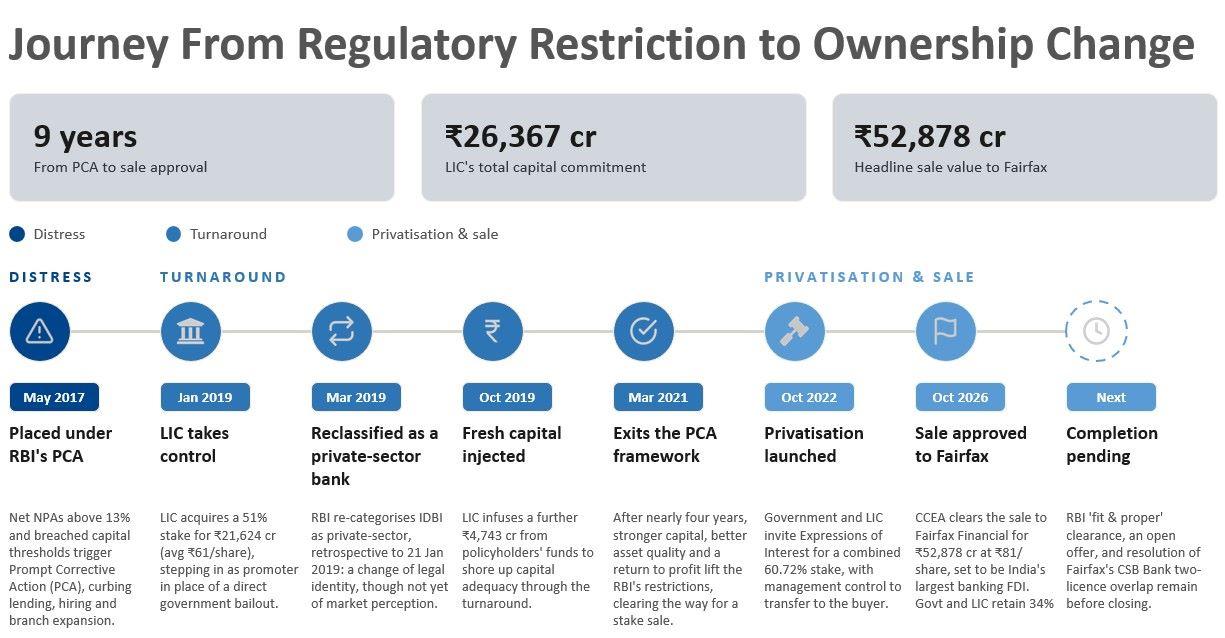
India’s Cabinet has approved the sale of a 60.72% stake in IDBI Bank to Canada’s Fairfax Financial for ₹52,878 crore, the largest-ever foreign investment in an Indian bank. It closes a nine-year journey, from IDBI’s deteriorating financial health in 2017, LIC’s rescue in 2019, and the bank’s profitable sale today. The deal shows that the government’s strategy of using LIC to nurse a failing bank back to health can pay off, helped in part by a strong stock market. It also offers a model for privatizing other banks and reflects regulators’ growing openness to foreign ownership, following recent deals by Emirates NBD, SMBC, and Blackstone.
India’s long-running attempt to exit IDBI Bank has finally concluded, and the manner of its conclusion matters more than the transaction itself. On October 14, 2026, the Cabinet Committee on Economic Affairs cleared the sale of a 60.72% stake in IDBI Bank to Fairfax Financial Holdings for ₹52,878 crore ($5.56 billion). For business leaders across banking, insurance and financial services, the deal is less a standalone event than a marker of three converging shifts: the revival of strategic disinvestment, the consolidation of India’s mid-sized banks, and the steady normalization of foreign strategic control in Indian lenders.
What is Fairfax Buying, And for How Much?
Fairfax Financial Holdings, led by Prem Watsa, will acquire majority control through a Canadian subsidiary. The winning bid of ₹81 per share came in above the ₹75.99 fair value assessed by two independent valuation agencies, and the stock closed above even the offer price, signaling that investors view the price as supportable rather than inflated. The shares are being sold by two public holders, viz. the Government of India (GOI) and Life Insurance Corporation of India (LIC). After completion, GOI will retain 15% and LIC 19%, taking their combined holding down to 34%. Once completed, this will rank as the largest foreign direct investment in India’s banking sector and the most significant strategic disinvestment since Air India. The transaction still requires the Reserve Bank of India’s “fit and proper” clearance and a subsequent open offer, so investors believe execution risk remains.
The History Matters: From Rescue to Sale
The present deal cannot be read without its origin. IDBI’s distress had deep roots: an aggressive corporate lending push through the mid-to-late 2000s, compounded by weak risk assessment and a wave of large corporate defaults, drove its gross non-performing assets (NPAs) from 3.22% in 2013 to 31.78% by September 2018, according to its regulatory disclosures. By then the strain was acute: the bank posted a ₹3,602 crore quarterly loss and was operating under the RBI’s Prompt Corrective Action (PCA) framework.
Rather than funding the bank directly, the government directed LIC to absorb it: LIC acquired 51% in January 2019 for ₹21,624 crore at an average price of ₹61 per share and later infused a further ₹4,743 crore using policyholders’ funds. That intervention was widely questioned at the time as a non-core deployment of insurance savings into a failing lender. Seven years on, with the bank returning to profitability and the stock trading near ₹90, LIC exits at a gain on the shares it sells while retaining a residual stake that has been appreciated in value. The implication is that the GOI’s practice of using LIC as a balance-sheet absorber for distressed assets has now completed a profitable round-trip, though a favorable equity cycle, as much as deliberate policy design, underwrote that outcome.
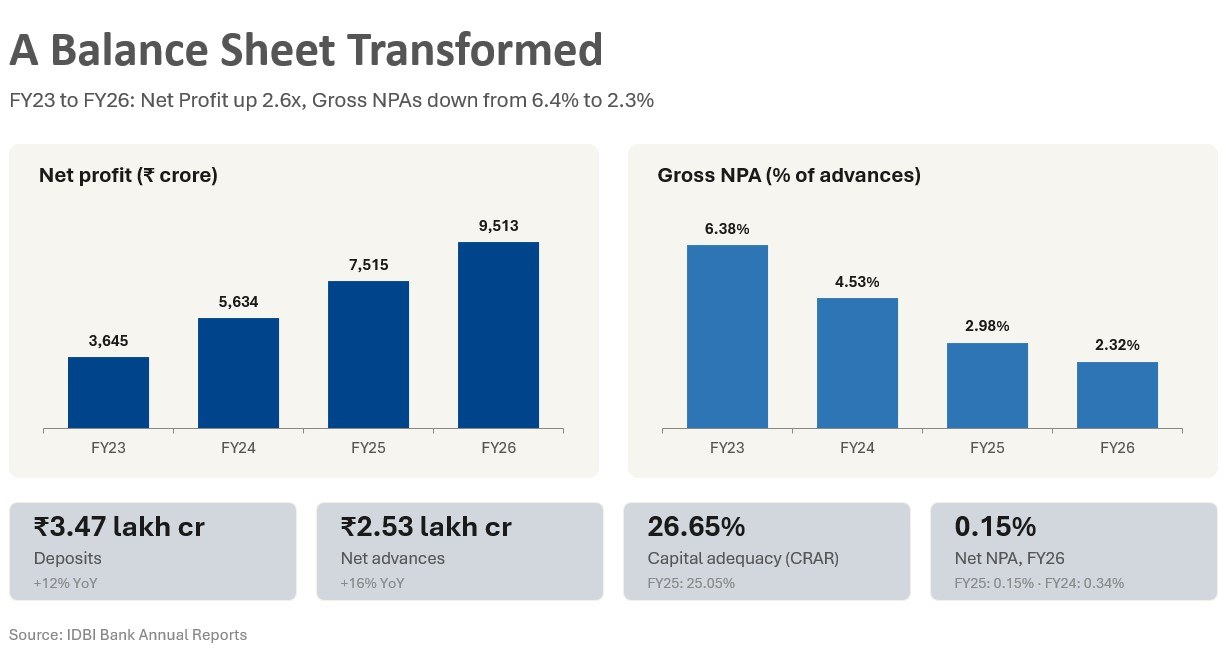
The scale of that turnaround shows up in the numbers. IDBI’s net profit climbed from ₹5,634 crore in FY24 to ₹7,515 crore in FY25 (33% growth YoY), and then to a record ₹9,513 crore in FY26.
Asset quality improved just as sharply: gross NPAs fell from about 6.4% of advances in FY23 to 2.32% in FY26, while net NPAs dropped from 0.34% in FY24 to 0.15% in FY26.
With a return on assets around 2.3%, a return on equity of 18.9%, and a capital adequacy ratio of about 26.7% (all figures for FY 2026), the bank Fairfax is buying now looks materially stronger than it did when LIC rescued it, helping explain the valuation and the depth of bidder interest.
A Trigger for More Bank Consolidation
The more immediate structural consequence lies in bank consolidation. Fairfax already holds roughly 40% of CSB Bank (formerly Catholic Syrian Bank Limited), and RBI norms prevent a single promoter from holding two banking licenses, obliging it to either merge CSB with IDBI or divest its stake in CSB within two years. Either path generates further transaction activity or reduces the number of independent mid-sized banks. For an industry where scale increasingly determines competitiveness in deposits, technology, and compliance investment, the IDBI deal is likely to accelerate the reshaping of the mid-sized private-bank tier below the four largest private banks (HDFC Bank, ICICI Bank, Axis Bank, and Kotak Mahindra Bank) – a tier long viewed as ripe for consolidation.
Part of a Bigger Foreign-Investment Wave
Viewed against the past 18 months, the IDBI deal reads as the largest entry in an established sequence rather than a departure.
- Emirates NBD (a UAE-based banking group) agreed in October 2025 to acquire a 60% stake in RBL Bank for around ₹26,850 crore (roughly $3 billion)
- Japan’s SMBC agreed in May 2026 to buy 20% of Yes Bank for ₹13,483 crore ($1.6 billion) and subsequently raised its holding to 24.9%.
- Blackstone, a US-based private equity firm, committed a ₹6,197 crore (approximately $700 million) investment for 9.9% of Federal Bank in November 2025.
The aggregate is substantial: As per industry reports, financial-sector M&A in India reached around ₹70,216 crore (roughly $8 billion) between January and September 2025, a 127% increase over the prior-year period. Three distinct acquirer types, a Gulf lender, a Japanese megabank, and a global private equity house, are converging on the same thesis: exposure to Indian credit growth through mid-sized franchises that need capital and sponsorship.
The Regulatory Framework Behind the Deals
What connects these transactions is not any recent change in the statutory ceiling but a discernible shift in how it is applied. India has permitted up to 74% foreign investment in private banks since 2004, with 49% on the automatic route and the balance requiring government approval. Separately, a single non-promoter foreign investor is capped at 15% without exceptional RBI approval. It is that exception that is increasingly being granted.
The RBI approved SMBC’s stake in Yes Bank and has signaled openness to Emirates NBD taking control of RBL, as part of a stated strategy to attract foreign investment and strengthen mid-sized banks. The consequence for global institutions is concrete: the binding constraint on strategic ownership is no longer the statutory ceiling but the regulator’s case-by-case comfort; and recent precedent suggests that regulatory approval is becoming more likely when the acquirer is well-capitalized and the target benefits from sponsorship.
What It Means for Foreign Capital in the Financial Services Sector
Three implications warrant attention from leadership teams:
First, the direction of travel favors control transactions over passive minority stakes; acquirers are now structuring for board influence and operational integration, not financial exposure alone.
Second, valuations for remaining mid-sized banks and prospective privatization candidates are likely to re-rate on acquisition optionality, compressing the window for entrants seeking reasonable entry multiples.
Third, the government’s willingness to revisit bank privatization will be assessed by IDBI’s precedent: though IDBI, already classified as a private-sector bank and majority-held by LIC, was a materially easier case than a conventional public-sector bank carrying union, sovereign-ownership, and priority-sector considerations. Over-extrapolation from this single success would be premature.
For global financial services executives, the practical conclusion is that India has moved from episodic foreign participation toward a more institutionalized channel for strategic capital in banking. The determinants of success are shifting accordingly: from securing entry to executing integration, managing the glide-path toward meeting minimum public shareholding, and resolving licensing overlaps. The IDBI–Fairfax deal closes one chapter in India’s disinvestment story and, more consequentially, confirms the template for the next one.
