
The GovTech Growth Race Is On - But What Will It Take to Win?
Published on 23 Oct, 2026

Government technology (GovTech) is entering a defining phase, where the ability to anticipate market shifts and make the right strategic bets would become an increasingly important differentiator. For solution providers, success would depend on looking beyond emerging technology trends to understand where demand is taking shape, how competitive dynamics are evolving, and which capabilities would be critical to winning and scaling in the public sector. The providers that make these choices early would be better positioned to capture emerging opportunities and establish a stronger foothold in the next phase of GovTech growth.
Technology is becoming central to modern governance
Governments worldwide are racing into a new era where technology is no longer optional but essential. Fueled by breakthroughs in artificial intelligence (AI), cloud computing, cybersecurity, and 5G, public sectors are reinventing how they serve citizens, manage resources, and tackle urgent challenges. This digital revolution is accelerating at an unprecedented pace, breaking down silos, creating seamless, interconnected systems, and reshaping the very fabric of governance. Yet, this transformation unfolds unevenly, shaped by each nation’s distinct priorities and capabilities. Regardless of the pace, GovTech is fundamentally redefining how governments connect with citizens, unlocking new levels of efficiency, transparency, and trust around the world.
Several dynamics are contributing to a rapidly evolving GovTech landscape:
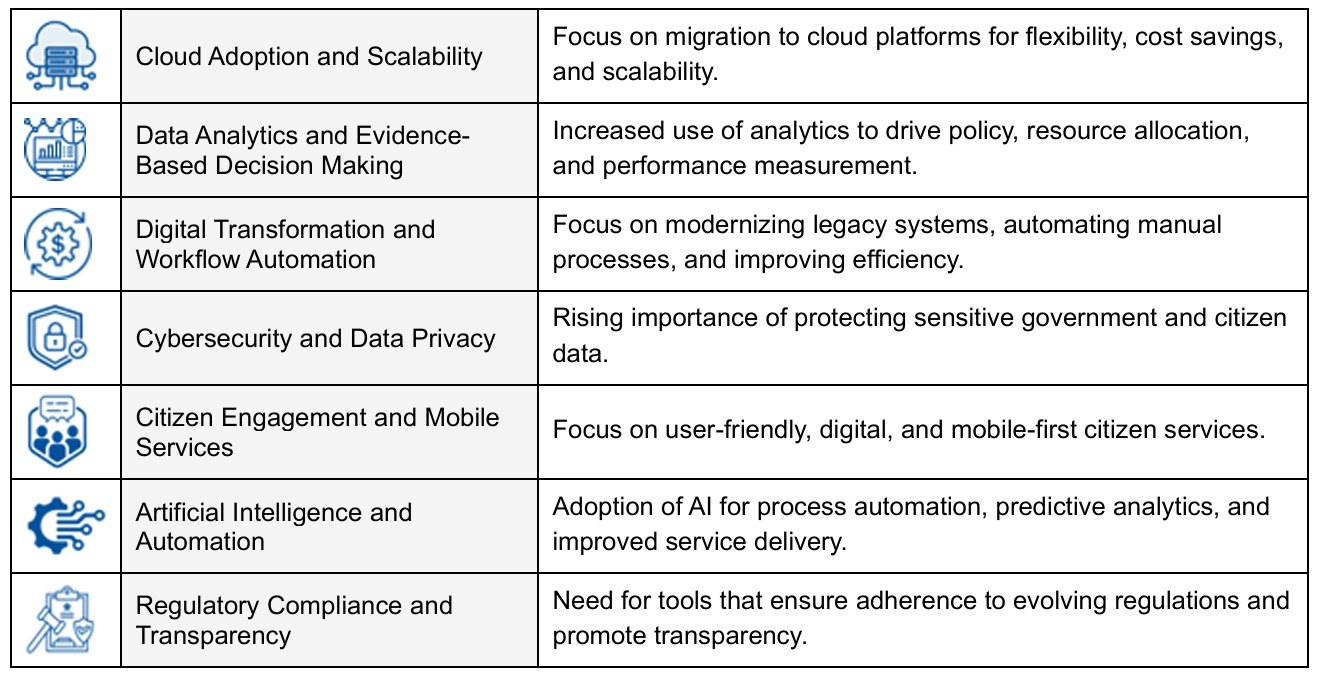
This shift is already changing how governments deliver services
While the overarching trends such as AI, cloud adoption, and heightened cybersecurity, are setting the stage for transformation, certain GovTech segments are surging ahead, capturing both investment and public attention. Among these, “Civic Engagement and Public Services,” “Administration and Operations,” and “Public Safety and Justice” are emerging as clear leaders, each harnessing technology to deliver tangible improvements in efficiency, accessibility, and trust. A wide range of initiatives across these segments is already proving technology’s capacity to deliver measurable results, as seen in several notable cases.
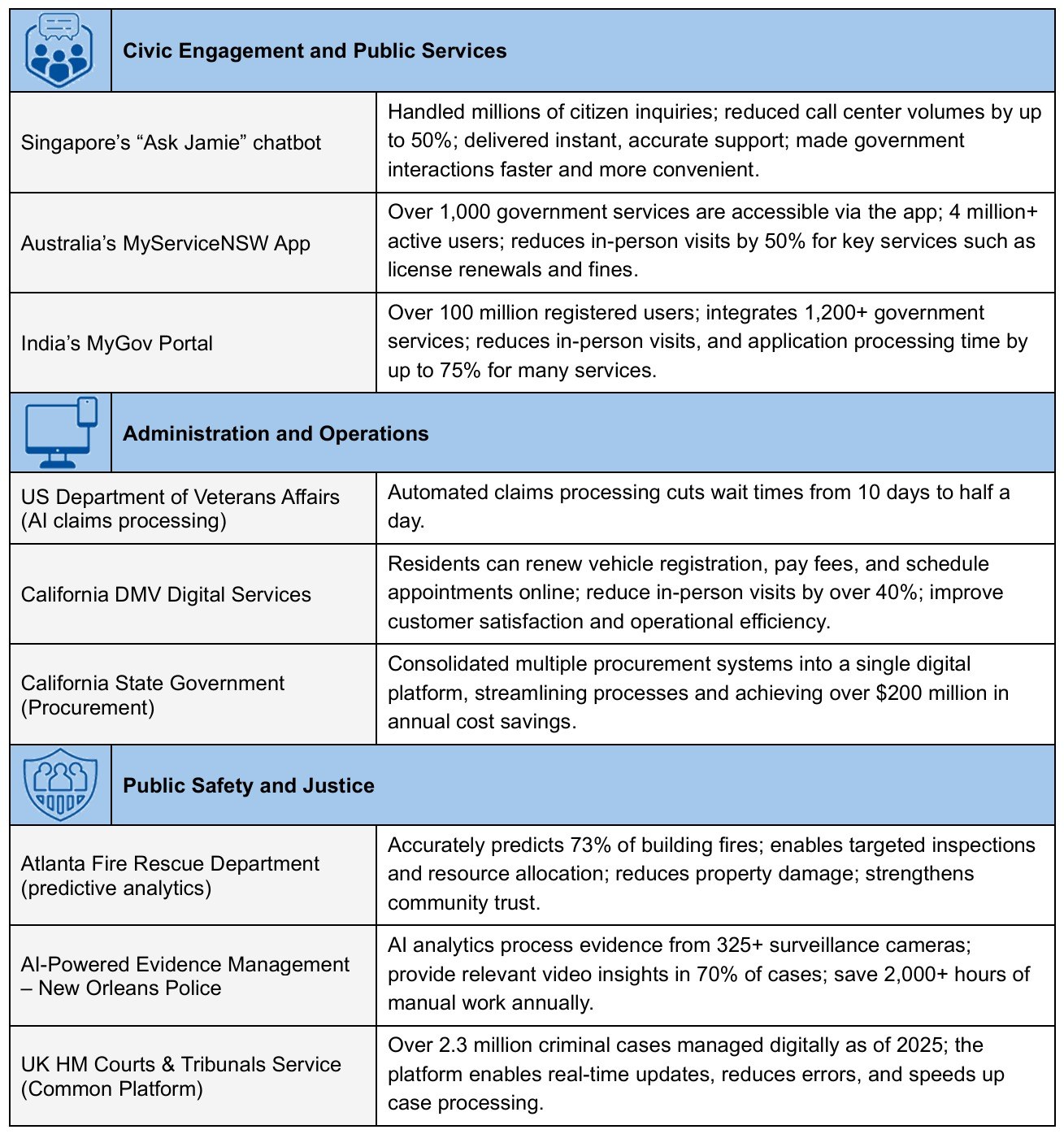
These changes are creating new opportunities across the GovTech market
The widespread adoption of these technologies is fueling substantial market growth, clearly reflected in GovTech’s impressive global trajectory. The GovTech market was valued at ~$650 billion in 2025 and is projected to reach over $1 trillion by 2030, representing a CAGR of 9-10%. This growth is driven by advances in digital technologies and rising expectations for government services to match private-sector convenience, supported by policies that enable secure modernization and innovation.
Governments are responding with clearer priorities and greater investment
In this landscape, government chief information officers (CIOs) are recalibrating their priorities to keep pace. In the coming years, cybersecurity and risk management are expected to remain paramount, reflecting the need to protect increasingly complex digital infrastructures. At the same time, there is a strong focus on harnessing AI and automation, modernizing legacy systems, improving data management, and enhancing accessibility, demonstrating a balanced approach that values both innovation and resilience as governments accelerate digital transformation.
This shift in priorities is clearly reflected in recent government investments and announcements. For example, India’s Union Budget has allocated ~$110 million specifically for cybersecurity projects and CERT-In in 2026-27. Similarly, the US FY 2027 budget proposes ~$12 billion for civilian cybersecurity, while the Department of Defense plans to invest $20.5 billion in cyberspace activities, including cyber operations. These substantial investments underscore how leading nations are backing up their digital ambitions with robust, targeted funding to safeguard public infrastructure and services.
A similar pattern is emerging in the field of AI, where governments are not only ramping up investment but also introducing new regulatory frameworks to guide responsible adoption. In 2025, US federal agencies introduced 58 AI-related regulations, more than double the number in 2023 demonstrating the growing importance of AI governance. Alongside this regulatory push, countries are making unprecedented financial commitments to AI: Canada pledged $1.74 billion (CAD 2.40 billion) as part of its new “AI for All” National AI Strategy, France committed $128 billion (EUR 109 billion), India pledged $1.25 billion, and Saudi Arabia’s Project Transcendence represents a $100 billion initiative. Together, these actions highlight how governments are pairing strong oversight with large-scale investment to drive innovation, ensure security, and maintain global competitiveness in the digital era.
But turning these priorities into results remains a challenge
The journey from investment to impact is far from straightforward. Many governments continue to grapple with outdated legacy IT systems and a persistent digital skills gap within their workforces. The task of embedding new technologies into established bureaucratic processes often exposes operational complexities that can impede progress. At the same time, the relentless pace of innovation requires continuous upskilling and agile policymaking to ensure that modernization efforts keep pace with evolving demands.
Taken together, these factors illustrate why the path to digital government is rarely linear. The following table highlights the most significant obstacles that agencies must navigate to achieve meaningful transformation:
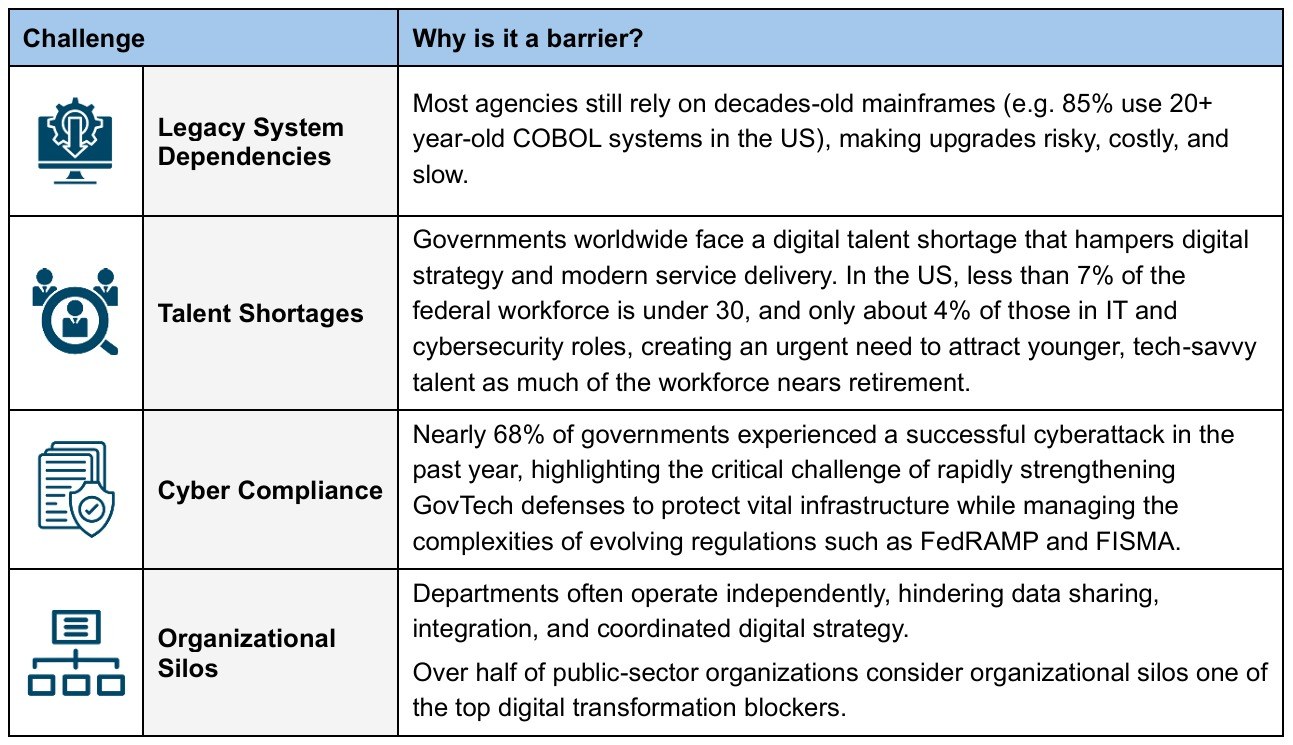
Other key barriers include the lack of a data and digital transformation strategy, inadequate data infrastructure or skilling, concerns about ethics, unclear ROI, and lack of funding.
Addressing these challenges requires more than technology alone
These barriers show that GovTech’s journey is not just a technological upgrade, but a test of vision, governance, and adaptability. Overcoming these barriers requires more than technology upgrades or isolated policy pushes; it demands a complete rethinking of government operating models, institutional agility, and industry collaboration. The very scale of investment and adoption seen today confirms that GovTech is not an emerging experiment, but the architectural backbone of governance in the digital era.
For GovTech providers, the next step is setting strategic priorities
The real frontier now is acceleration. As governments and GovTech solution providers lean into this decisive phase, the questions shift from “why” to “where to play, what to prioritize, and how to win”:
- Where are the biggest untapped opportunities for GovTech vendors: citizen services, internal government operations, public safety, healthcare, infrastructure, or defense?
- Where will the next wave of GovTech spending concentrate, and which technology categories will move from experimentation to mission-critical infrastructure?
- Where will AI create the largest new pools of government technology spending, and which use cases are most likely to scale beyond pilots?
- What capabilities and investments should GovTech firms prioritize today to remain relevant in a government landscape increasingly shaped by AI, automation, and data-driven decision-making?
- Which procurement and funding trends will have the greatest impact on vendor growth strategies in the years ahead?
- What will define the GovTech market leaders of 2030, and which strategic moves must vendors make now to secure that position?
Long-term growth will depend on delivering real value
GovTech is no longer waiting at the edge of transformation; it is becoming an increasingly important market for technology providers seeking new avenues for growth. Yet, capturing this opportunity would require more than keeping pace with emerging technologies. Vendors must understand the distinct needs of public-sector buyers, build solutions that can navigate complex government environments, and establish the capabilities and relationships needed to scale across agencies and markets. Ultimately, the ability to translate technological innovation into solutions that governments can adopt, trust, and sustain would shape the next chapter of the GovTech market.
