
AI as Economic Infrastructure: Key Insights from Davos 2026 on Scaling Value and Impact
Published on 20 Feb, 2026

At the 2026 World Economic Forum Annual Meeting in Davos, AI was framed as foundational infrastructure reshaping economies and enterprise strategy. The focus has shifted from model performance to large-scale execution—turning compute into tangible outcomes like productivity, revenue, and industrial transformation. Future value will come from efficient integration, rigorous measurement, and responsible governance, not experimentation.
At the 2026 Davos Summit, AI emerged not as a future promise but as a modern-day force, reshaping economics, geopolitics, and enterprise strategy.
The conversation moved decisively beyond model breakthroughs to diffusion, infrastructure, and execution.
The central question was no longer what AI can do, but instead:
- Who benefits from AI?
- How fast does value spread across the economy?
- Does AI broaden opportunity—or concentrate power?
Executive Summary:
Executives and leaders converged on a clear view: AI is becoming foundational infrastructure, akin to power, networks, or the internet itself.
Success depends less on model size and more on energy availability, computing efficiency, deployment capability, and governance discipline.
The next phase of value creation will be driven by:
- Multimodal and Physical AI, which combines models, data, robots, and real-world systems
- Speed of diffusion, not frontier capability
- Execution at scale, not experimentation
Key trends highlighted by world leaders in AI
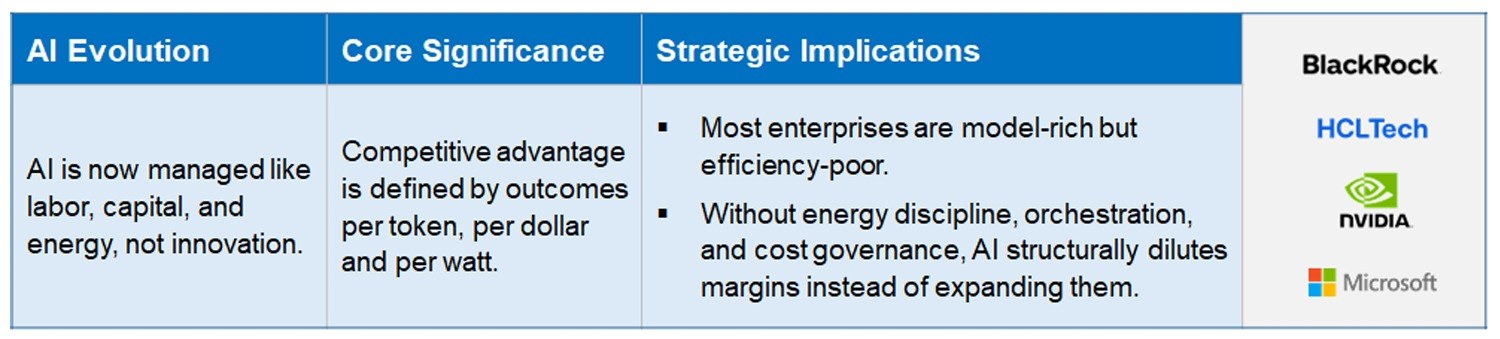
- The race is no longer for the smartest model, but for the cheapest, fastest conversion of compute into outcomes – AI is now a Production Input; not a Differentiating Feature
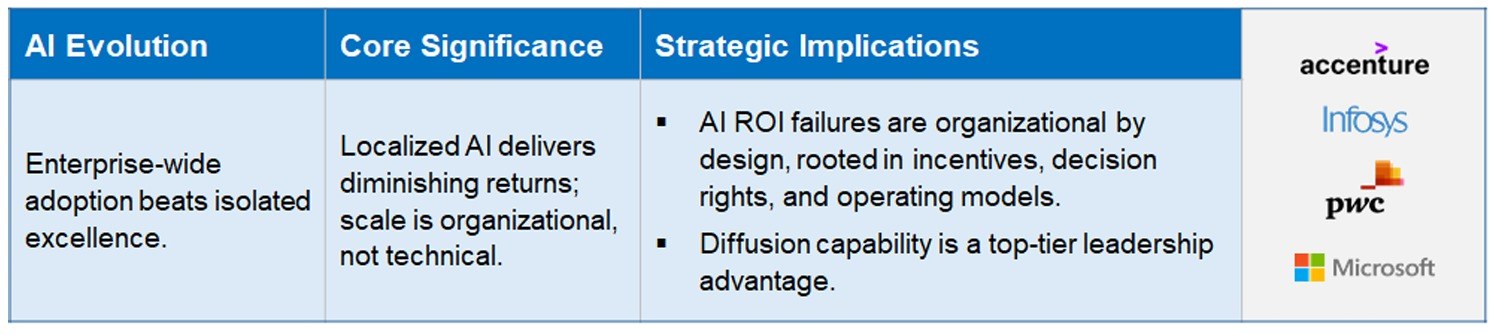
- AI creates durable value only through cross-domain integration; most organizations lack the operating capacity to absorb it at speed.
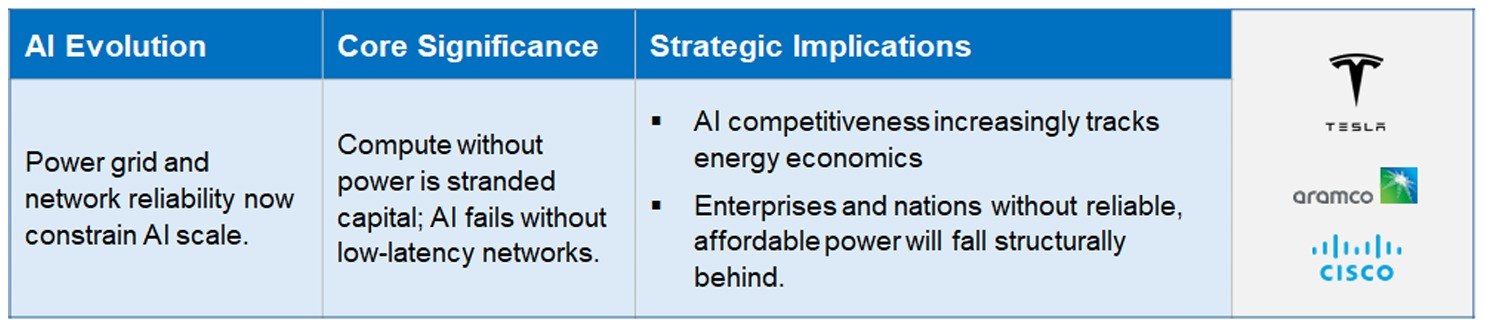
- The AI race is now limited by electricity, grids, and networks – not algorithms. – Power, not Chips, is the Binding Constraint on AI Scale
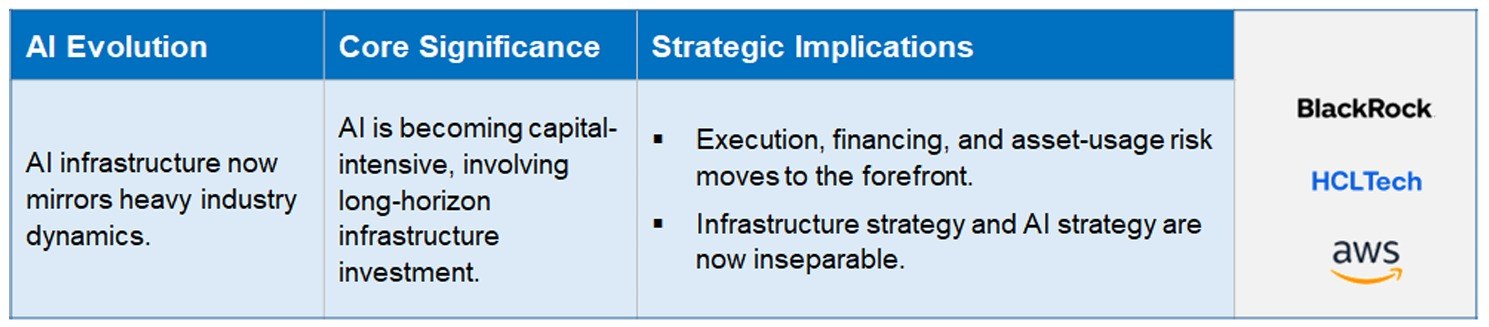
- AI infrastructure is starting to look like heavy industry. – Data Centers are Becoming AI Factories and that Changes Everything
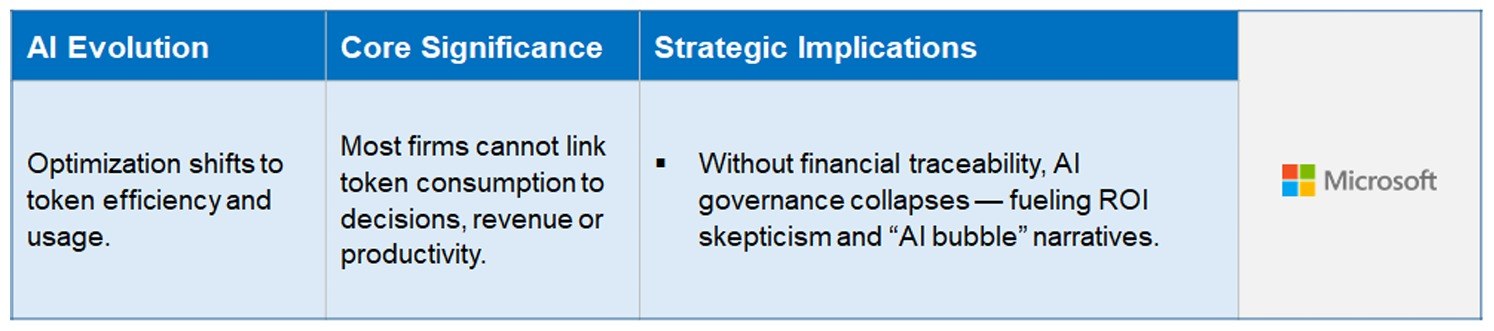
- AI competitiveness is about how efficiently tokens turn into decisions, revenue, and productivity. – AI Economics Are Token-Driven – and Most Firms Do not Measure It
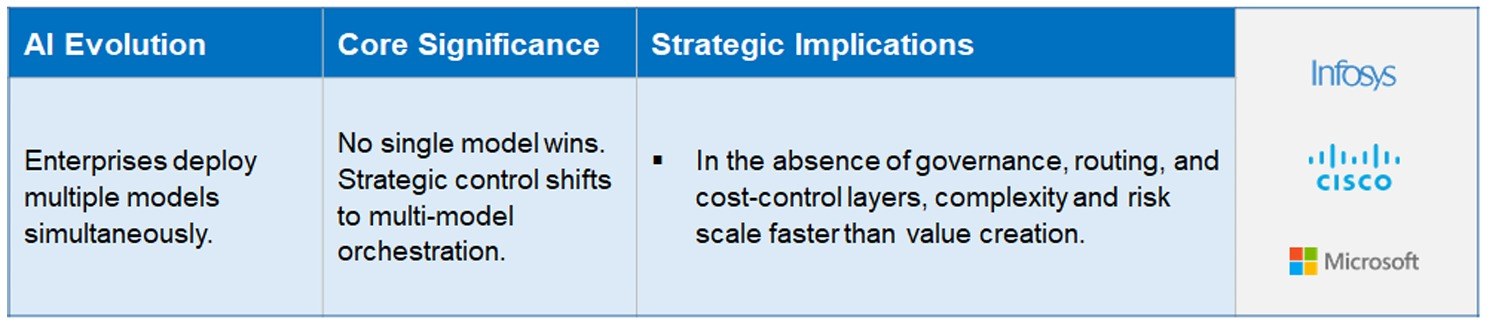
- No single model wins – control belongs to whoever orchestrates many – Multi-Model and Multimodal Is the Only Sustainable Enterprise Architecture
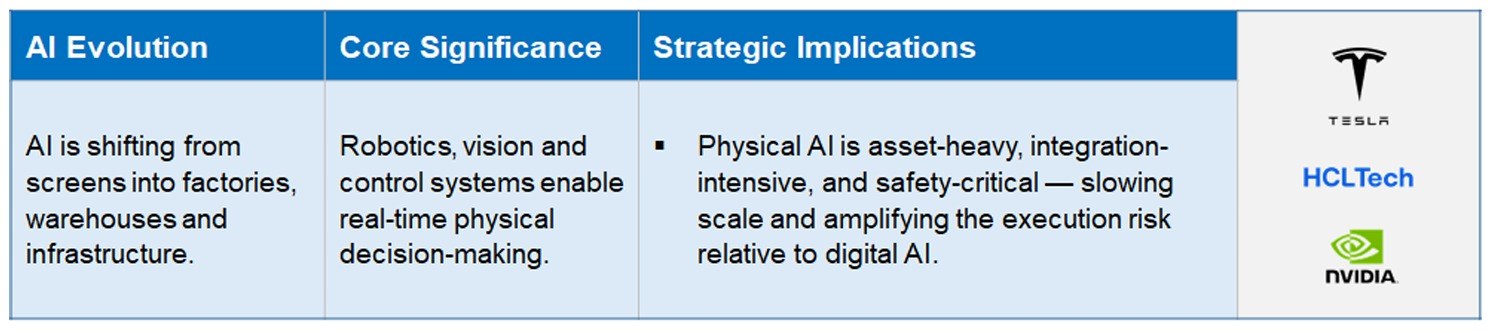
- AI is leaving the screen and entering factories, warehouses, and infrastructure. – Physical AI Is Where the Next Trillion-Dollar Value Pools Sit
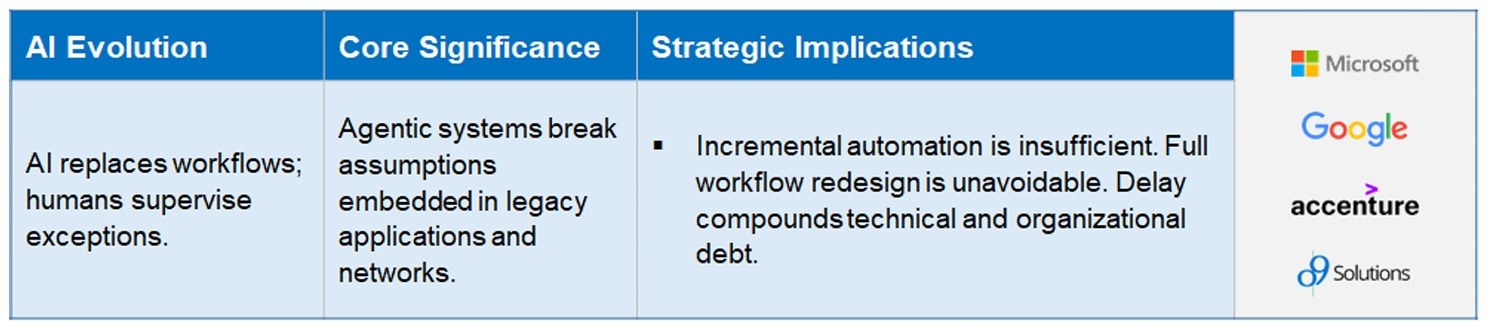
- AI does not fit into old workflows – it replaces them. – Workflows are Being Rebuilt for AI Agents – Humans offer Judgement as a Service to validate and maintain Governance
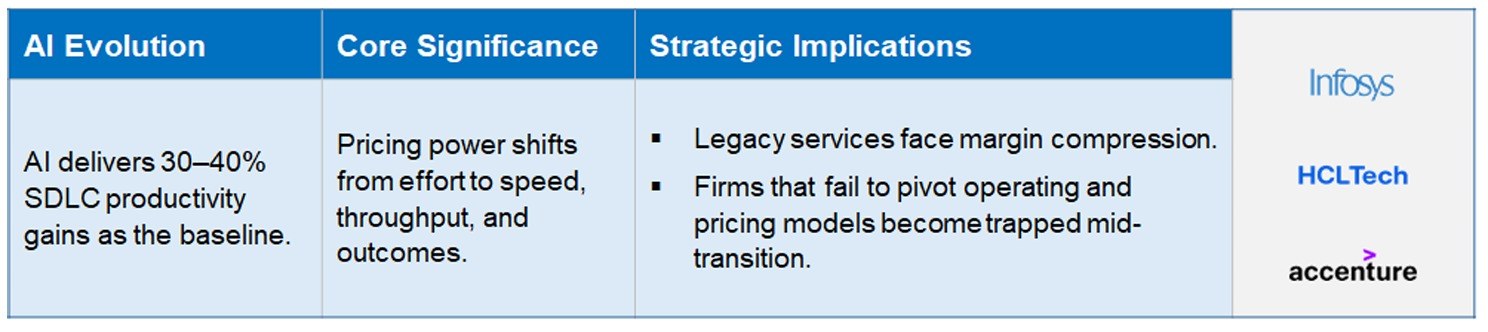
- AI multiplies engineer output but does not eliminate scarcity
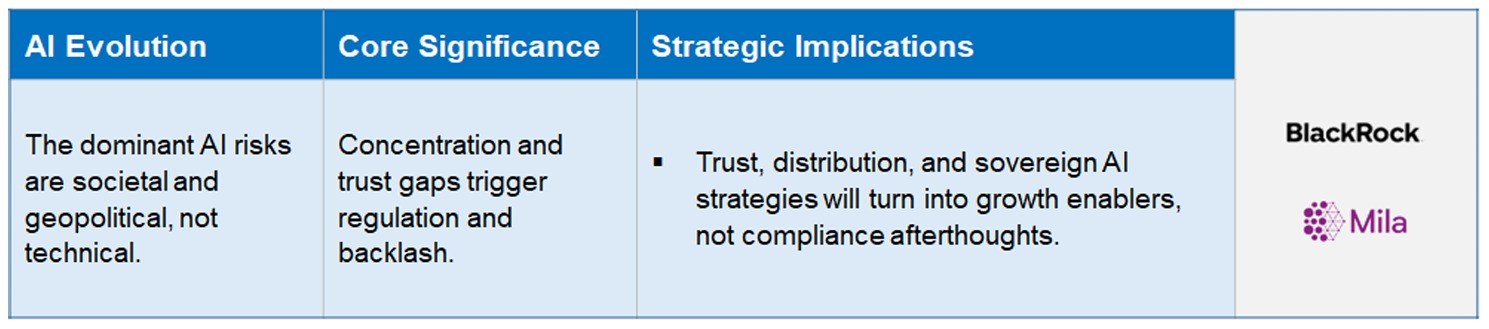
- The biggest AI risks are no longer technical; they are societal, geopolitical, and behavioral.
“AI will create value only when it is embedded into services and infrastructure, not when it is treated as an experiment.” C. Vijayakumar – CEO, HCLTech
“More than half of organizations are not seeing value from AI because they are unable to absorb it into how decisions are made.” Mohamed Kande – Global Chairman, PwC
“The constraint is no longer the chips. The constraint is power.” Jensen Huang – CEO, NVIDIA
“The opportunity is in infrastructure - that’s where long-term capital belongs.” Larry Fink – CEO, BlackRock
“Tokens are turning into the new input for economic growth.” Satya Nadella – CEO, Microsoft
“AI systems must span text, voice, vision, and networks to be useful at scale.” Jeetu Patel – EVP & Chief Product Officer, Cisco
“The biggest gains will come when AI is applied to physical environments.” C. Vijayakumar – CEO, HCLTech
“You don’t sprinkle AI on top of workflows; the workflows themselves change.” Satya Nadella – CEO, Microsoft
“The real opportunity is faster delivery and better outcomes, not fewer people.” Salil Parekh – CEO, Infosys
“We need humility and correction mechanisms as AI systems become more powerful.” Yoshua Bengio – Founder, Mila
CONCLUSION
Davos 2026 confirms that AI advantage will not belong to those who build the biggest models, but to those who industrialize AI into their economies and enterprises—efficiently, broadly, and responsibly.

Vineet Ghotkar

Priyanka Kulkarni
