
The Voucher Premium: Why the FDA's Fastest Review Lane Favors the Biggest Buyers
Published on 05 Nov, 2026

The FDA's Commissioner's National Priority Voucher has turned review speed into something companies can earn by aligning with national priorities, including affordability and domestic manufacturing. Reviews that normally take six to ten months are being completed in weeks. But a voucher cannot be sold, and several of the commitments that win one are easier for a large company to make than for a small biotech. This thought piece examines why the value of this speed increasingly sits with the owner of an asset rather than the asset itself and what it means for dealmaking.
Key Findings
The evidence so far points to four shifts:
- Speed is now a policy reward. The program promises decisions in one to two months, against a standard 10-month review goal. By late August 2026, a total of 11 products had been approved under it, with stated reviews of 24 to 55 days.
- Large, policy-aligned companies dominate the list. Most recipients have been large pharma companies, and all six in the second batch have already held pricing agreements with the White House.
- The premium belongs to the buyer. Vouchers cannot be sold or transferred, and the criteria reward commitments on pricing, onshoring, and manufacturing readiness that a small biotech often cannot offer. The same asset can, therefore, be worth more inside a large, policy-aligned acquirer.
- The premium needs a discount. The program has no specific statutory basis, its selection process is opaque, and its future may depend on the next round of FDA user-fee legislation, expected by September 2027.
1. How The Fast Lane Works
The FDA launched the Commissioner's National Priority Voucher pilot in June 2025. It offers a decision in roughly one to two months, against a 10-month goal for a standard review and six months for a priority review.
Vouchers go to products that serve one or more of five national priorities: public health crises, innovative cures, unmet medical needs, domestic manufacturing, and affordability. Proposals that address several are likely to be favored.
Exhibit 1. Reported voucher reviews have been far faster than standard goals
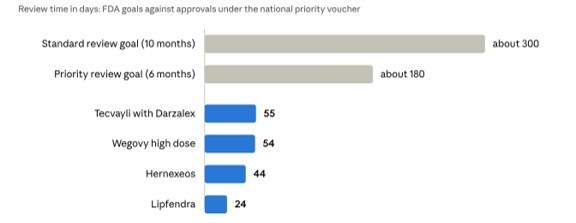
Early skeptics expected realistic timelines of 120 to 150 days. Where review times have been disclosed, the program has done better than them, although only four approvals have published figures.
2. Who Is Getting the Vouchers
More than 20 vouchers have been issued since the first batch in October 2025, and 11 products had been approved under the program by late August 2026.
Exhibit 2. Products approved under the national priority voucher by approval date
| Approved | Product | Sponsor | Stated review time |
|---|---|---|---|
| Dec 2025 | Augmentin XR | USAntibiotics | Not disclosed |
| Feb 2026 | Hernexeos | Boehringer Ingelheim | 44 days from filing |
| Mar 2026 | Tecvayli with Darzalex | Johnson & Johnson | 55 days from filing |
| Mar 2026 | Wegovy high dose | Novo Nordisk | 54 days from filing |
| Apr 2026 | Foundayo | Eli Lilly | Not disclosed |
| Apr 2026 | Otarmeni (DB-OTO) | Regeneron | Not disclosed |
| May 2026 | Bizengri | Partner Therapeutics | Not disclosed |
| Jun 2026 | Tzield | Sanofi | Not disclosed; route unclear |
| Jul 2026 | Casgevy | Vertex | Not disclosed |
| Jul 2026 | Lipfendra | Merck | 24 days from full receipt |
| Aug 2026 | Rasonque | Revolution Medicines | Not disclosed |
The pattern is clear. Most recipients have been large pharma companies, and all six companies in the November 2025 batch, including Lilly, Johnson & Johnson, and Novo Nordisk, already held pricing agreements with the White House. A pricing agreement is not a formal prerequisite, and smaller sponsors such as Revolution Medicines and USAntibiotics have also benefited. But the program's center of gravity sits with large, policy-aligned companies.
3. Why Does the Premium Belong to the Buyer
Business development teams have started to assess assets for "voucher alignment," and commentators argue that faster entry can lift an asset's value. This framing treats alignment as a feature of the asset. In practice, much of it is a feature of the owner.
Two design choices drive this. First, the voucher cannot be sold or transferred. Unlike a tradable rare pediatric disease voucher, which recent sales have valued at USD 180 million to USD 205 million, its value cannot be realized by selling it. It can only be realized by owning the product. Second, the criteria reward commitments that operate at company level.
Exhibit 3. Many voucher criteria are easier for a large company to meet
| What the program rewards | What a small biotech can usually offer | What a large, policy-aligned company can offer |
|---|---|---|
| Affordability | A price commitment for one product | Pricing agreements that already cover its portfolio |
| Domestic manufacturing | Reliance on contract manufacturers, often abroad | Its own US plants and onshoring pledges |
| Manufacturing readiness | A process still being scaled up | Established, inspection-ready production |
| Review readiness | A small regulatory team | Capacity to support a one-to-two-month review |
It is already noted that larger firms can offer broader investment and pricing pledges. The consequence for dealmaking follows directly. An asset that would struggle to win a voucher on its own can become a strong candidate once it sits inside a large, policy-aligned company. The value of that speed, estimated by FDA leadership at more than USD 100 million per voucher, is created by the change of ownership. It gives biotech firms one more reason to partner or sell and also gives them a reason to negotiate for a share of that value when they do.
4. Why the Premium Needs a Discount
Any value placed on a voucher should reflect three risks as follows:
Durability. The program has no specific statutory authorization and could be phased out by a later administration. Its future may depend on the next FDA user-fee reauthorization, expected by September 30, 2027. Legal commentators also see exposure to challenge, since the award process is discretionary and courts now give agencies less deference.
Predictability. It is not public which vouchers were awarded on application and which were proposed by FDA. Since the criteria are broad, a company cannot reliably plan on winning one.
Speed is not approval. A voucher shortens the review, but it does not change the standard. One product on the list received a complete response letter in February 2026, and some voucher holders still faced delays.
The practical conclusion is to treat the voucher as a valuable but uncertain option. It is worth paying for in a deal but through contingent terms rather than a fixed upfront amount.
5. What Each Group Should Do
Biotech:
- Assess voucher potential in both scenarios. Estimate the asset's chances of winning a voucher on its own and inside a likely acquirer. The gap between the two is negotiating leverage.
- Capture the uplift through contingent terms. Seek milestones tied to a voucher award or to approval within a set period rather than leaving the value to the buyer.
- Build what you can control. Manufacturing readiness and a credible US supply route improve the odds whoever owns the asset.
Big pharma business development teams:
- Value ownership-driven upside separately. Model the voucher as an option created by the acquisition and price it with a discount for policy risk.
- Use it as a differentiator in competitive processes. A credible path to a voucher, backed by existing pricing agreements and US manufacturing, can win deals without raising the upfront payment.
- Avoid over-reliance. Do not let launch plans or deal cases depend on a voucher that may not be awarded or may not survive the next reauthorization.
Investors:
- Expect a sell-side tilt. Where voucher eligibility depends on company-level commitments, more biotech firms may choose to partner or sell before approval.
- Watch concentration. If vouchers continue to mostly flow to large companies, the program will reinforce scale advantages in late-stage development.
6. What to Watch Out For
| Signal | Why it matters | What would change the picture |
|---|---|---|
| Who receives the next vouchers | Shows whether the program favors scale | A rising share of awards to small and mid-sized sponsors |
| Voucher-linked deal terms | Shows whether biotechs are capturing the value | Milestones tied to voucher awards appearing in licensing and M&A deals |
| FDA transparency | Affects how predictable the program is | Published criteria, award routes, and review times |
| User-fee reauthorization | Decides whether the program becomes durable | The program codified in law, or dropped, by September 2027 |
| Legal challenges | Tests the program's discretionary design | A court challenge to an award or a voucher-based approval |
The Bottom Line
The national priority voucher has made FDA review speed something that companies can earn. Since the voucher cannot be sold, and many of its criteria reward company-level commitments on pricing and manufacturing, that speed is worth the most to large, policy-aligned owners. For biotech firms, this is one more reason to partner or sell, and a reason to negotiate for a share of the value their buyer gains. For acquirers, it is a real but fragile advantage that should be priced with a discount for policy risk. The program's long-term effect may be less about faster approvals than about who ends up owning the assets that get them.
