
The Hidden Epoxy Chemistry Behind the AI Data Center Boom
Published on 22 Oct, 2026
The artificial intelligence (AI) boom is driving one of the biggest waves of data center construction the world has seen. The rapid adoption of generative AI, cloud computing, and high-performance computing is pushing operators to build larger facilities with significantly higher computing and power densities.
But the AI infrastructure story is not only about GPUs, servers, and semiconductors. Every new data center also requires a complex physical environment capable of protecting highly sensitive equipment, managing heat, handling heavy loads, and maintaining reliable operations.
That creates opportunities for a range of materials and chemical products, including epoxy.
Epoxy is often associated with industrial flooring, but it is much more than a flooring material. It is a versatile thermosetting polymer used across coatings, adhesives, composites, electrical applications, and protective systems. As data centers become more sophisticated, demand for high-performance epoxy-based formulations could increase alongside the broader construction cycle.
Why could AI change the epoxy opportunity?
The connection between AI and epoxy is indirect but potentially significant.
AI workloads require much higher computing power than traditional enterprise workloads. Higher computing density means higher power consumption and, consequently, greater heat generation. This is driving changes in data-center architecture, including more sophisticated cooling and power infrastructure.
For example, high-density AI deployments are increasingly driving adoption of liquid-cooling technologies. In India, Vertiv announced a direct-to-chip liquid-cooling deployment supporting 30 MW of AI-ready capacity at a data center in Navi Mumbai, illustrating how AI workloads are changing the physical infrastructure required inside facilities.
These changes can increase the importance of flooring and protective systems capable of handling demanding operating environments, heavy equipment movement, moisture-management requirements, and stringent cleanliness standards.
This does not mean that every new liquid-cooled data center would consume more epoxy. Rather, AI is expanding the market for high-performance infrastructure, creating potential opportunities for specialized resinous systems.
How big is the opportunity?
Data-center capacity is growing rapidly. Global capacity is expected to increase from 116 GW in 2025 to 207 GW by 2030, creating more demand for construction materials such as epoxy-based flooring and coatings. The US is expected to reach around 118 GW by 2030, while India could grow from 2.2 GW to 12 GW, with AI-focused capacity increasing from 275 MW to 6.55 GW over the same period. The global market for data-center coatings and ESD flooring is estimated at $2.8 billion in 2025 and could reach $5.1 billion by 2032.
Epoxy is expected to capture a portion of this market, with one estimate putting its share of low-VOC data-center floor coatings at ~42.5%, or ~$765 million in 2025. Therefore, the opportunity for epoxy producers comes not from the entire data-center market, but from the share of flooring, coatings, and other applications where epoxy-based systems are adopted.
Where can Epoxy be used in data centers?
One of the most visible applications of epoxy in a data center is flooring.
A typical resinous flooring system is installed over prepared concrete and can consist of multiple layers, including a primer, body or build coat and protective topcoat. Depending on the application, the system may also incorporate conductive or static-dissipative materials.
These systems can be thin coatings, high-build systems, self-leveling floors or thicker resinous mortar systems. Therefore, describing all epoxy flooring as simply “epoxy poured onto the floor” oversimplifies the technology.
The attraction is the performance of the cured system. A properly formulated resinous floor can provide a seamless, durable and easy-to-clean surface while offering resistance to abrasion, chemicals, and heavy equipment movement.
For data centers, these properties matter as these facilities contain expensive and sensitive electronic equipment operating continuously.
Other potential applications of epoxy in data centers
Flooring is the most straightforward application, but it is not the only potential route for epoxy chemistry into a data-center project.
Epoxy-based protective coatings can also be used on concrete and metal surfaces where resistance to abrasion, chemicals, moisture or harsh operating conditions are required. Data centers contain electrical rooms, mechanical spaces, cooling infrastructure, and other areas where protective coatings may be specified.
Epoxy chemistry also has broader relevance to electrical insulation, encapsulation, adhesives, and composite materials. However, these applications should not automatically be treated as major data-center epoxy demand drivers. Their importance depends on the specific equipment design and procurement specifications.
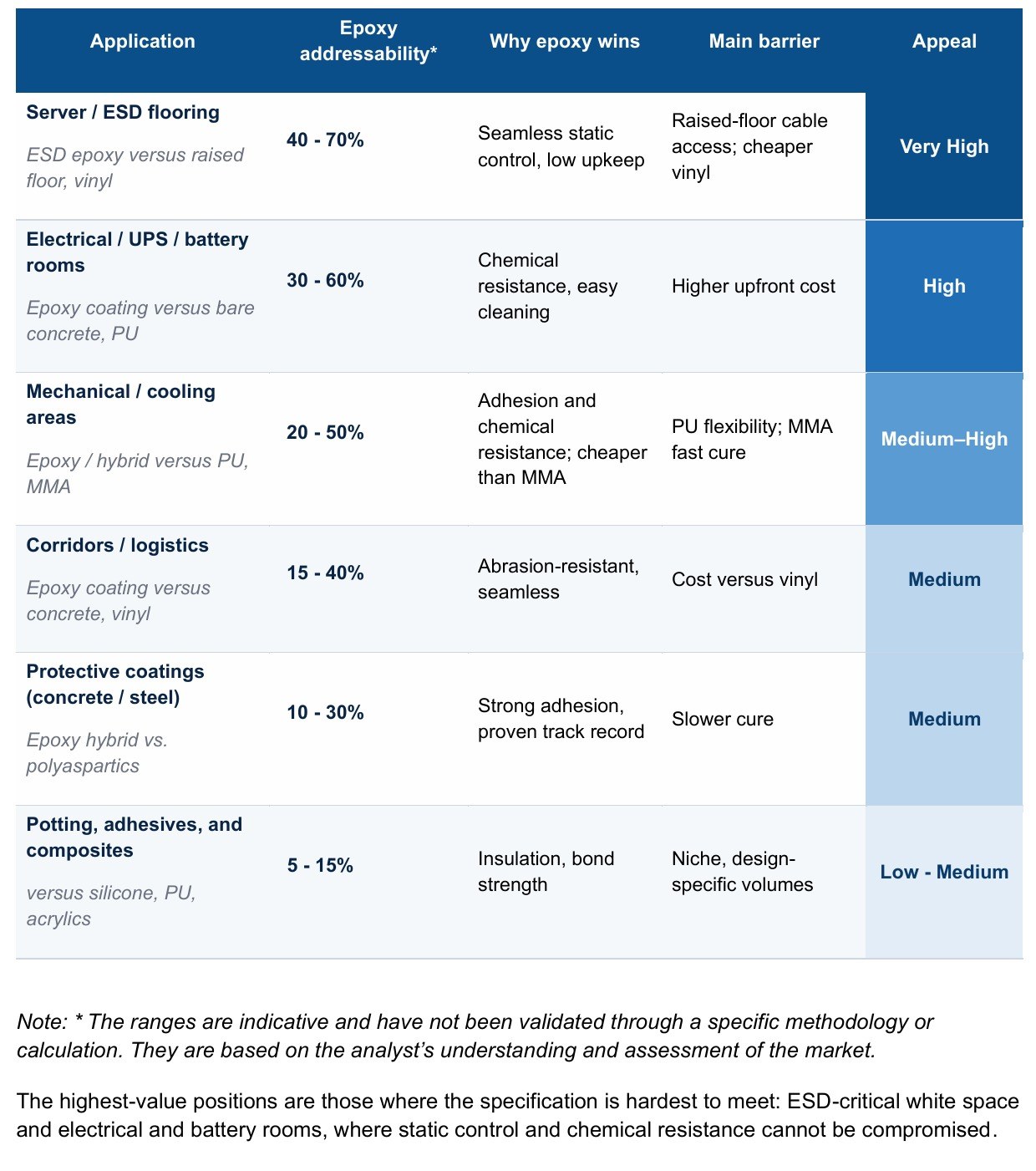
The more defensible opportunity therefore lies in identifying where performance requirements are becoming more demanding and where epoxy-based systems provide an advantage over alternative materials.
From AI demand to chemical demand
The commercial opportunity becomes clearer when the value chain is considered. A data-center developer or operator typically specifies the required performance level for the facility. Flooring or coating contractors then install a formulated system supplied by a flooring or coatings manufacturer. That formulation contains epoxy resin, curing agents, fillers, pigments, and other additives.
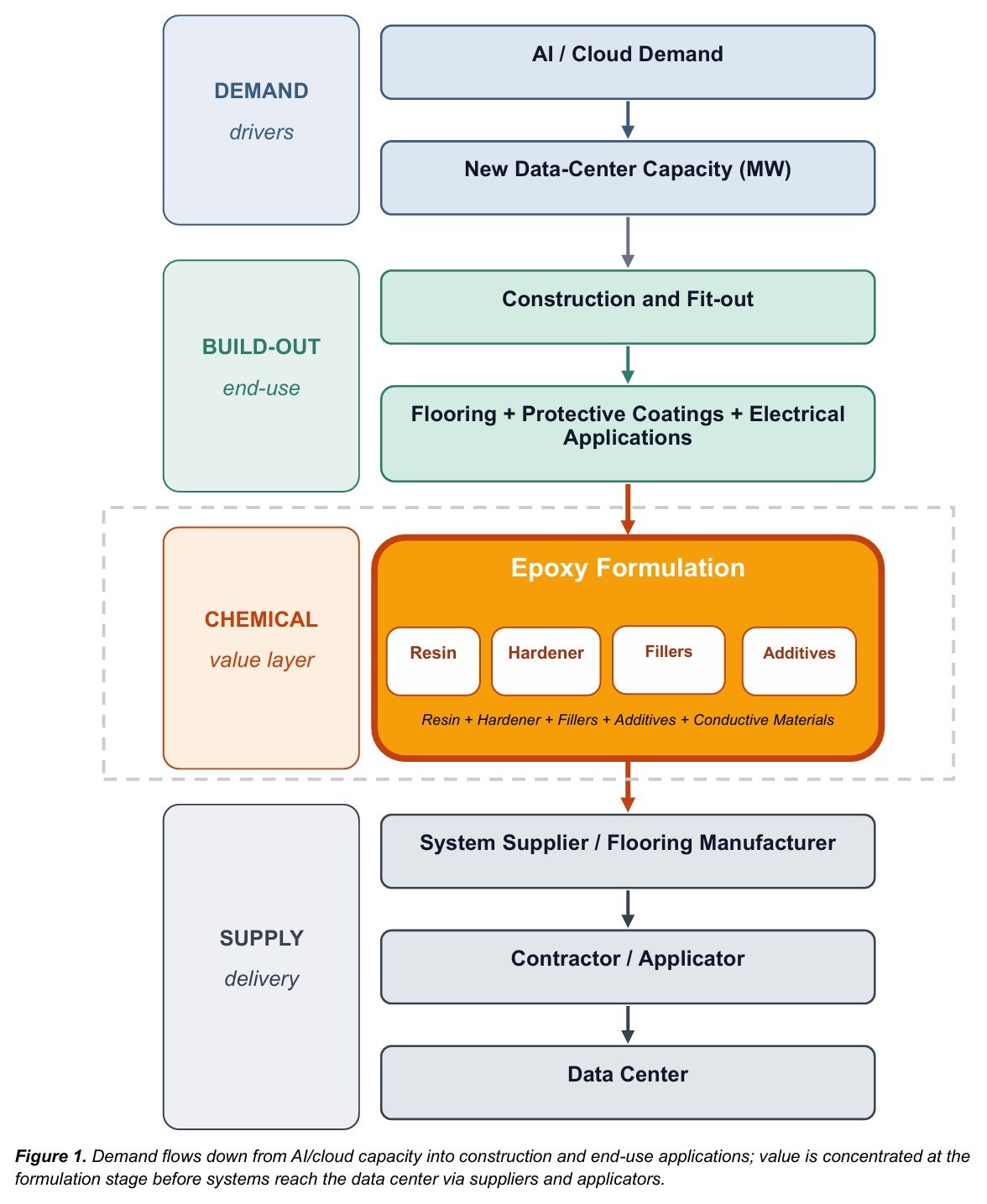
An increase in data-center construction does not translate one-for-one into an increase in epoxy resin consumption. Not every area receives epoxy flooring, and not every resinous flooring system is epoxy. Polyurethane, polyurethane-cement, methyl methacrylate (MMA), sealed concrete, and other systems can compete depending on the application.
The opportunity is therefore not simply about more square meters of flooring. It is also about the increasing performance requirements attached to those square meters.
Where epoxy can displace incumbent data-center solutions?
What does this mean for epoxy companies?
The AI data-center boom is unlikely to transform epoxy into a completely new product category. Instead, it can strengthen an existing application by creating a rapidly expanding end market with demanding performance requirements.
For epoxy resin producers, curing-agent suppliers, and specialty additive companies, the opportunity could emerge through partnerships with flooring and coating formulators, development of ESD and high-performance systems, and qualifications with contractors and infrastructure developers.
The companies best positioned to benefit may not necessarily be those selling the largest volumes of standard epoxy. They may be those capable of supplying consistent, high-performance chemistry that enables formulators to meet increasingly demanding data-center specifications.
The broader lesson is that AI is creating a ripple effect far beyond semiconductors. As computing infrastructure becomes more powerful, the materials supporting that infrastructure also need to evolve.
Epoxy is one example of this hidden chemistry behind the AI infrastructure build-out.
Conclusion
The rapid expansion of AI and data centers is creating a growing opportunity for high-performance materials, including epoxy-based systems. While epoxy would not replace every existing flooring or coating technology, its combination of durability, chemical resistance, ESD control, and seamless protection makes it well suited to several critical data-center applications. As data centers become larger, denser, and more technically demanding, the opportunity is likely to shift from standard epoxy products toward specialized formulations designed for specific performance requirements. For epoxy and chemical producers, the key opportunity is therefore not simply benefiting from growth in data-center construction but capturing a larger share of high-value applications. This opportunity would grow as technical requirements and adoption of advanced flooring and coating systems would increase.

Vijai VR
