
What Is Business Diversification? Types, Strategies & Real Examples
Published on 30 Jul, 2026

What happens to your revenue the day your biggest customer walks away, a regulator reshapes your industry, or a competitor makes your core product obsolete? For most companies, the answer is: a very bad quarter, or worse. That's the exact risk a well-built business diversification strategy is designed to neutralize.
Diversification isn't about chasing every shiny opportunity that crosses your desk. It's a deliberate, capital-intensive decision to build revenue streams, markets, or capabilities that don't rise and fall together. Done right, it turns a fragile, single-threaded business into one that can absorb shocks and keep growing. Done poorly, it destroys shareholder value and dilutes management focus.
This guide breaks down what diversification really means, the core types and strategies, and how companies like Amazon, Alphabet, and Berkshire Hathaway have used it to build resilience so you can evaluate whether it belongs in your own strategic roadmap.
What Is Business Diversification?
Business diversification is the strategic decision to expand a company's operations into new products, services, markets, or industries beyond its current core business. The goal is twofold: reduce dependence on any single revenue source, and open new avenues for growth.
At its core, diversification occurs when a company expands beyond its current products, services, or markets, with the primary goal of spreading risk and capitalizing on new opportunities. It's often described as a "strategic firewall" - a way to contain the damage from a downturn in any one part of the business.
For CFOs and corporate strategists, diversification sits at the intersection of two disciplines: portfolio risk management and growth strategy. It's rarely a side project. It typically requires capital allocation decisions, M&A evaluation, and long-term governance commitment from the top of the organization.
Why Diversification Matters Right Now
Boardrooms aren't diversifying for novelty reasons. They’re doing it because the macro environment is forcing the issue. In 2026, global markets are more interconnected and more unpredictable than ever, and inflationary cycles, shifting monetary policies, and geopolitical tensions have made clear that no single investment or business strategy is foolproof.
Key drivers pushing diversification up the boardroom agenda:
- Supply chain fragility exposed by recent global disruptions
- Rapid shifts in consumer preferences and technology adoption
- Geopolitical and regulatory volatility affecting single-market operators
- Investor pressure for more resilient, predictable earnings
Types of Business Diversification
Not all diversifications look the same. Understanding the different types helps leadership teams match the approach to their risk appetite, core competencies, and capital position.
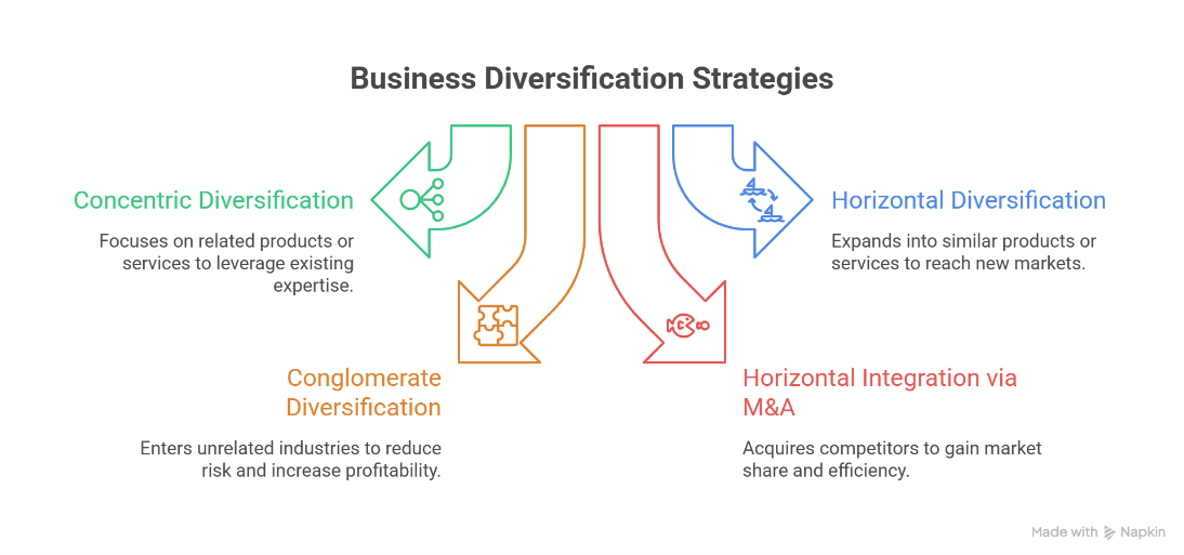
1. Concentric (Related) Diversification
This is when a company expands into a new product or service that leverages its existing expertise, technology, or customer base. A classic example is a camera manufacturer developing high-end drones equipped with advanced imaging technology - a natural extension of its core competency.
Why it works: Lower execution risk because the new venture builds on capabilities the company already has.
2. Horizontal Diversification
Here, a company introduces new, unrelated products or services aimed at its existing customer base. Think of a fitness apparel brand launching a nutrition supplement line - different product, same audience.
3. Conglomerate (Unrelated) Diversification
This is the boldest form: entering completely unrelated industries with no direct link to the existing business. Berkshire Hathaway is the textbook example: it owns businesses across insurance (GEICO), railroads (BNSF), and consumer goods (Dairy Queen), a diversified portfolio that protects the company from volatility in any single industry.
Trade-off: Maximum risk-spreading, but it demands strong central capital allocation discipline to avoid becoming an unfocused conglomerate that destroys value instead of creating it.
4. Horizontal Integration via M&A
Many companies diversify inorganically, buying their way into new capabilities or markets rather than building them internally. This is a major reason M&A remains one of the most used diversification levers among large enterprises.
Core Business Diversification Strategies
a. Product Diversification
Expanding your product lineup to serve new needs within or adjacent to your current market. This reduces reliance on a single product's lifecycle and can smooth revenue across changing demand cycles.
b. Market (Geographic) Diversification
Expanding into new geographic regions to access new demand pools and reduce dependence on any one economy. Over the past decade, the Middle East has emerged as a rising hub for global higher education, prompting Western universities to expand into the region as a geographic diversification play that accesses entirely new markets with growing demand.
c. Vertical Diversification (Integration)
Moving into different stages of your own supply chain, either upstream (toward raw materials/suppliers) or downstream (toward distribution/retail). This gives companies more control over cost, quality, and margin capture.
d. Innovation and R&D-Driven Diversification
Rather than building on existing assets, this strategy bets on the future through dedicated research. Alphabet's "moonshot" division, X Development, is a prime example, exploring everything from self-driving cars to renewable energy as a forward-looking diversification bet.
e. M&A-Led Diversification
Acquiring companies to instantly gain new capabilities, customer bases, or market access - much faster than organic build-out, but with higher integration risk (more on this below).
f. Unrelated (Conglomerate) Diversification
As covered above, this is diversification purely for portfolio risk-spreading, independent of any operational synergy with the core business.
Real-World Examples of Business Diversification
Amazon: What began as an online bookstore diversified rapidly into cloud computing (AWS), consumer electronics (Kindle, Echo), and streaming services (Prime Video). Today AWS alone is one of the most profitable arms of the business, proving that a well-executed diversification strategy can eventually eclipse the original core business.
Alphabet (Google): Through its X Development division, Alphabet runs "moonshot" projects spanning autonomous vehicles and renewable energy, a deliberate bet on innovation-led diversification to build the company's next growth engines.
Berkshire Hathaway: Warren Buffett's conglomerate spans insurance, railroads, and consumer goods, insulating it from downturns in any single sector.
Small-business diversification: Diversification isn't only a large-cap play. A landscaping company owner acquiring a local snow-removal service is a simple example: the two businesses are unrelated, but one peaks while the other slows, creating steady cash flow year-round.
Growth-stage brands: Firms like Gymshark show how thoughtful, incremental product and channel diversification can sustain growth even without conglomerate-scale resources.
The Risks: Why Diversification Isn't Automatic Upside
This is the part every CFO needs on the table before greenlighting a diversification play. Diversification, particularly through M&A, has a mixed track record.
The data is sobering: Around 60% of M&A deals destroy shareholder value. Yet the upside is real for those who get it right, successful M&A deals can generate returns up to three times the market average.
Deal type matters enormously to success rates. A recent study found that "bolt-on" acquisitions within a company's existing industry and service lines succeed 80–85% of the time, while ventures into genuinely new services within the same industry succeed only 65–70% of the time a clear signal that the further you diversify from your core, the harder execution becomes.
Common failure points:
- Overpaying for acquisitions without a clear value-creation thesis
- Underestimating integration complexity and cultural mismatch
- Spreading leadership attention too thin across unrelated units
- Diversifying defensively, without a genuine capability or market edge
Preparation matters too: Companies with clearly defined strategic goals going into a deal are 2.2 times more likely to succeed, according to Harvard Business Review research.
How to Build a Sound Business Diversification Strategy
For executives evaluating whether and how to diversify, a disciplined process beats opportunistic deal-chasing every time.
- Audit your core capabilities first. Identify what you're genuinely good at before deciding how far from it you're willing to move.
- Define the objective clearly. Are you diversifying for risk mitigation, new growth, or capability acquisition? Each points to a different type of move.
- Start with staged, testable bets. A capability audit combined with staged experiments, strict KPIs, and disciplined governance materially improves the odds of a successful diversification strategy.
- Preserve financial flexibility. Don't over-lever the balance sheet chasing a single diversification bet. Always maintain capacity to course-correct.
- Build integration muscle before you need it. Whether through internal R&D or M&A, integration capability is often the real differentiator between success and failure.
- Set a clear divestment threshold. Know in advance what "not working" looks like, and be willing to exit underperforming units rather than propping them up indefinitely.
Conclusion
A well-executed business diversification strategy can be one of the most powerful tools in a leadership team's arsenal, turning a single-threaded, vulnerable business into one built to absorb shocks and capture new growth. But the data is equally clear that diversification done carelessly, particularly through poorly evaluated M&A, can destroy far more value than it creates.
The companies that get it right; Amazon, Alphabet, Berkshire Hathaway, share a common thread: disciplined capital allocation, a clear strategic rationale for every move, and the governance to know when to double down and when to walk away.
Ready to evaluate whether diversification is the right move for your business? Explore our business diversification consulting solutions to start building a diversification roadmap tailored to your company's risk profile and growth goals.
Explore More Growth Opportunities with Aranca
Interested in exploring more growth opportunities? Learn how Aranca's Growth Advisory Solutions help businesses identify, evaluate, and execute high-impact growth strategies.