
How to Win in Bio-Based Chemicals
Published on 17 Nov, 2026

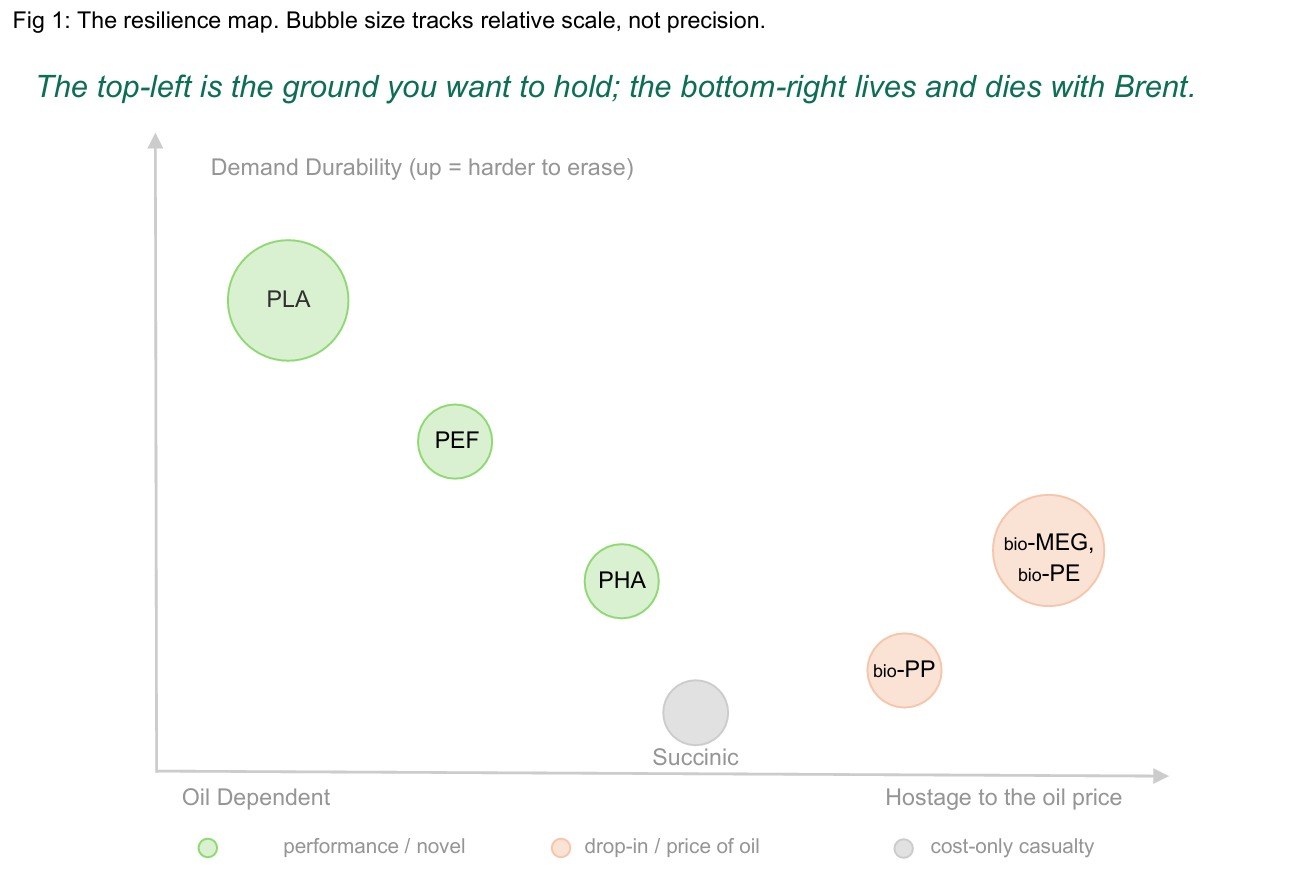
Having spent nearly two decades in this industry, I have witnessed several cycles of excitement around bio-based chemicals, many of which ultimately struggled to deliver sustainable value. The key lesson is that being green does not automatically translate into a successful business. Long-term success depends on understanding which strategic path a molecule follows. The first path is replication, where bio-based alternatives such as bio-ethylene, bio-monoethylene glycol (MEG), or bio-polyethylene (PE) compete directly with fossil-derived products and succeed primarily on cost. This makes them highly exposed to oil price volatility. The second path is innovation, where materials such as polylactic acid (PLA), polyethylene furanoate (PEF), or polyhydroxyalkanoates (PHA) offer unique performance advantages that customers value regardless of changes in crude prices. While recent swings in oil markets temporarily improved the economics of bio-based substitutes, they largely benefited replication models and risked creating a false sense of long-term sustainability. For leaders, the more important question is not whether a molecule is bio-based but whether it has a resilient demand foundation and whether the business is positioned on the right path to create enduring value.
Pick Your Road Before the Oil Price Picks It for You
There are two ways to make money in bio-based chemicals, and they reward almost opposite instincts. I have watched a full cycle of operators confusing the two, and the confusion is expensive.
Demand First: Which Molecules Have a Floor
Most biochemical business cases start with supply-side metrics such as plant capacity, yield, and carbon intensity. In my view, the real starting point lies elsewhere: demand. Unlike sustainable aviation fuel, bio-based chemicals are not supported by production mandates. Their success depends on whether demand is durable enough to withstand economic downturns and commodity price cycles.
The strongest demand foundations fall into three categories. First are regulation-driven materials. Europe’s Packaging and Packaging Waste Regulation, effective from February 2025 and broadly applicable from August 2026, mandates compostability in specific applications such as tea and coffee bags, single-serve units, produce stickers, and very lightweight carrier bags. It also introduces recycled content requirements of 30–60% from 2030 and may extend recognition to bio-based feedstocks after a planned 2028 review. This creates a tangible demand floor for materials such as PLA and, in selected applications, PHA. Second are performance-driven materials such as PEF, produced from furandicarboxylic acid (FDCA), where superior oxygen barrier properties create value independent of sustainability trends. Third is structurally competitive drop-in products such as bio-MEG and bio-PE, where integrated sugarcane-based producers can supply renewable content at costs that remain competitive even under normal oil price conditions.
Scale, however, remains an important reality check. Bio-based plastics account for only about 0.5% of the world’s annual plastics production of 431 million metric tons. Global bio-based plastic production capacity is expected to nearly double from 2.31 million metric tons in 2025 to 4.69 million metric tons by 2030. Packaging represents around 41% of capacity, PLA accounts for about 23%, PHA capacity is projected to grow more than sevenfold to reach roughly 17% of capacity by 2030, and PEF is expected to expand rapidly from a very small base. The growth trajectory is clear, but capacity expansion should not be mistaken for demand creation. Ultimately, the winners will be determined by two factors: the durability of demand and the extent to which their economics remain exposed to oil price volatility.
Two Ways to Win, and the Disconnect Between Them
The economics of bio-based chemicals depend on which path a molecule follows. In replication models, competitiveness is fundamentally a cost curve question. As the molecule is identical to its fossil counterpart, pricing power is limited and demand can quickly shift when premiums become unattractive. Profitability is therefore determined by feedstock costs, integration, and oil prices. Integrated sugarcane-based bio-ethylene breaks even at roughly USD 69 per barrel, compared with about USD 99 for the corn route and USD 117 for merchant ethanol. The technology may be similar, but cost position determines who remains viable when oil prices normalize. In this segment, scale, integration, and cost leadership are the decisive advantages.
Innovation follows a different logic. Materials such as PEF and PLA create value through differentiated performance and regulatory relevance, allowing premiums to be sustained beyond commodity price cycles. The challenge is that building new value chains and securing customer qualification requires significant time and capital. The greatest risk lies in the middle ground: drop-in producers without a structural cost advantage and novel materials without genuine differentiation. In both cases, premiums are difficult to defend, making the undifferentiated middle the least attractive position in the industry and the source of much of the sector’s historical value destruction.
What Winning Looks Like at Each Link
Winning in bio-based chemicals is not a single outcome; it depends on where a company is positioned in the value chain. The source of defensible margins differs significantly between replication and innovation models. In replication-based products, margins are protected upstream through access to low-cost feedstocks and integrated operations. The molecule itself is a commodity, leaving little room for differentiation at the polymer level. Braskem’s bio-PE business illustrates this well, with its advantage rooted in a strong Brazilian sugarcane ethanol position and expanded green ethylene capacity of approximately 275,000 metric tons per year. In this model, feedstock access and integration create the moat, while downstream participants largely remain price takers.
Innovation-led materials create value differently. Here, the defensible margin sits in proprietary technology, qualified specifications, customer adoption, and long-term offtake agreements. Feedstock represents only a small share of the value equation; the greater advantage comes from differentiated capabilities such as the FDCA technology underpinning PEF or the certified compostability profile of PLA. As a result, capital allocation should focus less on feedstock ownership and more on strengthening intellectual property, scaling differentiated applications, and deepening customer integration. The key distinction is simple: replication wins through cost leadership, while innovation wins through differentiation.
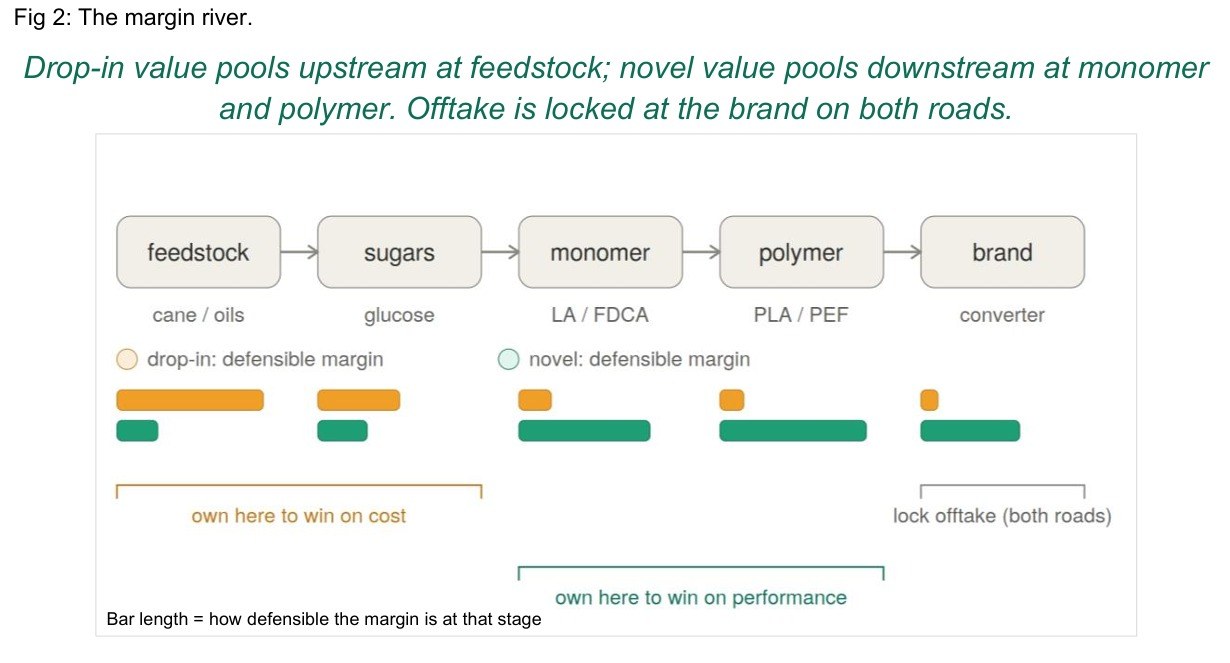
The brand link matters on both roads for a reason that has nothing to do with margin: it is where you lock the offtake that keeps the plant full.
Does Vertical Integration Pay? Only Where It Buys You the Moat
Integration is not a strategy; it is a tool, and its value depends entirely on where the competitive moat exists. For replication-based products, the moat lies upstream in feedstock economics. Owning or tightly securing access to sugar and ethanol can be the difference between remaining profitable at USD 70 oil and relying on USD 90 oil to sustain returns. The objective is not simply vertical integration, but control over the part of the value chain that determines cost competitiveness.
NatureWorks illustrates how integration can reinforce that advantage. Its new Thailand facility combines lactic acid fermentation, lactide production, and polymerization on a single site, supported by sugarcane sourced within approximately 50 km and designed for 75,000 metric tons of annual PLA capacity. By integrating from feedstock to polymer, the company strengthens both cost efficiency and product sustainability credentials.
For innovation-led materials, the logic is different. The moat lies in intellectual property, differentiated specifications, and customer adoption rather than feedstock ownership. Companies should therefore integrate around the value-creating steps while outsourcing lower value commodity activities where appropriate. Avantium provides a good example, retaining ownership of its FDCA plant and YXY technology while using a tolling partner for PEF polymerization. The principle is straightforward: integrate where you can defend margins and avoid investing capital in parts of the value chain that add scale but not competitive advantage.
The Two Killers: Feedstock You Cannot Rely On, and Demand You Never Locked
Developing a bio-based alternative is only half the challenge; building a viable business around it is often far harder. In my experience, more projects fail because of feedstock and demand issues than because of the underlying chemistry. Success depends not only on creating a differentiated molecule, but also on securing reliable inputs and converting market interest into sustained commercial demand.
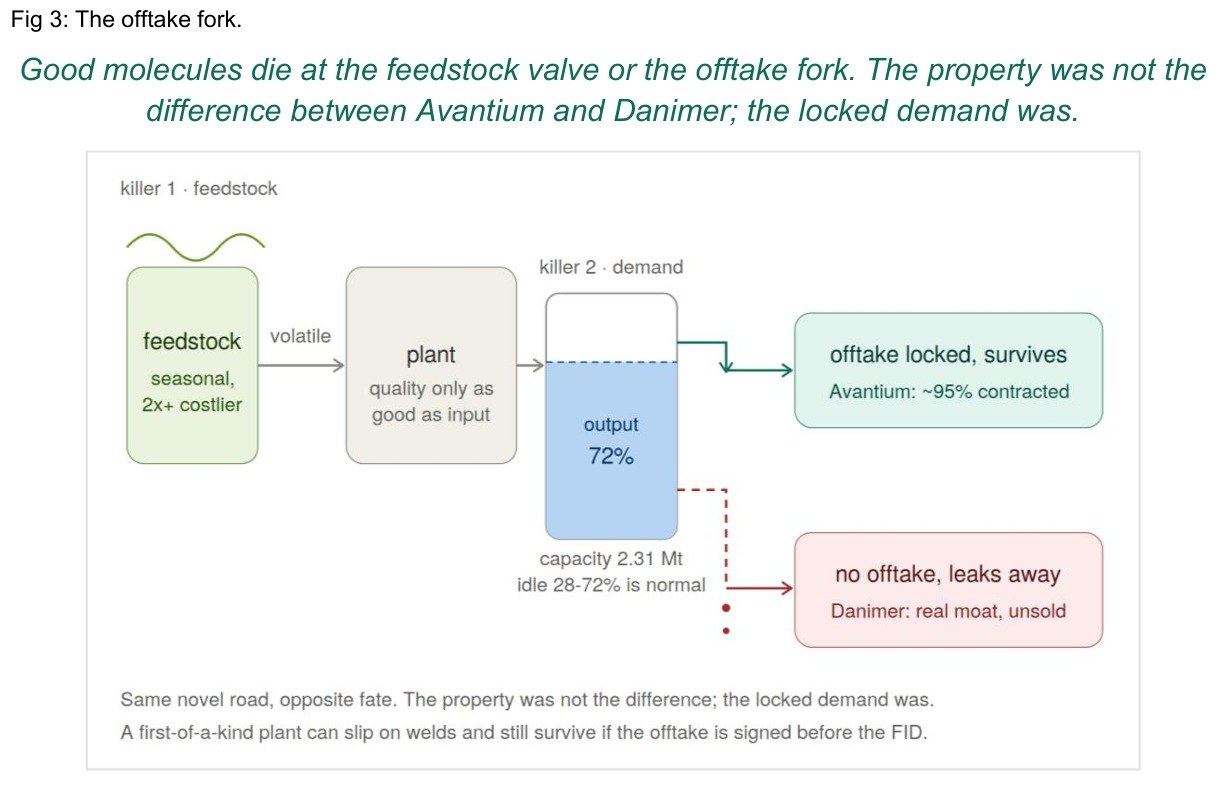
The first challenge is feedstock. Bio-based inputs are seasonal, variable in quality, and frequently compete with food and feed markets, creating cost and supply volatility that traditional petrochemical value chains rarely face. The scale of this challenge is significant. In July 2025, used cooking oil traded at approximately USD 1,206 per metric ton, compared with a Brent equivalent of around USD 539 per metric ton, more than double the cost. Consistent product quality ultimately depends on consistent feedstock supply, making feedstock strategy a critical determinant of competitiveness.
The second, and often more serious, challenge is demand that has not been converted into firm offtake. Global bioplastics capacity utilization averaged only about 72% in 2025, with individual polymers operating anywhere between 28% and 100% utilization. Danimer Scientific demonstrates the risk. Despite developing Nodax PHA, the first PHA certified as marine degradable, and building a commercial-scale facility in Kentucky with approximately 25,000 metric tons of annual capacity, the company filed for Chapter 11 in March 2025. Over a nine-month period, it generated only about USD 26 million in revenue while recording losses of roughly USD 72 million, largely because customer interest failed to convert into committed volumes.
By contrast, Avantium highlights the importance of securing demand before scaling capacity. Its first commercial FDCA plant at Delfzijl, with capacity of approximately 5,000 metric tons per year, experienced startup delays that pushed initial commercial sales into the second half of 2026. However, the company entered construction with around 95% of its first five years of capacity covered by conditional offtake agreements, including commitments from companies such as Henkel and Carlsberg. The lesson is clear: technology may create opportunity, but firm customer commitments determine survival. In bio-based chemicals, the ability to secure demand ahead of capacity is often the defining difference between industry winners and losers.
Redressal: How the Survivors De-Risk Both Killers
Neither challenge is fatal if addressed early through disciplined design and execution. For feedstock, resilience comes from flexibility and proximity. Plants should be capable of processing multiple feedstocks, supported by long-term sourcing agreements and, where justified, backward integration into feedstock supply. Equally important is locating production close to feedstock sources, as demonstrated by NatureWorks’ approximately 50 km sourcing radius, which helps reduce logistics costs, improve quality consistency, and mitigate supply disruptions. Often, the greatest operational risks lie not in the chemistry itself, but in feedstock handling, storage, pre-processing, and quality management.
For demand, the priority is securing committed offtake before committing capital. The strongest business cases are anchored in applications supported by regulation, such as compostability requirements, recycled content mandates, or performance-driven use cases, rather than voluntary sustainability pledges alone. Success depends on underwriting specific, identifiable demand and maintaining robust certification standards that can withstand increasing scrutiny. In a market where premiums are often the first target during cost pressures, demand certainty and credibility are as important as the technology itself.
Who Can Win Where, Because No One Wins Everywhere
The most important lesson for leadership teams is that the right to win is highly positional. Competitive advantages do not transfer across business models. Integrated commodity players with strong sugarcane and ethanol positions succeed in drop-in materials because their advantage lies in feedstock cost, scale, and carbon efficiency. Their focus should be on cost leadership and upstream integration, treating periods of high oil prices as opportunities rather than long-term strategies.
Specialty innovators operate by a different set of rules. Companies such as NatureWorks and Avantium create value through proprietary technology, differentiated performance, and customer specifications. Their success depends on converting these advantages into contracted demand before investing in capacity. As the Danimer experience demonstrated, even a differentiated product can fail if commercial adoption does not translate into committed volumes.
Brands and converters play a distinct role by shaping demand through early offtake commitments and industry standards. These actions help secure future supply and accelerate market adoption. By contrast, the least attractive position is the middle ground: producers with neither a structural feedstock advantage nor a genuinely differentiated product. Their path to long-term value creation is to choose a clear strategy, either building a low-cost feedstock position or focusing on materials with distinctive performance attributes, rather than relying on favorable commodity cycles.
The Winning Strategy: What, How, When
Let me distill the argument into a practical playbook. The first step is to classify every molecule and business as either a drop-in or a novel material and avoid the middle ground. Drop-in players win through cost leadership and should be competitive even at USD 70 oil, while novel materials must offer a differentiated property that customers are willing to pay for and support through contracted demand.
Execution should follow the source of competitive advantage. On the drop in path, integrate around feedstock and cost position. On the novel path, focus on the monomer, polymer, intellectual property, and customer specification that create differentiation. In both cases, secured offtake and feedstock flexibility are essential to reducing risk.
Business models should be tested against tough assumptions. If profitability disappears without a green premium, the value proposition is likely too fragile. Likewise, demand should be anchored in the strongest pull factors available, such as compostability mandates, recycled content requirements, or critical performance benefits, rather than voluntary sustainability commitments.
The timing is favorable, but discipline matters. Through 2026, strong economics for some drop-in materials should be treated as an opportunity to strengthen balance sheets, not to over-expand. At the same time, key catalysts are approaching: Europe’s packaging regulations took effect from August 2026, the European Commission’s review of bio-based feedstocks is due in 2028, and recycled content requirements begin in 2030. The businesses best positioned for these milestones, with either a defensible cost advantage or differentiated performance backed by contracted demand, are most likely to create enduring value when oil prices inevitably normalize.
What Would Have to Be True Before I'd Back It
- A defensible position on one road, not a foot on each. A genuine low-cost integrated feedstock position, or a genuine buyer-valued property. Never the middle.
- Survival at USD 70 oil for a drop-in, underwritten without a war premium. If it only works above USD 90, it is an oil call wearing a green label.
- Offtake locked before the plant is sanctioned. Contracted volume, ideally regulation-pulled, not a wishful thinking.
- Feedstock de-risked by flexibility, proximity, or backward integration, so neither the harvest nor a price spike can idle the asset.
- The green premium stress-tested to zero. If nothing survives without it, pass.
- Certification is robust enough to survive a greenwashing challenge, as the premium is the most contestable line in the model.

Vivek Gorle
