
Anthropic's IPO: Can AI's Growth Story Survive the Cautious Market?
Published on 16 Nov, 2026
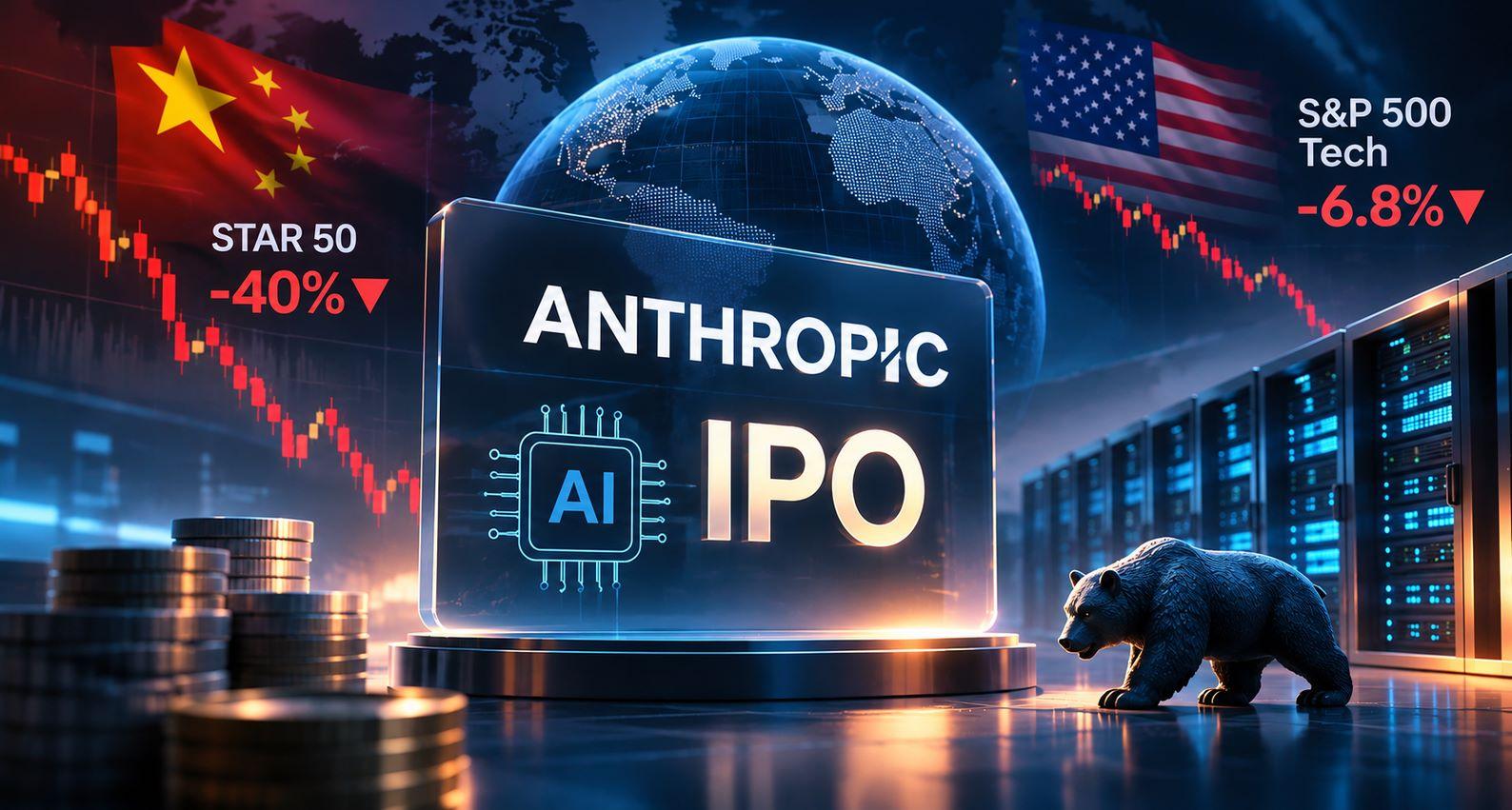
Anthropic is preparing to enter public markets at a time when investor sentiment towards AI is becoming more cautious. While demand for AI solutions continues to grow, concerns around high valuations, rising infrastructure costs and the ability to generate sustainable profits are influencing investment decisions. The recent correction in AI stocks across China and the US further highlights the growing scrutiny of AI-related investments. In this environment, Anthropic's IPO could serve as an important test of whether public-market investors remain willing to assign premium valuations to AI companies or are beginning to place greater emphasis on commercial performance, capital efficiency and long-term profitability.
The artificial intelligence (AI) investment boom is entering a more demanding phase. After years of rising valuations, large funding rounds, and infrastructure expansion, investors are questioning whether returns from AI justify the scale of capital being committed. This shift in sentiment is visible in global technology markets, where concerns around valuations, borrowing costs, and sustainability of AI spending are influencing investment decisions.
Against this backdrop, Anthropic prepares for one of the most closely watched technology IPOs in recent times. The company, which develops the Claude family of AI models, seeks to raise capital as investor enthusiasm for AI remains strong but is no longer unconditional. Its listing could, therefore, transcend fundraising and establish an important valuation benchmark for the AI industry.
Anthropic entering public markets at a critical time
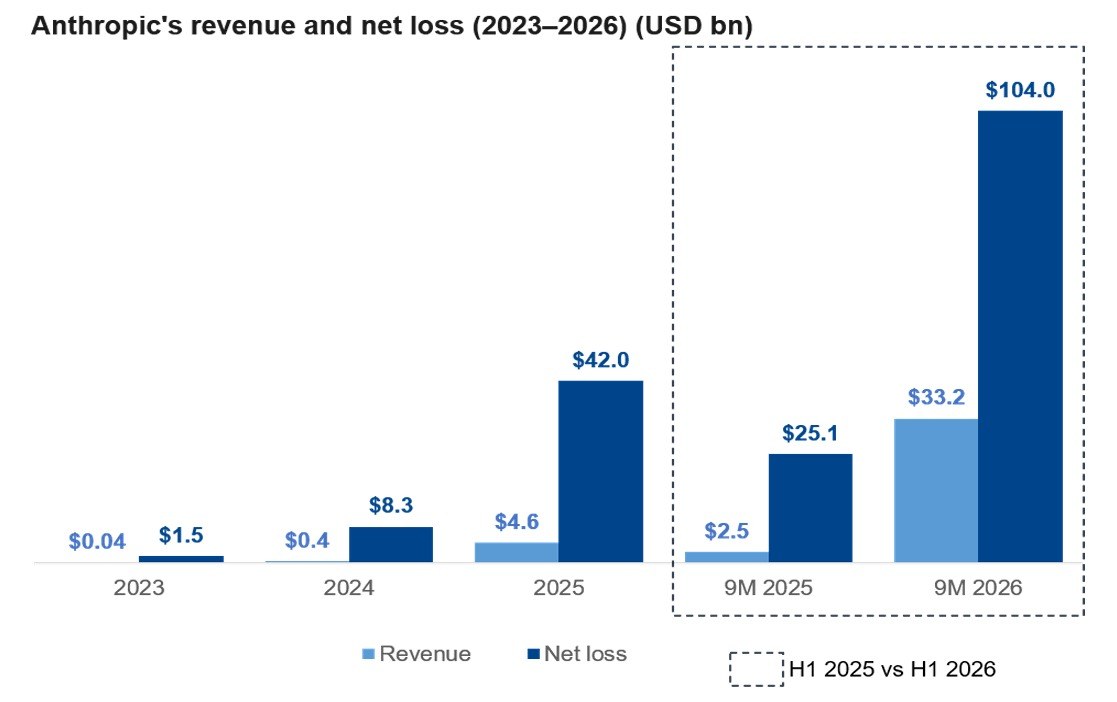
Anthropic's financial growth is an attractive investment proposition, with revenue increasing approximately 13 times to USD 33.2 bn in the first nine months of 2026. However, the company reported net loss of USD 104 bn during this period, including accounting adjustment linked to financing agreements. Its latest Q3 2026 results showed revenue of USD 17 bn with net loss of USD 23.3 bn.
The scale of its infrastructure commitments is another important consideration. Anthropic has disclosed approximately USD 895.4 bn in committed spending on computing and infrastructure, including USD 70 bn expected to be spent the next 12 months. This highlights the substantial investment required to develop and operate advanced AI models.
The challenge is for investors to assess whether Anthropic can convert its rapid revenue growth into sustainable margins and cash generation while meeting significant infrastructure commitments.
The timing of the offer makes this assessment particularly important. According to a recent Reuters report, some investors were reconsidering Anthropic's expected valuation, with discussions suggesting valuation decline from approximately USD 2 Tn to USD 1.5 Tn. Slow revenue growth and concerns about AI infrastructure financing contributed to the reassessment.
Widening gap between AI optimism and investor appetite
Anthropic's IPO is unfolding amid increasing selectivity in technology investments. Investors are becoming more conscious of the differences between companies developing AI applications, those building foundational models, and those supplying operational infrastructure.
This difference is reflected in IPO activity. While Anthropic continues proposed listing, several AI and data center companies have decided to postpone their IPOs.
For instance, data center operator, Switch, and AI infrastructure provider, Nscale, postponed their listing plans amid market volatility, high interest rates, and concerns about consumer and business spending on AI. This suggests investor appetite varies across the AI value chain. Companies with established customers and growing revenues may continue to attract interest, while infrastructure businesses requiring substantial capital face greater scrutiny over their funding requirements and expected returns.
This supports the hypothesis that investors are becoming selective about AI investments, particularly toward companies demonstrating how customers are willing to pay for their products, revenues can sustain, and investments can translate into future earnings.
China's AI market correction offers early warning
Developments in China provide an important dimension to the changing investment environment. The country's AI and semiconductor rally has experienced a sharp reversal, highlighting the risks associated with valuations that move ahead of underlying business performance.
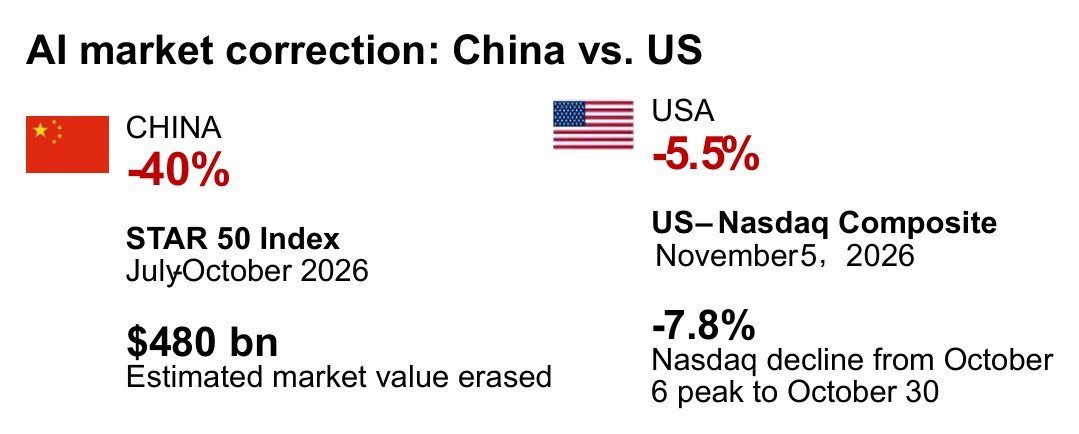
In October 2026, China's STAR 50 index, which tracks leading AI and semiconductor companies, fell approximately 40% in less than four months, erasing almost USD 480 bn in market value. This reflects concerns over high valuations, uncertainty around future AI demand, and possible restrictions on Chinese technology suppliers to overseas data centers.
Parallelly, in the US market, USD 2.5 tn was wiped off from AI and data center stocks on November 5, 2026, following the Democratic Party's victory in midterm elections and its takeover of both chambers of Congress. S&P 500 fell 4.4%, while Nasdaq declined 5.5%, marking the steepest single day fall in 19 months. AI and semiconductor stocks were particularly affected, with Nvidia declining 9.3%, AMD falling 17.3%, and the Philadelphia Semiconductor Index dropping almost 12%. Data center operators and infrastructure companies, including CoreWeave, IREN, and Applied Digital, also witnessed significant declines.
This bloodbath reflects concerns that change in congressional control can lead to higher regulatory scrutiny of AI infrastructure development. Several newly elected representatives and local policymakers have supported restrictions on data center construction, citing concerns around electricity consumption, water usage, and pressure on local infrastructure. This has raised questions about the pace of future data center expansion, particularly in states such as Texas and Georgia. Construction delays or restrictions on new facilities could affect demand for AI chips, servers, power equipment, and related infrastructure.
The correction in China coincided with a decline in US technology and AI stocks. In October 2026, the S&P 500 technology sector fell 6.8%, marking its steepest monthly decline since March 2025. The sell-off intensified toward the month end following disappointing results from Intel and Amazon. On October 30, the Nasdaq declined 2.9%, while Nvidia and AMD fell 4.2% and 10.9%, respectively. The broad semiconductor index also declined 7.2% the same day. By November 2, Reuters reported investors were increasingly questioning whether returns from large-scale AI investments would justify the capital being committed.
The regulatory response in China adds to the correction narrative. On November 3, China's securities regulator reportedly informally asked investment banks to pause IPOs and temporarily suspend large share sales by existing shareholders until market conditions improved. This reported guidance followed a sharp decline in the CSI 300 index, which fell 8.5% in October. These measures were intended to limit additional selling pressure while regulators attempted to stabilize the market.
Although China's AI market operates under different competitive, regulatory, and capital-market conditions from the US, this correction could influence global investor sentiment. Also, it may make investors more cautious about US-listed AI companies that rely heavily on future growth and continued investment to justify their valuations. The recent market wipe-off in USA’s AI stocks highlights how changes in political control and possibly tight regulations can affect investor expectations, without immediate changes in AI demand. For AI companies, the risk extends beyond competition and profitability to the regulatory environment governing the infrastructure required to support future growth.
Aranca's Point of View: The next phase of AI investment will be judged on returns, not just revenue growth
Developments across the US and China point toward significant changes in how investors are evaluating AI businesses. As the industry matures, three factors are likely to influence investment decisions:
- Revenue quality and commercial adoption: Investors will look beyond headline revenue growth to assess recurring enterprise demand, customer retention, pricing power, and the extent to which AI products are generating predictable revenues.
- Infrastructure economics and capital efficiency: Cost of computing capacity, model training, and inference will remain central to profitability. Companies need to demonstrate that technological improvements and operating efficiencies can support growth without requiring proportionate increase in capital expenditure.
- Visibility of returns and funding requirements: Large infrastructure commitments and dependence on external financing could increase financial risks, particularly if interest rates remain high or investor appetite weakens. Companies with clear paths to positive cash flow may be better positioned to withstand market volatility.
These factors could also influence the relative attractiveness of different segments of the AI value chain. While foundational model developers such as OpenAI, Anthropic, and Google may continue to attract investor attention, infrastructure providers and supporting technology businesses will need proof of how their expansion is supported by sufficient demand and commercially viable returns.
Anthropic's IPO may potentially set tone for AI valuations
Anthropic's proposed listing coincides with public market investors reassessing how they value AI businesses. While the company has demonstrated significant commercial traction, the financial performance and infrastructure commitments remain important considerations for determining market valuation.
The listing could provide a benchmark for other AI companies planning to enter public markets, particularly those with high growth rates but substantial capital requirements. A successful IPO could encourage other AI businesses to pursue public listings, while weak reception may lead companies to reconsider valuation expectations and listing timelines.
The broad shift is not away from AI, but toward greater accountability for the invested capital. As the industry moves from expansion to execution, companies increasingly need to demonstrate that their growth can translate into sustainable economic returns.

Rishika Kaushik
