
Copper at an Inflection Point – Market Volatility and Resilience to 2030
Published on 05 Jan, 2026
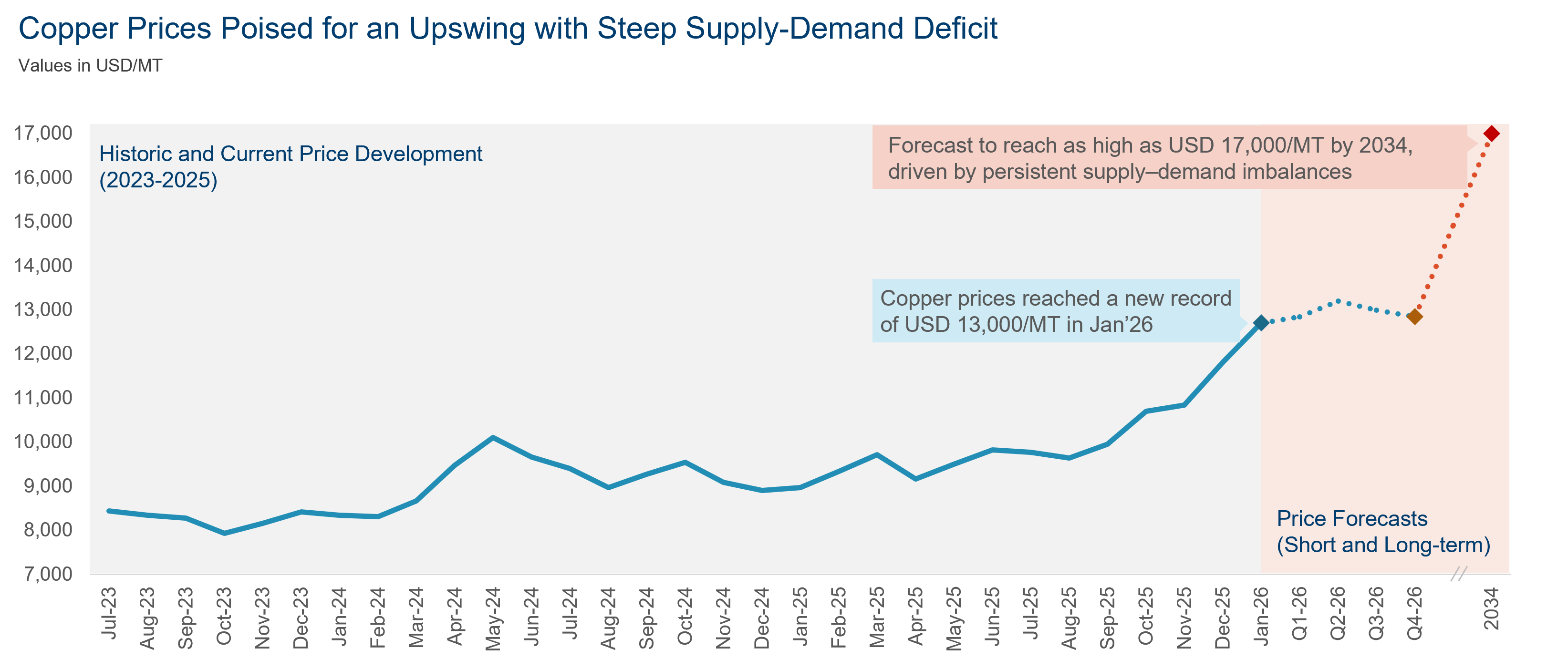
Copper entered a new price regime in 2025, with prices rising over 30–35% YoY to exceed USD 12,000/MT in Dec’25 and hit a record USD 13,000/MT in Jan’26, driven by strong structural demand and tightening fundamentals. Rapid growth in energy transition applications—electric vehicles, renewable power, grid modernization, and digital infrastructure—has collided with declining ore grades, low inventories, and limited supply elasticity. Looking ahead, copper prices are expected to remain elevated and volatile in 2026, with upside potential of up to USD 17,000/MT by 2034, as long-term structural deficits persist, driven by a strong long-term demand outlook. In this environment, procurement organizations must shift from reactive price management to proactive resilience—strengthening long-term supply partnerships, scaling recycling and secondary copper usage, and accelerating material substitution and value-chain interventions to stay competitive.
Copper prices witnessed an exceptional rally through 2025, reaching over USD 12,000/MT in December 2025 and a record high of USD 13,000/MT in January 2026. Prices rose by more than 30–35% over the year, marking the strongest annual increase since 2009, when copper surged as global markets rebounded from the financial crisis. Unlike previous price spikes driven by cyclical recovery or speculative positioning, the 2025 rally was underpinned by structural demand strength and tightening physical fundamentals.
Accelerating demand from energy transition–linked applications—including electric vehicles, renewable power generation, grid expansion, and digital infrastructure—combined with persistently low inventories and limited supply responsiveness, has led to a structural re-rating of copper.
As the market looks toward 2026 and beyond, copper price behavior is expected to remain volatile, shaped by a widening imbalance between demand growth and supply elasticity.
Here is a quick perspective on the changing supply-demand dynamics, potential influence on the commodity prices, and key strategies to adopt to build supply chain resilience.
Supply-Demand Dynamics: A Forward Outlook
A. Maintaining Supply Pace Remains a Critical Challenge
Global copper mine production is expected to peak at ~23–24 million MT during 2025–26. Beyond this period, production growth is projected to stagnate and gradually decline at a ~2–3% CAGR through 2035, driven by:
- declining ore grades across mature mining assets, as ageing copper mines are getting less productive
- depletion-led mine closures
- rising capital intensity and extended lead times for new developments, as bringing new copper mines online is hugely expensive and takes years
Beyond this period, copper production is expected to decline at ~2-3% CAGR until 2035 due to depleting ore grades and mine closures. Although new mining projects aim to offset this decline, their contributions are unlikely to sustain existing production levels.
B. New Projects and Recycling Efforts to Fall Short of Supply Gap
The International Energy Agency (IEA) highlights a concerning gap between supply and demand as we move beyond the next 2-3 years. By 2035, copper production from announced projects is likely to fulfill only 70% of the anticipated global demand.
Copper recycling is expected to partially alleviate this shortfall, with scrap supply projected to increase to 19 million MT by 2030. However, even with further growth to 27 million MT by 2050, recycled copper would meet just three-quarters of the required volumes, leaving a persistent supply gap.
C. Regulatory Hurdles and Policy Shifts – Uncontrolled Bottlenecks Ahead
Copper supply chains are becoming progressively exposed to geopolitical and regulatory risks, particularly across key producing regions:
- Chile and Peru, which together account for a significant share of global copper output, continue to face tighter environmental regulations, water constraints, labor unrest, and community resistance.
- Resource nationalism and evolving fiscal regimes add uncertainty to long-term production economics and investment decisions.
- Trade policy volatility and tariff-related uncertainty have distorted regional copper flows, contributing to inventory imbalances and regional price premiums.
These factors have reduced supply elasticity, making copper prices more sensitive to operational disruptions and policy changes.
Elevated Demand and Substitution Pathways
A. Strong demand from processors/end-use industries
Copper demand growth is undergoing a structural transformation. While traditional end-use sectors such as construction, infrastructure, machinery, and transportation are expected to grow at a moderate 2–3% CAGR, demand from energy transition–related applications is expected to expand at a significantly higher 8–10% CAGR over the next decade.
Key demand drivers include electric vehicles and charging infrastructure, renewable energy generation, grid expansion and modernization, and data centers, AI infrastructure, and telecom networks.
Demand linked to energy transition applications is expected to increase 2–3x by 2035, translating into an incremental 13–15 million MT per annum. This additional demand alone represents a volume that current and planned supply pipelines are structurally ill-equipped to absorb.
B. Exploring Copper Alternatives Amid Rising Prices
With copper prices reaching unprecedented levels and supply risks intensifying, companies are increasingly exploring alternative materials and technologies to mitigate exposure. Aluminum and copper‑clad aluminum (CCA) are gaining traction in electrical wiring and EV components due to lower cost and lighter weight, while carbon nanotubes (CNTs) and graphene‑enhanced aluminum are being assessed in advanced electronics for conductivity and durability improvements.
Fiber optics and silver or nickel-based alloys are also being explored in telecom, data transmission, and PCB applications. These initiatives reflect a growing trend of material diversification aimed at enhancing supply chain resilience and cost efficiency amid sustained copper market volatility.
Conclusion
Copper’s structural tightening is expected to persist through 2026 and beyond, keeping prices elevated and volatile. Consensus estimates suggest copper prices could reach as high as USD 17,000/MT by 2034, driven by persistent supply deficits and demand growth continuing to outpace mine output.
Procurement organizations within copper-dependent industries are carefully reassessing their strategies amid soaring prices and tightening supply conditions. Potential mitigation strategies that companies are actively resorting to build resilience include securing long-term offtake agreements, expanding recycling and secondary copper usage, increasing strategic inventory buffers, and exploring material substitution where feasible

Hardik Wade
