
Japan Outbound M&A Landscape: Value Concentration and Strategic Selectivity Reshape Dealmaking
Published on 09 Jan, 2026

Japan’s outbound mergers and acquisitions (M&A) market has entered a structurally different phase in its post-pandemic evolution. This analysis covers Japan-linked cross-border deal activity, reflecting Japanese acquirers’ selective expansion internationally, a trend that increasingly influences headline deal values. After a period of volatility, dealmaking momentum is increasingly defined by capital concentration, strategic consolidation, and balance-sheet-driven acquisitions than by a broad base of smaller deals. The growing divergence between deal volume and deal value highlights a maturing market where fewer, larger, and more complex transactions are driving overall outcomes.
The data indicates that deal activity reached a value peak in 2024 before normalizing in 2025, while deal volumes have moderated. This divergence underscores Japan’s transition from a volume-led expansion cycle toward a value-led M&A environment shaped by governance reform, shareholder pressure, and structural economic constraints.

Deal Volume Trends: Recovery Followed by Rationalization
Japan’s outbound M&A deal volumes showed resilience between 2020 and 2024, hovering near 190 transactions annually during peak periods. This activity was driven by the necessity of securing external growth engines, digital transformation initiatives, and supply chain diversification.
However, 2025 shows a moderation in deal volumes to 167 transactions. This pullback does not indicate a weakening of underlying M&A fundamentals but rather a shift toward greater selectivity. Buyers are taking longer to execute transactions as diligence standards rise, valuation discipline tightens, and strategic fit becomes paramount. Importantly, while volumes have slightly dipped, the strategic intent remains robust, reinforcing Japan’s position as an active global acquirer despite the near-term slowdown in count.
Deal Value Trends: Capital Concentration Drives Market Outcomes
While deal volumes moderated in 2025, deal value reveals a different story of volatility and concentration. Aggregate deal value fluctuated significantly, rising from USD 21.9 Bn in 2020 to USD 26.7 Bn in 2021, before falling during the global market corrections of 2022 and 2023. In 2024, however, total deal value surged sharply to USD 38.9 Bn, nearly doubling year-on-year, supported by a wave of large-scale, high-impact transactions in the Americas.
Deal value normalized to USD 21.0 Bn in 2025. This divergence between the 2024 peak and 2025 levels highlights a fundamental shift in Japan’s outbound market structure. Capital is increasingly concentrated on a limited number of strategic transactions, including platform acquisitions and cross-border consolidations. These deals tend to be transformational in nature, particularly driven by long-term competitive positioning rather than short-term earnings accretion.
Deal Size Dynamics: Large Transactions Dominate Value Creation
Following the sharp rise in aggregate deal value in 2024, Japan’s outbound M&A market continues to show a clear skew toward large-ticket transactions. A comparison of the data between 2020 and 2025 shows that headline deal value trends are still largely determined by the presence of large and mega deals, rather than incremental growth across smaller deal categories.
This dependence on large transactions suggests that year-to-year value volatility is likely to persist, as aggregate outcomes are heavily influenced by the timing and completion of a handful of major deals, particularly in Western markets. The structural shift indicates that Japanese corporates are reserving capital for "needle-moving" acquisitions rather than dispersing funds across fragmented, smaller assets.
Key Drivers Behind Japan’s Outbound Deal Momentum
Behind these trends is a set of durable structural drivers pushing Japanese capital outward. First, domestic market saturation remains a critical constraint. Japan’s aging population limits the scale of future expansion at home, encouraging corporates to seek demand pools in faster-growing international markets.
Second, governance reform and shareholder pressure are accelerating portfolio rebalancing. Companies are increasingly divesting non-core domestic assets and reinvesting into high-growth opportunities overseas, particularly in sectors where global scale and strategic positioning matter. Finally, Japan’s financial advantage supports this activity; relatively low financing costs and strong corporate balance sheets give Japanese buyers the capacity to pursue larger deals and compete in global auction processes
Sector Trends: Deal Value Shifts Toward Services and Technology
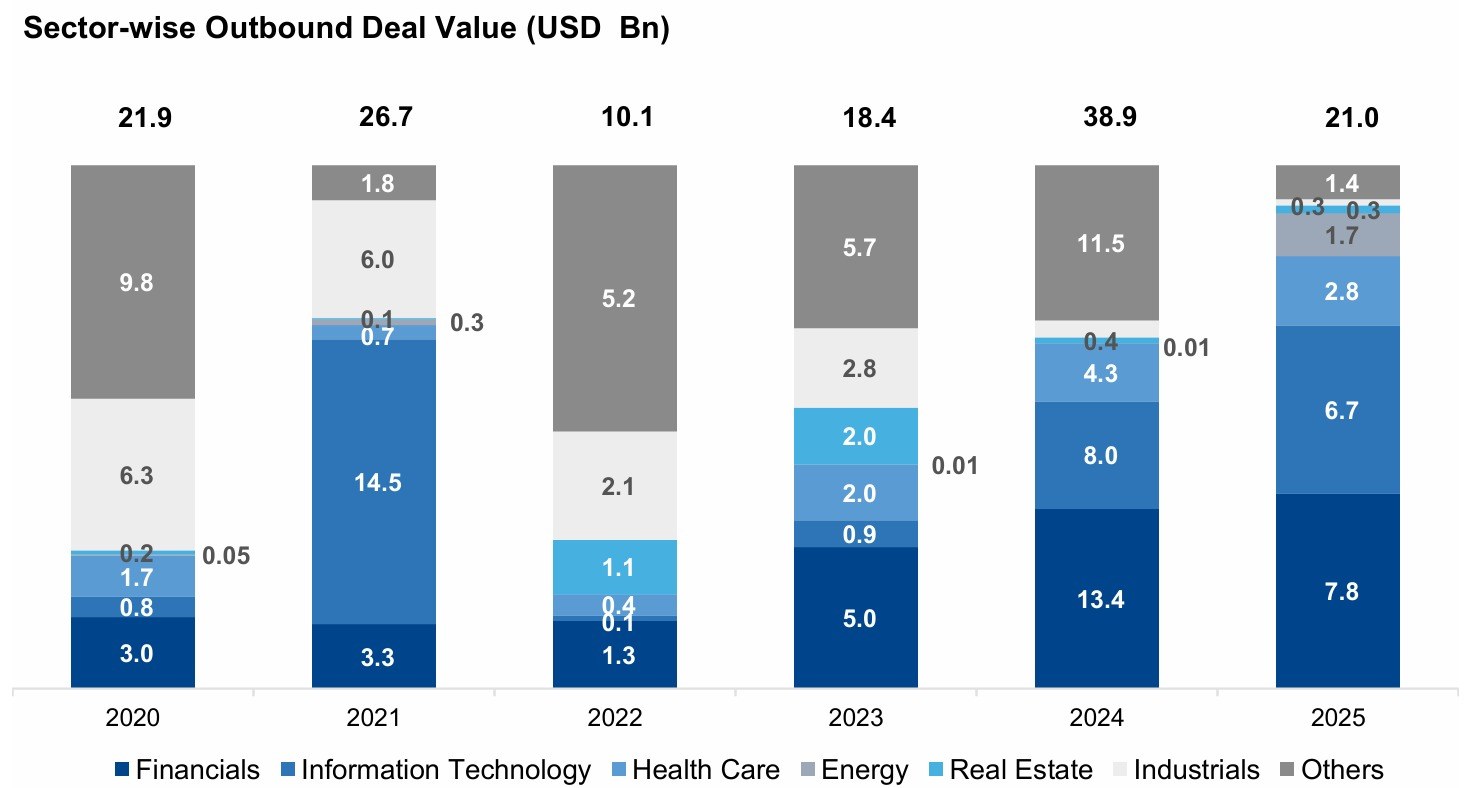
The dominance of large transactions in driving aggregate deal value is also evident in how M&A value is distributed across sectors. Rather than being evenly spread across industries, sector-level deal value has shifted decisively away from traditional heavy industries toward services and technology.
In 2020, deal value was heavily concentrated in Industrials (USD 6.3 Bn), reflecting Japan’s traditional manufacturing focus. However, by 2024 and 2025, the sector mix shifted sharply.
- Financial Services: This sector became overwhelmingly dominant in 2024, contributing USD 13.4 Bn, and remained the leader in 2025 with USD 7.8 Bn. This spike suggests that aggregate value is now driven by large transactions in banking, insurance, and asset management platforms.
- Information Technology: IT contributed strongly in recent years, recording USD 8.0 Bn in 2024 and USD 6.7 Bn in 2025. This reflects a sustained push to acquire software and digital capabilities.
- Industrials: In a marked structural shift, value in the Industrials sector contracted severely, dropping to USD 0.3 Bn in 2025.
- Energy: After years of muted activity, Energy saw a resurgence to USD 1.7 Bn in 2025, likely driven by energy transition and security mandates.
Overall, the 2025 mix suggests continued reliance on selective high-value transactions across Financials and IT, rather than broad-based expansion across the full industrial spectrum.
Geographic Trends: Western Markets Anchor Strategic Capital
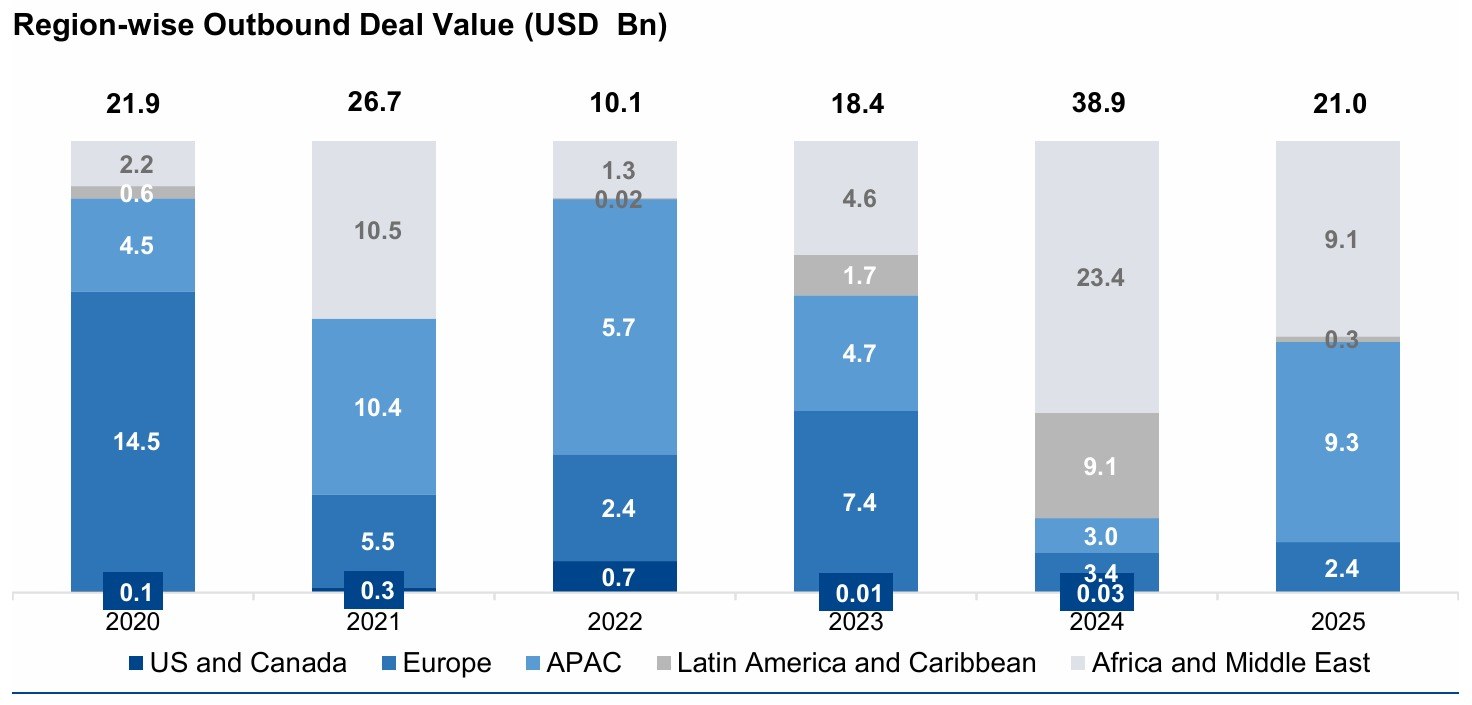
As Japanese buyers sharpen their sector priorities, the geographic allocation of capital has also transformed. The data reveals a distinct pivot toward Western economies, driven by the search for stable, high-value assets.
- Europe: In 2025, Europe emerged as the primary destination for Japanese capital, attracting USD 9.3 Bn, representing a significant surge and underscoring a renewed strategic focus on European financial and infrastructure assets.
- North America: The United States and Canada remain critical engines for dealmaking. After a record-breaking USD 23.4 Bn in 2024, the region attracted USD 9.1 Bn in 2025, solidifying its role as a key partner for Japanese strategy.
- Asia-Pacific (APAC): Conversely, deal value in APAC has moderated. From over USD 14 Bn in 2020, value fell to USD 2.4 Bn in 2025. While deal counts remained stable due to supply chain linkages, the region is currently attracting less capital from Japan for large-scale platform M&A compared to the West.
Investor Landscape: Strategic Corporates Anchor Deal Value
The concentration of deal value in a limited number of large transactions is closely mirrored in the investor landscape. Strategic corporates continue to anchor market outcomes, while financial sponsors broaden participation selectively.
Japanese corporates dominate outbound activity, leveraging strong cash positions to pursue acquisitions aligned with long-term portfolio objectives. Large trading houses, financial institutions, and diversified conglomerates remain central to the ecosystem. However, the rise of the Technology and Financial Services sectors as top targets indicates that the profile of the "active buyer" is evolving. It is no longer just the industrial giants; banks, insurers, and tech conglomerates are now the primary architects of Japan’s global footprint.
Most Active Buyers/Investors by Deal Value
| Company Name | Total Deal Value (USD Mn) | Sectors of Interest |
|---|---|---|
| Nippon Paint Holdings | 14,330 | Materials, Industrials and Consumer Discretionary / Consumer Staples |
| Renesas Electronics Corporation | 13,021 | Information Technology and Industrials |
| Nippon Life Insurance Company | 12,038 | Financials, Real Estate, Infrastructure and Energy transition |
| Hitachi | 11,366 | Industrials, Information Technology and Energy / Utilities |
| SoftBank Group Corp. | 10,089 | Information Technology, Consumer Discretionary and Financials |
| Panasonic Connect | 7,100 | Industrials, Information Technology and Consumer Discretionary |
| Mitsubishi Corporation | 5,351 | Energy, Materials, Industrials, Consumer Staples / Consumer Discretionary and Financials |
| Recruit Holdings | 4,820 | Information Technology and Consumer Discretionary |
| Ocean Link | 4,820 | Industrials, Real Estate and Energy |
| DCP Investments | 4,820 | Information Technology, Financials, Health Care and Industrials |
Most Active Buyers: Strategic Acquirers Drive Deal Value
The concentration of Japan’s outbound M&A value is sharply defined by a small cadre of high-capital investors. A select group of corporate giants and financial institutions drives most capital deployment, underscoring a market shaped by balance-sheet strength and strategic necessity.
Nippon Paint Holdings leads with USD 14.3 Bn, exemplifying the continued push for global scale in Materials. Simultaneously, the imperative to digitize is evident in heavy spending by Renesas Electronics (USD 13.0 Bn) and Hitachi (USD 11.4 Bn), both aggressively acquiring assets to modernize industrial capabilities. Nippon Life Insurance (USD 12.0 Bn) anchors the shift toward Financial Services, seeking yield-generating assets abroad to offset low domestic returns.
The landscape is diverse but top-heavy. From SoftBank’s tech-focused capital deployment to Mitsubishi Corporation’s diversified energy portfolio, these players illustrate a dual focus: acquiring cutting-edge digital platforms and securing stable, long-term supply chains.
Outlook: High-Value Deal Momentum Likely to Persist
Looking ahead, Japan’s outbound M&A environment is expected to remain active through 2026, with a continued bias toward large transactions and sector-led consolidation.
First, the continued strength in the Financials and Technology sectors suggests that large deals will remain the primary driver of deal value, supported by ongoing corporate restructuring and the need for new revenue models. Second, geographic trends indicate that North America and Europe will continue to absorb the majority of Japanese investment capital.
Finally, while deal volume may normalize below the peaks seen in previous years, Japan’s M&A baseline has structurally shifted toward quality over quantity. This reflects stronger strategic acceptance of acquisitions as a growth lever. Overall, Japan’s outbound M&A landscape is transitioning into a more mature and value-intensive phase defined by large-ticket transactions, diversified sector participation, and sustained global ambition.

Rishika Kaushik
