
As companies pursue growth beyond their home markets amid macro uncertainty and tighter capital discipline, market entry decisions have become materially more consequential. While delayed entry can lead to missed opportunities and weak competitive positioning, poorly structured or rushed entry decisions can be equally damaging. Once executed, these choices often lock organizations into governance and time-consuming, costly operating models.
Choosing between partnerships, JVs, and acquisitions is fundamentally a question of strategic discipline, particularly for organizations focused on risk containment, capital efficiency, and long-term governance stability. While market attractiveness and growth potential are often well understood, many expansion efforts underperform because entry modes are selected reactively, driven by deal availability, regulatory constraints, or precedent rather than a structured assessment of strategic fit. These decisions have lasting implications for risk allocation, capital deployment, and control over critical commercial and operating decisions.
Therefore, the entry mode selection should not be viewed as a legal or transactional exercise. It is primarily a governance and execution decision. When control requirements, execution readiness, and value capture mechanisms are not evaluated together, even attractive markets struggle to deliver sustainable returns.
To address this challenge, Aranca has developed the CREATE framework, drawing on its broader Market Research and Advisory Services for Japanese Companies, a structured decision-making lens that helps organizations and investors evaluate market entry options across key strategic and execution dimensions. The framework enables decision-makers to align entry structures with strategic intent and organizational capability, rather than allowing transaction mechanics or short-term pressures to dictate outcomes.
Framing the Market Entry Decision as a Capital Allocation Choice
Market entry should be approached as a strategic capital allocation decision, not a transaction-driven one. In practice, organizations often default to acquisitions to gain speed or partnerships to preserve flexibility, without fully assessing how these structures align with internal capabilities, risk tolerance, and long-term objectives. A disciplined approach requires clarity on the purpose of entry—whether the objective is market testing, capability access, near-term revenue, or building a scalable long-term platform.
For many Japan-based investors, this decision is further shaped by a preference for phased commitment, where control and capital exposure increase over time rather than being assumed upfront. This approach allows organizations to balance learning with risk containment, particularly in unfamiliar regulatory or operating environments.
Control requirements are central to this assessment. In regulated, politically sensitive, or asset-intensive markets, the ability to influence pricing, operations, intellectual property, and customer relationships can be as important as ownership itself. Time-to-value further complicates the decision, especially in competitive markets where delayed entry can permanently weaken positioning.
When these factors are not addressed upfront, organizations often select entry modes that appear attractive at the deal stage but prove difficult to govern and execute, resulting in slow decision-making, misaligned incentives, and constrained value realization.
Japanese M&A Transactions and JVs, 2020-2025 (in Units)
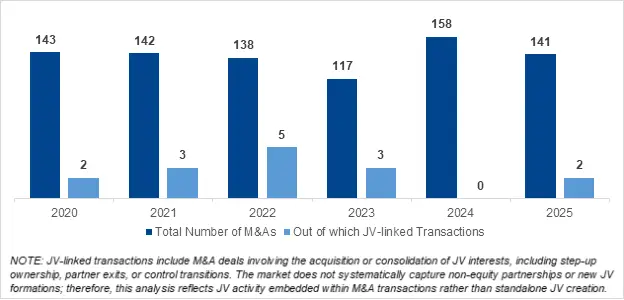
Despite sustained outbound and cross-border M&A activity by Japan-based investors, JV-linked ownership structures remain limited, aligning with Japan's outbound M&A trends that favor large, fully controlled acquisitions. Between 2020 and 2025, JV-linked transactions accounted for just a low single-digit share of the total closed M&A deals each year, with 3-5 JV-linked transactions annually against 120-160 total M&A transactions. This pattern is consistent across cycles and reinforces the dominance of full-control acquisitions as the primary market entry mechanism.
However, the prevalence of acquisitions in deal data should not be interpreted as a lack of collaborative intent. Rather, it reflects how transaction databases classify deals—based on legal form at close rather than underlying governance or economic design.
In practice, many cross-border entries by Japan-based investors follow a staged control pathway, beginning with minority investments, sponsor-strategic co-investments, or joint operating arrangements, and later transitioning into majority ownership or full buyouts. While recorded as M&A at the point of control consolidation, these structures often retain joint venture-like characteristics, including negotiated governance rights, phased capital deployment, and differentiated strategic objectives.
As a result, deal labels provide an incomplete picture of collaboration during market entry. This reinforces the need for a framework that evaluates entry modes based on control, risk allocation, capital commitment, and execution capability, rather than deal classification alone.
The CREATE Framework: A Structured Lens for Entry Mode Selection
Selecting the right entry mode requires a systematic assessment of strategic priorities and execution constraints. Aranca applies the CREATE framework to evaluate entry options across six dimensions that materially influence outcomes: control requirements, risk allocation, equity and capital intensity, ability to execute, time horizon fit, and economics of value capture.
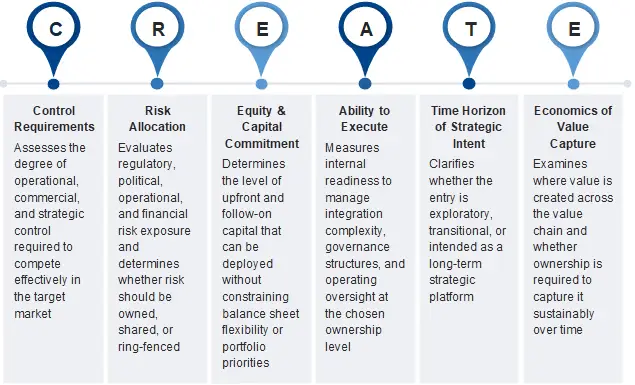
Rather than prescribing a single “right” entry mode, the CREATE framework highlights the trade-offs inherent in each option. It helps organizations avoid structural choices that are misaligned with strategy, risk appetite, or execution capability.
Partnerships: Flexibility and Learning with Limited Control
Partnerships are most appropriate when organizations seek early market exposure with limited capital commitment. Within the CREATE framework, partnerships work best when control requirements are low, risks need to be contained, and strategic intent is exploratory or medium-term.
They are particularly relevant in consumer-facing, technology-driven, and service-oriented sectors, where market conditions evolve quickly and early assumptions need validation. Low capital intensity preserves flexibility and enables learning around customers, regulation, and competitive dynamics.
However, partnerships offer influence rather than ownership-level control. Execution outcomes depend heavily on partner priorities, which may not align with long-term objectives. Customer ownership, pricing authority, and operating decisions typically sit outside the entrant's control. Without clear governance, performance metrics, and exit mechanisms, partnerships risk delivering insight without durable strategic value.
From a risk perspective, partnerships effectively ring-fence downside exposure, making them suitable for uncertain markets. That said, they still require active coordination and governance discipline to perform as intended.
JVs: Shared Risk and Shared Control
JVs sit between partnerships and acquisitions on the control and commitment spectrum. Under the CREATE framework, they are most appropriate when control requirements are moderate, risk needs to be shared, and there is a clear long-term strategic rationale. However, full ownership is impractical or undesirable.
This structure is common in regulated or capital-intensive sectors such as energy, infrastructure, and heavy manufacturing, where local participation improves regulatory access and execution outcomes. For Japan-based investors entering unfamiliar markets, JVs can materially reduce execution friction through risk sharing and local insight.
That said, governance complexity is frequently underestimated. Unclear decision rights, misaligned capital priorities and differences in risk appetite can slow execution and dilute accountability. These challenges often intensify as the venture scales or encounters stress. Exit mechanisms, if not defined upfront, further complicate value realization.
Experience suggests that joint venture success depends less on partner selection and more on governance discipline, including clear authority, aligned incentives, and predefined exit pathways.
Acquisitions: Full Commitment with Elevated Execution Risk
Acquisitions represent the highest level of commitment under the CREATE framework. They are most appropriate when control requirements are high, long-term strategic intent is clear, and the economics of value capture justify full ownership. In consolidating or highly competitive markets, acquisitions may be the only viable route to establish scale quickly.
The primary advantage of acquisitions is control. Full ownership enables alignment of strategy, operations, and investment decisions and allows organizations to pursue synergies without compromise. For companies seeking proprietary capabilities, talent, or established customer relationships, acquisitions often provide the fastest route to scale.
However, acquisitions also carry the highest execution risk. Integration challenges, cultural misalignment, and leadership turnover frequently undermine value creation. Evidence consistently shows that post-acquisition underperformance is more often driven by execution failure than by flawed strategic rationale.
Conclusion
The assessment below illustrates how each entry mode typically performs on control, risk allocation, capital intensity, execution demands, time horizon alignment, and value capture potential, highlighting the inherent trade-offs rather than prescribing a single "best" option.
| Dimension | Interpretation | Partnerships | JVs | Acquisitions |
|---|---|---|---|---|
| C: Control Requirements | Indicates the degree of decision-making authority and operational control |  |
|
 |
| R: Risk Allocation | Reflects the extent to which commercial, regulatory, and execution risk can be shared | |
|
|
| E: Equity & Capital Intensity | Measures the level of upfront equity investment and balance-sheet commitment required |  |
|
|
| A: Ability to Execute Required | Represents the level of organizational capability, governance maturity, and management bandwidth needed | |
|
|
| T: Time Horizon Fit | Assesses how well the entry mode supports the intended duration of strategic commitment | |
|
|
| E: Economics of Value Capture | Indicates the extent to which economic upside and long-term value creation can be retained | |
|
|
|
Low
Medium
High
|
|
|||
The CREATE benchmarking highlights that each entry mode embeds distinct structural commitments. Partnerships involve limited upfront capital and balance-sheet exposure, joint ventures require shared equity and ongoing funding, and acquisitions demand full capital deployment at entry. This progression is reflected across control, risk allocation, execution intensity, and value capture—where partnerships provide influence with limited control, JVs balance shared governance and risk, and acquisitions deliver full control and value capture at the cost of higher execution complexity. The framework therefore compares structural trade-offs rather than absolute advantages.
In an environment of heightened uncertainty and capital discipline, market entry decisions are increasingly time critical. Poorly structured entry choices risk locking organizations into governance models that constrain execution and erode long-term value.
Aranca recommends a structured approach to entry mode selection. With experience supporting multinational corporations, startups, and global investment firms, Aranca works across the market entry lifecycle—from strategy and partner assessment to transaction support and post-entry execution—helping clients achieve sustainable value creation.